




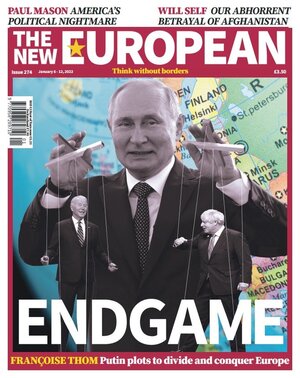
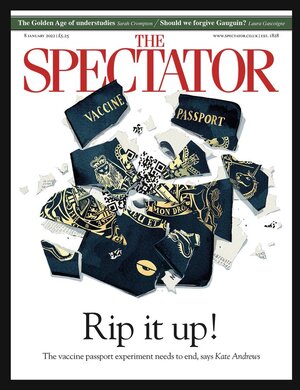


More to follow.



More to follow.

Minister for Finance, Paschal Donohoe (left) with Minister for Public Expenditure and Reform, Michael McGrath at government buildings this afternoon
This afternoon.
We’re back, baby.
Via RTÉ News:
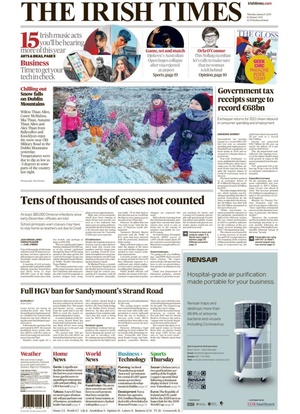
The Department of Finance has recorded the highest ever tax take of €68.4 billion, pushing the Exchequer deficit down to €7.3 billion.
According to the latest Exchequer figures, tax receipts were up by €11.2 billion (19.7%) on 2020. This was the highest ever tax yield, over €9 billion ahead of the previous highest yield reached in 2019.
Growth was robust across virtually all tax heads, with particularly strong performances in income tax, VAT and corporation tax.
Cumulative income tax receipts of €26.6 billion for the year were up by €3.9 billion (17.4%) on 2020. This reflects the ongoing recovery in the labour market along with growth in wages in the sectors insulated from the pandemic.
Anyone?
El mapa de las obras de #Arte más famosas de Europa.
¿Cuántas reconoces? Dentro hilo 🧵 pic.twitter.com/LSZBrEoYhU— ƉAƲIƉ ƁOKEH (@DavidBokeh) December 27, 2021
A map of Europe by ‘most famous artwork’.
Complete list here.
Ireland’s choice?

The Meeting on the Turret Stairs, 1864.
by Wicklow-born, Clare-bred Sir Frederic William Burton.
Rebooted by street artist Joe Caslin in 2015.
Your pick?
Ah here.
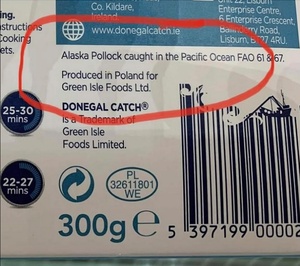
Poland-packed, pacific pollock pretending to be paddies?
i-Fish writes:
Called into local Tesco on Monday evening and lifted a box of fish branded “Donegal Catch”. What a misrepresentation – Alaska pollock caught in the Pacific and packaged in Poland! Hasn’t ever came close to anywhere in Ireland. Needless to say I put it down and bought chicken instead.
Thanks Bebe

Senator Michael McDowell
Who doesn’t love a crafty gasper?
The state for one.
Via Michael McDowell in the Irish Times:
…Cigarettes may even be restricted to sales in pharmacies, we are told. This is absurd. If a highly profitable State monopoly on tobacco sales is to be conferred on anyone, it should not be pharmacies. And it is even possible, according to the HSE, that filters will be banned on cigarettes – making them more harmful as a deterrent is a new idea.
Another idea under consideration is printing cancer warnings on each cigarette.
I don’t smoke and I totally supported Micheál Martin’s ban on smoking in indoor premises to which the public have access. But while I really pity nicotine addicts, I do not think that tobacco should be the subject of American-style 1920s Prohibition-era laws.
This is a case of the nanny state going a step too far. If people want to smoke, the State has no business preventing them from doing so. If people want to drink, you can’t bring in prohibition in the interests of cancer prevention, public health or the HSE’s budget.
It is noteworthy that we are considering legalising the smoking of cannabis while the HSE is planning the banning of smoking altogether – or nearly altogether.
Does the HSE want us all to live until we are 100? Who will pay the HSE for the consequences of that?
Public health policy does not warrant such coercion in a free society…
Ratlicker!
*sparks up afternoon fattie*
Michael McDowell: Anti-alcohol law contains some utterly ridiculous legal provisions (irish Times)
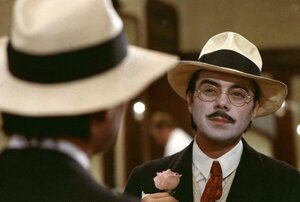

From top: Dirk Bogarde in the 1971 film adaptation by Visconti of Thomas Mann’s novella ‘Death in Venice’; David Langwallner
I have been asked by several organs and journals to review Colm Tóibín’s book on Thomas Mann, The Magician, and it is, in my view, beautifully written. But that is an aside.
The reasons that I have been asked, so plentifully, to review are patently obvious in some respects and ought to dictate, in these perilous times, a level of circumspection.
In fact, modesty aside, and he was modest and hardworking, I am like a pale zeitgeist anomaly of Mann. I reserve it for Broadsheet, and it is an especially important text, The Magician, and says a lot by implication. In fact, it is one extended foreboding metaphor for our time.
The very civilised editor of one organ who has published me, although liking my content, does not like my prose style.
Let us remind ourselves this is what the magician Thomas Mann said about his prose style self reflexively and with innate protestant judgment and modesty. He said it is ponderous, ceremonious, and civilised. The same could be said about me. It is certainly not sexy.
Of course, Mann followed that observation with a very pregnant sentence: it is all the thing the fascists hate. Well Touché. That is because they burn books, peddle disinformation, do not like nuanced or reasoned argument and resort to hysteria. As a writer of prose, he is lesser than Kafka and Musil and Broch in the Austro German 20th century canon though he did win the Nobel prize and early (1929).
Buddenbrooks which won him the prize and The Magic Mountain – though suffused with good things – are written in terrible Hoch Deutsch Prussian turgid prose, stilted, civilised and bourgeoisie to quote himself on himself again. So, though much celebrated, they are not terrific books, which is not to diminish that they are particularly good Sehr Gut books of educational and instructional value. If that were all he would be a very minor writer indeed but that is not all. The best was yet to come, in exile.
Death In Venice, though earlier, is a terrific book is a kind of cry of his repressed same-sex attraction and of the end of that that hyper civilised aesthetic intelligence and it is a masterpiece. The film by Visconti with Dirk Bogarde, though laboured, also so. The film includes at length the famous adagio by Mahler and Mann knew Mahler. In fact, he knew everybody and was very catholic in his tastes and his company even extending to rum company.
The literary reputation of which Tóibín does not deal with deliberately is not just based on that short novella or other great short novellas such as Mario the Magician, but of his end-of-life books. Peripatetic and a moving target where he correctly saw himself as a potential golden prize for the fascists. Those late books are after the deluge where the Lübeck conservative let fly at all he hated.
The book traces in detail how the arch senatorial conservative and custodian of the system simply could not deal with Nazis. At an implicit or explicit level, it is a simply a judgment of taste and he had impeccable personal and aesthetic taste and was cosmopolitan but not decadent in same.
As an arch conservative from an arch conservative family, he saw no difficulty in marrying a converted Jewess who he was deeply in love with. At all levels, the book shows how conservative apolitical manners are a force for the good. The book constantly stresses from observation and quotation from his speeches and writings that he was a very apolitical and private man and often observed he was a social and family-oriented person focused on the work. He liked nothing better than to go out for walks with his wife after making love to her.
His mother was Brazilian and his father a toad and a martinet who dictated coercive tones towards family regulation on his death, as the book establishes. So, his attitude towards women was much better and he he disapproved of dissolute men from Oscar Wilde to his lesser writer brother, the fecklessly irresponsible Heinrich Mann.
The reason, I suspect, Tóibín has engaged in his subject, though not explicit in the text, is that Mann is central to our age. He faced an ethical dilemma. He was the famous and esteemed writer in Germany, but he could not abide the boorish and uncivilised Nazis, so he left for Switzerland, America and Switzerland again.. A forced Goethesque grand tour as I am sure he might have framed it. But it led to the greatness Tóibín only touches on.
Dr Faustus is one of the terrific books of all time written when he was near 80. It is a masterpiece. The book is about the composer Leverkuhn who sells his soul to the devil. Fascism. It is also about the corrupting influence of atonal music and its nihilistic dissonance which creates a valueless universe. As do the structuralists and deconstructionists of our age.
Also, I think, it is about Martin Heidegger as the two central intellectual figures in Germany they were both presented with a dilemma. Heidegger fell for the bait and took all the Nazi accolades. He took the Faustian pact even with a Jewish mistress, Hannah Arendt, who wrote eloquently subsequently about the banality of evil. Mann, though wealthy, did say no and there his greatness as a human being resides. In a speech in America, championed indirectly by Eleanor Roosevelt, he said:
“They cannot last, they must not last, they will not last/”
It is what is needed in our time and a kind of parable. The reassertion of civilised cosmopolitan tolerance. Of decency, rigour, and moderation. Of stable family structures and hardworking routines. Of civic decency and private ordering.
And when the magician, the most private of men, feels he must become public.,well that is also necessary for many now.
David Langwallner is a barrister, specialising in public law, immigration, housing and criminal defence including miscarriages of justice. He is emeritus director of the Irish Innocence project and was Irish lawyer of the year at the 2015 Irish law awards. Follow David on Twitter @DLangwallner
MGM

Nigel.
Trending.
‘Our’ Nigel?
We may never know.
*shakes fist anyway*

Telefis – Falun Gong Dancer
Station to station.
Contrarian Corkonian Cathal Coughlan teams up with ace producer Jackknife Lee on this third single from their forthcoming album A hAon.
The blurb states:
“In contrast with the first two releases, “Falun Gong Dancer” has a very stark arrangement, featuring a cyclical, meditative melody over dissolving piano chords and synth pulses, heard in episodic passages which take the listener on a tour of the world – from London, to the US-Mexico border, to the cities of Australasia – in the company of a hapless narrator.
“Occasional interludes of electronic harmony hint at either a tentative intimacy, or at an isolation which is final and absolute – it remains ambiguous.”
The visuals by film-maker Matt Mahurin are quite startling.
Nick says: No flipping.

Zinc hair salon, Dublin last Summer
Slightly Bemused writes:
So, as the Erc Carmen song went, I ran a comb through my hair. This morning, I had snarls. I did not think my hair was long enough for snarls, and certainly it is short enough that they were easily dealt with.
Now, her Little self has longer hair, and she had snarls. She would not let me help, as she said she needed to feel them as she freed them. Makes sense to me. But whether related or not I am still finding strands of long hair about the place. And before anyone asks, yes, I did clean and hoover. I think though that these are like the pine needles off a Christmas tree. No matter how hard you try, some will still turn up in July.
She had to clear the shower drain several times while here. While I did my best to keep it clean, snarls of hair were never the problem.
Where I work is at a hospital. I am not clinical staff, at best I am support, and I will do my best to support. But one of my jobs has me randomly walking about the building. On one of those days, I crossed paths with a nurse taking to an older lady, who would be about my mother’s age. They were going down to an empty room so the lady could get her hair washed, and combed. A seemingly simple thing, it was about restoring the dignity to the lady. The remnants of her auburn locks were visible even before the wash.
It reminded me of my own mother, and hers. My Grandma, for all the time I knew her, had white hair. Not silver, white. And my mother once told me that she always wanted white hair like that. She never dyed her locks, but as her younger sisters grew grey and some added colour to retain their honestly youthful looks, my mother’s hair stubbornly did not change, and for so many years retained the kind of lightly reddish brown that I also ended up with, after apparently having very white blonde hair as a child. My Dad’s was much darker, and a brother and sister in particular ended up with his very dark black hair. So we were all of us either slightly auburn, or very black.
And over the few too short months she was here, my Little one’s hair grew out. The remnants of the colour she had put in it cleared, as it does, and underneath her original colour returned. A colour I see in the filaments I still find around the house. A colour that reminds me, every time, of her grandmother. My Little one, looking at the photos, wanted the black from my father, with whom she was very close, but she got me. And she got her Grandma.
 Slighly Bemused‘s column appears here every Wednesday.
This afternoon.
Via RTÉ News:
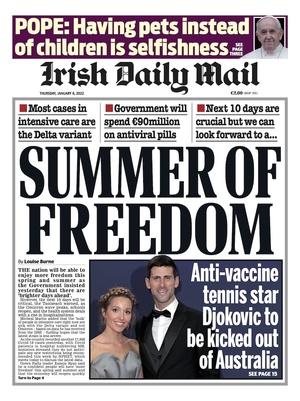
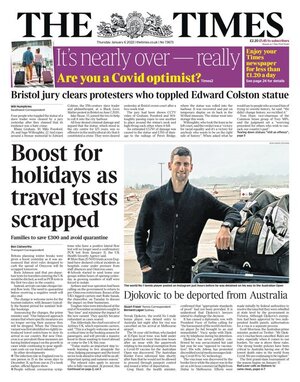
The Cabinet has agreed new travel rules which would see the requirement for vaccinated passengers to have a negative Covid-19 test dropped.
However, unvaccinated travellers would be required to show a negative PCR test taken 72 hours before arrival.
The Government moved to require all passengers to have a negative test for the virus when the Omicron variant of Covid-19 first emerged.
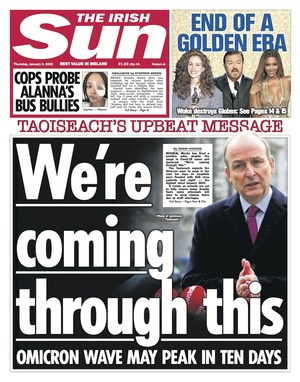
However, now that it is the dominant variant in Ireland, the Government has dropped that requirement for vaccinated passengers, Taoiseach Micheál Martin said today.
Requirement for vaccinated passengers to have negative Covid test to be dropped (RTE)