

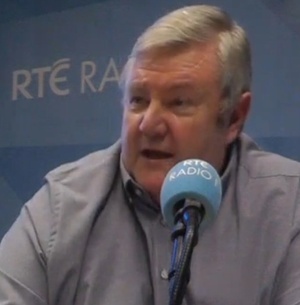
From top: The House of Commons yesterday; Derek Mooney

If you ever start to despair while watching Dáil Éireann live – stop, take a deep breath and think… well, at least it’s not as bad as the House of Commons.

While this may not offer a huge amount of comfort and certainly does not ease the frustration of seeing the current Dáil initiating some decent pieces of legislation, only for them to disappear into a black hole of money messages and other governmental devices designed to stifle debate, it is still something to bear in mind.

For decades I have been listening to some folks here opining on how the UK political and legislative system works better than here.

While some of this may have been driven by an element of cultural cringe, it was also informed by the idea that politics in the UK is more policy driven and based on ideas.

Irish politics, they argue is just too tribal, too based around the centre. We do not have the benefits of the big policy debates and arguments between the left and the right that they have in the UK.

But, the argument goes, it is about more than just the origins of our main parties and their relative positions on political spectrum… British MPs are legislators first and foremost. Not for them the paltry concerns with constituency matters and the parish pump that preoccupy our TDs.

British MPs, it was thought, were able to focus on the national issues and the bigger picture because they were, unlike our gang, in single seat constituencies and therefore not in a constant political battle to fight off party colleagues or constituency rivals.

The problem with Irish politics versus British politics was that we had too much clientelism which informed our political debate from start to finish.

These arguments still have a validity. It is not that we are in some political nirvana and that the pendulum could not bear swinging back a few notches to establish a better political equilibrium, but the proximity to the voters that our system brings means that our TDs are not as tone deaf to shifts in political mood as their British counterparts.

Whatever their faults, successful and attentive TDs in our system are connected to the concerns of the public and do not need polls, surveys or petitions to know what the public is thinking.

I know this is a difficult claim to make in a week when the official homelessness figure went over the 10,000 mark for the first time and we have a Minister for Housing presiding over this outrage who thinks it is “very irresponsible” to promise to end homelessness, but even in today’s Dáil the majority of TDs know this situation is unsustainable, the pity is that few of them are in Leo’s inner circle.

To its credit the Dáil has dealt with the complexities of Brexit with a great deal more skill and cohesion than Westminster. Rather than turning the issue into a partisan battle full of red-lines and unachievable demands, parliamentarians here have worked together via a series of all-party committees.

It is not that politics stopped, it is just that it saw boundaries. Fianna Fáil criticised the lack of adequate no deal preparations by government and Sinn Féin saw no reason not to keep demanding unity polls, but the work went on.

There were UK parliamentary committees doing some good work on Brexit too, but May’s insistence on putting Tory unity ahead of all other considerations effectively handed control of the process over to the hard-line brexiteers.

And what a company of hardliners they are. It’s not just Rees-Mogg, Raab, Cash and Johnson who have driven the debate into the realms of Fake News.

Over the past few weeks we seen a procession of previously unheard-of Tory and Labour back benchers make claims about the Backstop and adopt positions on Brexit that make you think, thank God you are not my representative.

And remember, these MPs are first and foremost legislators, they are supposed to be the national politicians.

While the British Labour party has some pro-Brexit duds, such as Kate Hoey who advocates the hardest possible Brexit despite representing a constituency that voted 77% to Remain in the EU, the worst of the pack hail from the incongruously named European Research Group (ERG), the Tory anti-EU caucus.

ERG Tory MPs such as Anne Marie Morris, Mark Francois, Marcus Fysh, Andrew Bridgen have shown staggering levels of ignorance on what is actually in Teresa May’s Withdrawal Agreement. Not only that they have each shown no understanding of why the Backstop exists and only prove how far out of tune they are.

Bizarrely, I’m writing this on the day after the House of Commons has had its most sensible and coherent debate on Brexit yet.

While yesterday’s indicative votes did not come up with any options that commanded majority support, it was positive to hear many MPs focus for the first time and the realities of Brexit and the complexities and limitations of various ways forward on offer.

What a pity that Westminster go the route of indicative votes some months back when it was suggested by the likes of John Major and Bertie Ahern.

Setting out the options and discussing them one-by-one has enable some MPs to focus their minds on what is achievable, rather than just on what they want to see happen.

As Margaret Beckett said as she opened her contribution to the debate yesterday:

“Negotiations succeed when no one gets everything they want but everyone gets something they want”.

Beckett, a former Labour party Deputy Leader made what was probably the most insightful speech of the day. She picked up on what now appears to be shifting public mood on Brexit, saying:

“Consider the possible consequences for trust in politics or for social peace if this House forces an outcome on the people of this country that they no longer desire—that really would be the undemocratic, establishment stitch-up of all time.”

I say “appears to be a shifting” view as the polling data is not showing dramatic changes, though the doyen of British pollsters Prof John Curtice says the result of the latest British Social Attitudes Survey, corroborated by various polls:

“...is enough to raise doubts about whether, two and half years after the original ballot, leaving the EU necessarily continues to represent the view of a majority of the British public”

Whether Theresa May’s spectacular mishandling of the whole article 50 process is driving this shift, is debateable, there is no doubt that her chronically poor messaging and insistence on over promising and under-delivering made the selling of her deal unnecessarily fraught.

And recall that this was the easier part of the two stage Brexit process. May’s Withdrawal Agreement is the basic divorce stage. It addresses the arrangements for simply leaving, the more complex part which is about the future arrangements with the EU has yet to come.

And, I have discussed all of this without once mentioning the DUP… so, hands up who thinks that this British Government or House of Commons is capable of handling the next phase?

No, me neither.

Derek Mooney is a communications and public affairs consultant. He previously served as a Ministerial Adviser to the Fianna Fáil-led government 2004 – 2010.  Follow Derek on Twitter: @dsmooney

Sean Whelan

Laura Fitzgerald writes;

RTÉ News is pleased to announce the appointment of Sean Whelan as its new London Correspondent. Sean has held the role of Economics Correspondent with RTÉ News for almost nine years, extensively reporting the economic crash, the Troika bailout and the economic recovery

Sean will be commencing his new role in the Summer. Sean succeeds Fiona Mitchell who will be taking up a new assignment later this year when her four year posting in London comes to an end…

Pic: RTÉ


The mechanically operated flip books of artist Juan Fontanive, wherein 4-colour screen prints of 18th and 19th century natural history illustrations are extrapolated to contour the effect of birds hovering and in flight.

More of his work here.

colossal

Behold: the Karlman King – the world’s most expensive SUV.

Stealth bomber styling on the outside, bespoke ultra luxury on the inside with options ranging from retractable screens, ambient lighting and Nespresso machines to ballistic armour plating and whatever you’re having yourself.

Based on a Ford F550 with a V12, 6.8l engine, the top speed is limited to a paltry 140km/h on account of its colossal 5.9 tonne weight.

Yours for a hefty €1.77 million+.

uncrate

e

From top:  for Finance and Public Exependiture Paschal O Donohue  and  Taoiseach Leo Varadkar TD  at the Fine Gael Party Conference in Wexford last weekend; Michael Taft

The Finance Minister needs to buy the Taoiseach an abacus. It would also be helpful if he would brief him on certain economic realities. For the Taoiseach has been both promising and mispricing the irresponsible.

At the Fine Gael Ard Fheis last weekend the Taoiseach trotted out his tax cut proposal – raising the standard rate tax threshold:

‘Over the next five years, we will increase the point at which people pay the higher rate of tax to €50,000 for a single person and €100,000 for a couple.’

This would be a substantial rise on the current €35,300 (€70,600 for a couple) tax threshold. This proposal is not new. The Taoiseach came out with this last November.

What is new is the Taoiseach’s claim that this tax cut would be relatively cheap.

Back in November it was generally conceded that this proposal would cost €3 billion. And for good reason. That’s the price tag the Revenue Commissioners put on the proposal. Each increase of €1,000 in the standard rate tax band costs €206 million.

However, the Taoiseach went on to say:

‘Let me tell you how we’ll pay for it. Because there are more people working every year, and people are earning more, we’ll take in about €1.8 billion extra in income tax. I want to give about half of that back to you, taxpayers and pensioners.’

So now this €3 billion tax cut will only cost €900 million (and is he including pension increases in that?). How did this happen? I have no idea. I wonder if the Taoiseach does.

Apart from mispricing, the Taoiseach’s proposal couldn’t be more irresponsible. This is all the more the case given the ESRI’s modelling of the potential impact of Brexit.

This Cabinet was briefed on this paper before it was published, so the Taoiseach was aware of its findings before his speech at the Ard Fheis.

The ESRI found the impact of Brexit could be substantial. In the worst case scenario – a chaotic, no-deal Brexit – the ESRI estimates that over the next five years

20 percent could be knocked off of real GDP

Employment could be about 50,000 lower

Real wages and personal disposable income will fall while consumer prices rise

All this will, of course, throw public finances off course with the deficit rising by approximately €2 billion.

Even in a ‘deal-done’ Brexit – where the UK makes an orderly agreed exit from the EU involving a transition period up to 2020, and a free trade agreement with the EU thereafter – the economy will still be hit: up to €10 billion could be knocked off GDP while employment could be 20,000 – 25,000 lower.

Wages and incomes would still go south while prices would still head north.

While the impact of a done-deal Brexit would be less than a disorderly affair, it only looks good by comparison. On its own, it still represents a significant negative impact on the economy.

If this wasn’t bad enough, our major trading partners are in serious trouble. The Eurozone is flirting with yet another recession while in the US, the Trump tax cuts are wearing off with growth slowing down.

In this highly uncertain, potentially volatile environment – not even taking into account the substantial fines for missing our EU climate change targets (have these even been factored into medium-term government projections?), the downside impact of any change in international taxation and the eventual rise in interest rates – why would the Taoiseach make such a proposal?

Here are some explanations.

Escalation of commitment:
the Taoiseach made a promise before a Fine Gael audience last November. Rather than step-back in the face of growing uncertainties, he is irrationally doubling down because to do otherwise might suggest he was wrong to make the proposal in the first place.

Cynical: the Taoiseach knows he cannot fulfil this promise but maintains it as a ‘flagship’ policy. If external events intervene to prevent it, he can always blame the Brits.

It’s What We Do:
just like Fianna Fail, who cut every tax possible prior to the crash (egged on by Fine Gael), cutting taxes is in the genes regardless of what economic reality tells us. The scorpion can’t help being a scorpion.

Even without the negative impact, the proposed tax cuts are highly inequitable. In a previous post we saw that the Government intends to cut public services and social protection in real terms over the medium-term.

In effect, the Taoiseach’s tax cuts proposals will not be financed by ‘more people working and earning more’ as he put it. It will be financed by real spending cuts.

Now add in Brexit – even a done-deal one – and see what will happen.

In truth, none of this is sustainable. The Taoiseach must surely have some sense of this. But his determination to hoover up votes with the promise of tax cuts (which didn’t get Fine Gael very far in the last election) trumps reality.

Progressives will no doubt highlight the inequity of his proposed tax cuts and they would be correct. But there is another prize – painting the Government as being fiscally irresponsible, a mirror-image of the Fianna Fail’s reckless pre-crash policies.

Even the Irish Fiscal Advisory Council doesn’t believe the Government:

‘ . . . the medium-term budgetary plans are not credible,’

Ultimately, the Taoiseach’s proposed tax cuts are fiscally irresponsible. Fianna Fail has no alternative. It is time the Left step forward with a credible path forward. And if that means challenging some of their own proposals and analysis, all the better.

Do it publicly, invite people into the debate over the process of building a productive economy that can withstand the shocks of uncertain events.

That is proper leadership. And, boy, do we need some that now.

Michael Taft is a researcher for SIPTU and author of the political economy blog, Notes on the Front. His column appears here every Thursday.

Top pic: Rollingnews

Meanwhile…

From top: Fianna Fáil deputy leader Dara Calleary; Tánaiste Simon Coveney

This afternoon.

In the Dáil, during Leaders’ Questions.

Fianna Fail’s deputy leader Dara Calleary raised the latest homelessness figures with the Tánaiste Simon Coveney.

During his contribution, Mr Calleary mentioned an interview the Housing Minister Eoghan Murphy’s gave RTÉ’s Morning Ireland this morning in which Mr Murphy accused journalist Bryan Dobson of speaking from an “ideological” position when the broadcaster asked the politician about the Government’s record on housing and homelessness.

Mr Calleary asked Mr Coveney to “finally ‘fess up” and admit the Government’s housing plan Rebuilding Ireland – launched when Mr Coveney was Minister for Housing in 2016 – is not working.

Mr Coveney said nobody is denying the facts and the figures of homelessness in Ireland, and the emotion attached to the same, before going on to cite Rebuilding Ireland figures.

He then said:

“The truth is, deputy, we are listening to others in this house and, indeed, experts outside it. Rebuilding Ireland was always a policy initiative that would change, depending on where the pressures and demands were coming from and that is what it’s doing.

“But if you look at the number of people that we are taking out of homeless right now, it’s a higher figure than ever before.

“If you look at the number of social houses that are being delivered, it’s higher than at any point in the last decade.

“The truth is there are more families and individuals coming into homelessness now than I think anyone in this house predicted.”

Mr Calleary told Mr Coveney his response was the same response he gave in 2016, 2017 and 2018.

Mr Coveney said there is work to be done but the Government has “changed the housing market in Ireland” with rent pressure zones and increasing the powers of the Residential Tenancies Board.

He also said Rebuilding Ireland was a five-year housing plan and the Government is only three years into it.

Sinn Féin TD Pearse Doherty also raised the homelessness figures and also raised Minister Murphy’s interview on Morning Ireland.

He called on the Government to support a bill proposed by Sinn Fein TD Eoin O’Broin – aimed at preventing buy-to-let landlords from evicting tenants.

Mr Coveney said:

“The truth is that this State is not the only one facing this challenge. Last year, almost 20,000 households approached housing bodies in Northern Ireland because they consider themselves homeless… and solutions have to be found there as well as here. This is a challenge that many countries are facing.”

Mr Coveney also insisted Mr O Broin’s bill will not work “legally or in practical terms”.

Watch back here

Aonghus (Johnny Chóil Mhaidhc) Ó Coistealbha

Síolscéalta.

Produced and directed by Paula Kehoe.

Linda Ní Ghríofa writes:

Síolscéalta is a four part series following the growing year at An Garraí Glas with Aonghus (Chóil Mhaidhc) Ó Coistealbha, a charismatic young man on a mission to grow food sustainably at his homeplace. A small holder with a big vision swimming against the tide.

Aonghus was born and grew up in Na Creagáin, Connemara. His life’s work is to grow food organically and on a small scale, without chemicals or machinery, for the people of Connemara.

Having spent years abroad working on organic farms in different countries, and studying their methods and permaculture, Aonghus decided it was time to return to his birthplace and create a smallholding there, using all he’d learned alongside the older, traditional methods he grew up with.

In fairness.

Síolscéalta on TG4 tonight at 8pm and repeated Sunday at 6.40pm.

Pic: TG4

From top: John Connors; Tweet from ‘Doctors for Choice’

Terry McMahon writes:

I Had the honour of hosting an extraordinary post-show Q&A with actor and writer John Connors in Clontarf last night.

The passionately articulate audience discussed class, ethnicity, gender, and mental and physical disability. It was remarkable to have uninhibited conversations about such taboo subjects.

They also touched on a subject that nobody is allowed to question anymore. Abortion.

There are many reasons why a woman or couple might feel the need for an abortion but this is also a subject that caused such rage-fueled hatred in so many egalitarian activists that they wanted John wiped off the face of the earth. Or, at the very least, stripped of his thoughts, his voice and his livelihood.

Later we talked about the avalanche of celebrities who fell over each other to be front row centre on the abortion train. They couldn’t get enough of it. Horrific stories of young girls impregnated by their scumbag fathers and rape victims left in crisis by their scumbag rapists were the only conversations allowed to be had.

Anyone who questioned if ethnicity, gender or mental or physical disability would be grounds for termination were labelled right-wing, misogynistic, fear-mongering extremists.

No doubt some will insist that it’s done. Get over it. Move on.

Then Doctors For Choice post this remarkable tweet (above). And the questions came back.

Proudly using the word “guesstimate,” they describe 900 terminations in two months. Men and women who have sworn to protect life consider 900 terminations a “privelege” (sic).

And Government leaders who let women die of cervical cancer consider themselves feminist icons. And 450 lives per month are considered products for pharmaceutical companies.

At the time, John Connors spoke up. His questions have been answered. Ethnicity, gender and physical or mental health are perfectly normal grounds for abortion. As is anything else.

We even refuse to administer pain relief to late-term aborted babies on the grounds that it may, “shame the mother.”

Where are the celebrities who brayed so loudly and so proudly back then? The ones who labelled anybody who spoke up as right-wing, misogynistic, fear-mongering extremists.

Where are these wailing accusors? These heart-on-the-sleeve liberals. These egalitarian activists. These suddenly silent hypocrites.

Terry McMahon is a filmmaker and can be found on Twitter @terrymcmahon69

Previously: Terry McMahon on Broadsheet

Broadsheet.ie