


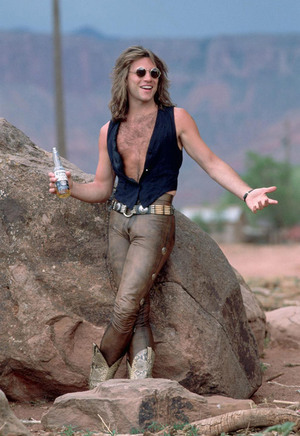
You think you can handle the Jon Bon. But you cannot.
You cannot handle the Jon Bon.
Previously: Can You Handle The Hoff?



You think you can handle the Jon Bon. But you cannot.
You cannot handle the Jon Bon.
Previously: Can You Handle The Hoff?

Keano writes:
As it’s Seachtain na Gaeilge and leading up to St Patrick’s Day we put together some basic survival phrases as Gaeilge for you.
However the teachers are from all over the world Brazil, Italy, USA, Greece, Holland and elsewhere!
They’re worse than us.
Troid!


No. For aunts.
This morning.
Gaiety Theatre, Dublin 2
Cast members of Maeve Binchy’s ‘Light A Penny Candle’ – including top from left: Clelia Murphy, India Mullen and Kate Gilmore – looking at the play’s model box, designed by Maree Kearns, as they gather for the first day of rehearsals.
Adapted for the stage by Shay Linehan, this world premiere production will run at the Gaiety from April 23 – May 4 before a nationwide tour.
Light A penny Candle (Gaiety Theatre)
Leon Farrell/Photocall Ireland

Tanaiste and Minister for Foreign Affairs Simon Coveney and Minister for Finance Paschal Donohoe TD in the Courtyard of Government Buildings today, as they gave an update on Brexit following a Cabinet meeting.
Via Prospect magazine:
There are myriad reasons why the UK doesn’t like the backstop. They can be simply summarised thus: because it entails compromise.
The EU doesn’t like it for the same reason, but from a different perspective. It entails compromise of the EU’s customs union.
The UK would have tariff free and quota free access to the EU, to avoid customs controls on the Irish land or sea border.
And it entails compromise of the single market. For it breaks up the four freedoms: effectively allowing free movement of goods to and from Northern Ireland but not the other three.
It also means that Northern Ireland would be outside the EU but treated as if it were part of the single market in some areas, including agriculture—a privilege that even the non-EU members of the European Economic Area do not have.
This is a huge ask of the EU, which is so protective of its single market and so suspicious (with no small cause) of British agri-food, especially meat products.
And there is second irony in all of this. Whilst British MPs complain about being “trapped” in a customs union or Northern Ireland “tied into” the single market, they miss the fundamental point: that as Article 1.3 of the [Protocol [on Ireland/Northern Ireland in the Withdrawal Agrtement] makes clear, what we see in the backstop is purely what the EU is prepared to do for the “unique circumstances on the island of Ireland.”
Be in no doubt that when the negotiations on the future relationship begin, we will see far less ambiguity and flexibility from the EU. It is not only the UK that is interested in “taking back control.”
The true cause of our backstop obsession (Kathy Hayward, Prospect)

An impressive, award-winning short by Hakim Ismail of the Royal College of Art that tells the story of a pregnant mother rushed to hospital in the aftermath of a bombing – as told from the perspective of the child in her womb.


Behold: the VW Beetle ID concept, debuted this month at the Geneva Motor Show – an all electric update of the Meyers Manx dune buggy with 201bhp of sand-kicking power, a 250km range, no roof, no side windows and a series of holes in the floor to let water drain out..


‘sup?
This morning.
The Department of Children, Dublin
Minister for Children and Youth Affairs Katherine Zappone and Taoiseach Leo Varadkar launching the National Childcare Scheme with toddlers, Donnacha Barr (top left) and Sam Laffertty Klvlehan and a sock puppet.
It’s not a caption competition until you insist.


From top: Minister for Employment Affairs and Social Protection Regina Doherty, Taoiseach Leo Varadkar and Minister for Buisness, Enterprise and Innovation Heather Humphries TD after a special cabinet meeting in The Academy in Dublin last Friday; Bryan Wall
Inequality in Ireland has become so commonplace that any reporting of it is accepted and then quickly forgotten about. We have a health service on the verge of collapse, a housing and homelessness crisis, and an elite indifferent to the needs of the many.
This is the status quo of many societies in the West. It’s no different here. It also explains the attraction that many have for the far right and its various elements. Mainstream politics has noticeably failed to bring about equality and justice.
The far right offers — or at least claims to offer — a different way of doing things; one which will bring greater justice and equality to society.
These individuals and groups are ascendant but they do not pose the threat that the mainstream political right do, at least not yet. The latter hold the economic reins. It is to them that we are beholden and to whom we all have to answer in some manner.
But do not think for a second that the reverse is also true. Political elites claim to answer to the people but this is far from accurate. In many cases they have to be forced to listen. Often this involves the use of mass movements. And on more than a few occasions it involves outright aggression.
What will it take for elites in Ireland to listen?
Will threats to their political popularity prick up their ears? Or would a mobile guillotine on a nationwide tour be more effective? The anger is palpable here, let’s not be mistaken about this.
There are literally thousands of people without a home. And there are many more who will never have a chance to own a home of their own. Insane house prices and a government with no interest in providing housing have left them without a chance of ever being able to afford one
There are even more people on hospital waiting lists. We have unemployed people being sanctioned for daring to be unemployed. Their future is being determined by a privatised welfare system intent on making profit over having any kind of humanistic ethos.
Decency be damned, a profit must be made. This is the society that the political class has created in Ireland. They operate in it as efficiently as a fish in water.
So when a report is released about lone parents and high rates of poverty it can be cast aside. The figures are clearly inaccurate; the report is missing vital context; the economy is doing well; unemployment is down. Take your pick. These lines are trotted out again and again to explain away inequality.
The report in question found that one in five lone parents was living in poverty. Leo Varadkar was quick to resort to a reliable response:
“I do not believe the report that was issued today tells the full picture.”
Varadkar can go on to claim that poverty rates have fallen not caring that a report recently issued by TASC found otherwise.
As mentioned before, it’s not that he’s a bumbling politician. He knows the facts. It’s just that they don’t matter compared to the need for business as usual. Reform, cut, privatise; that’s what really matters. Society is nothing to be concerned about.
In a Thatcherite Ireland only the individual matters to the extent that they can either make a profit or provide one for somebody else. And it’s the latter position that most of us find ourselves in.
The simple harsh reality is that successive governments have overseen a transfer of wealth to the top 1% in Ireland. TASC found that between 1975 and 2009 the top 1% of earners “almost doubled its share of national income”.
Part of this time period, they noted, “coincides with the advent of neo-liberalism, [and] the rightward shift in economic policy.”
In total, TASC found that:
“The bottom 40 percent receives about 22% of national income, while the top ten percent receives almost a quarter.”
Yet, the rate of poverty among lone parents is to be disputed. Reality only extends as far as its usefulness to an elite who are happy to oversee economic inequality. Meanwhile people have to march on the streets in order to try and force the government to do something about the homelessness and housing crisis.
Thus far marching has done nothing. And the longer that peaceful protest fails to deliver the more likely it is that someone will decide that direct action is next logical step. The logic isn’t flawed.
When a white powder was sent to Health Minister Simon Harris’s department no mention could be made of the above context. Nothing about the cervical cancer deaths, the striking nurses and midwives, the failing health service, or Harris’s general role in a right-wing government. Of course Varadkar calling the sender or senders of the white powder “oddballs” was reported.
Actions like this, as abhorrent as they may be to a lot of people, do not take place in a vacuum. But this is what you’d think if you read the mainstream media’s reporting of the incident.
For now we find ourselves under the foot of an unjust economic system. This same system is implemented by politicians who feel perfectly content knowing that the policies in question cause mass inequality and injustice.
The future holds either more of the same or an explosion of some kind. What that explosion will be is anybody’s guess. But it is unlikely to be a revolution at the ballot box.
We are living in an era where economic stagnation is the best we will soon be able to hope for. Climate change will pound the world and much of humanity into submission. Elites will leave us to drown in the fetid waters that their very policies created. From their sanctuaries they will continue to oversee a world in which profit comes at the expense of basic decency.
Ireland is in no way immune from any of this. We have leaders here who would happily sacrifice us all if it meant even just a bit more power and a bit more profit. For them the ballot box is a valve that releases the pressure that builds up in society. They rely on it to counter any moves for real change.
Some people already realise this or soon will. There are hints of this in Ireland. Only one thing is certain: When a mass of people come to the same conclusion, all bets are off.
Bryan Wall is an independent journalist based in Cork. His column appears here every Monday. Read more of his work here

