This afternoon.

Federal Courthouse, Fort Lauderdale, Florida, USA

Donald Trump confidante Roger Stone attempts to speak to reporters following his arraignment charged with seven counts, according to a grand jury indictment made public by US Special Counsel Robert Mueller’s office.

Earlier:

https://www.youtube.com/watch?v=fbSUHsKpoNo

CNN footage showing FBI arrive at Roger Stone’s Florida home to arrest him.

‘The indictment alleges that [long-time Donald Trump confidante] Roger Stone made multiple attempts to contact WikiLeaks through an intermediary about documents stolen from the Democratic national committee and Hillary Clinton’s presidential campaign, and passed on information to Trump’s election campaign team about the documents.’

Trump ally Roger Stone arrested on seven charges in Mueller inquiry (The Guardian)

Video shows FBI at Roger Stone’s house (CNN)

Meanwhile…

Meanwhile…

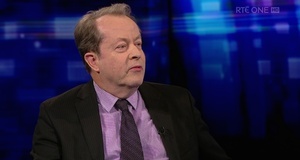
Master of the High Court Ed Honohan with David McCullagh on last night’s Prime Time on RTÉ One

Last night.

At the end of RTÉ One’s Prime Time.

Journalist David McCullagh briefly interviewed the Master of the High Court Edmund Honohan.

It followed the decision of the President of the High Court Peter Kelly to remove all debt cases from Mr Honohan.

From the interview…

David McCullagh: “When did you hear about this decision?”

Edmund Honohan: “A reporter rang me. I haven’t officially been told anything by anybody. Nobody has contacted me officially from the president’s office or any other official source.”

McCullagh: “There is a statement up on the website I suppose but you haven’t been directly approached.”

Honohan: “I haven’t been approached. I haven’t had any explanation offered to me.”

McCullagh: “Ok. How do you think you’ve performed in handling these particular cases?”

Honohan: “Extremely well.”

McCullagh: “Well, you would say that I suppose wouldn’t you?”

Honohan: “Yeah. Well, I’ve been there now for in excess of 15 years. I think you have to go back a little bit. A previous master, Patrick Lindsay, Paddy Lindsay, a Fine Gael TD and Minister at the time, he wrote in his autobiography, I brought it in for you here and it’s quite interesting. He said, when I took up the position, he says,

‘Any day that I worked after lunchtime as a Master [of the High Court] was rare,’ he said. ‘I go through things fast, I attributed the speed with which I was able to turn over an awful lot of work to the honesty and integrity of people appearing before me. There were very few people, I can think of only one, whose word I could not take. And generally, if asked, ‘are your proofs in order?’, or ‘are your papers in order?’ and the answer was yes, then you knew, you could believe what you were told.’

“In other words, he wasn’t reading the papers. Now, I read the papers and I find a surprising number of errors. And my function is to arrange those papers so that they’re in order for a fair hearing downstairs [before the High Court]. And if I find a mistake, I can invite the plaintiff to correct the mistake and if he declines to correct the mistake, then the papers are not in order, and I strike out the summons. Now this may be a source of difficulty, there’s no difficulty about it because that decision can be appealed.

“The real problem seems to be that there’s a perception that if I strike out the summons, that I’m acting in some kind of quasi-judicial manner, I’m not. I’m pointing out that there’s an error in the paperwork, it’s not ready to go on. And I have a duty, under the 2003 Act, to ensure that the hearing which transpires later on, downstairs is a fair hearing for both sides.”


McCullagh:
“Now, just because people might not be that familiar with the legal system. You’re not a judge. It’s a quasi-judicial function. But it’s an administrative thing, to make sure that all the ducks are lined up in a row.”

Honohan: “That’s it yes. You’d often have very, very silly mistakes like affidavits of service not being before the court or affidavits which don’t state the means of knowledge of the deponent. But it’s becoming more and more difficult actually, in relation to the probative value of evidence.

We have Supreme Court decisions now which are of great assistance to the courts which are not actually being read by the practitioners. And they’re not actually being filtered through to the High Court so if I pick up a case and I find there’s a mistake, which causes me to draw attention of the practitioners to the new decisions that are coming forward from the Supreme Court – I point this out. And boy there are plaintiffs who do not like it.

They’re the plaintiffs who are churning out papers on a factory basis and if I say ‘oh, I’m sorry, but I’m going to have to adjourn this, they’ll say ‘why?’. Then I’ll say, ‘I’m going to strike out the motion because the papers are not in order’, they’ll say ‘we’ll appeal that’. This is not a difficulty, it is in fact the way the job should be done. Because the papers should be in order.

Otherwise you do not have the opportunity for both sides to effectively participate.

Now I’m dealing with a lot of lay litigants. I don’t know if you understand the concept of ineffective participation – that’s when you’re there in court and you don’t know what’s going on. It’s my job to try and spoon feed these people, to enable them to get to grips with the process that’s before the court.”

McCullagh: “OK, now as you say, you don’t know why this particular decision has been taken. But it’s fair to say that you have been vocal, you have been perhaps controversial. A lot of people would know that you’ve spoken up in favour of people who’re facing repossession and so on…”

[Honohan nods in agreement]

McCullagh: “Would some people wonder whether you’re impartiality might be in question?”

Honohan: “No, no, I can’t imagine how? Because a level-playing pitch in the courts is what the objective is. And there’s no way that I’m making a judgement which is actually impacting on the actual strict legal rights of either party. I’m simply making sure that both parties are ready and prepared to deal with the case when it comes on before the court.”

McCullagh: “You also, famously, recently brought a hammer into your courtroom to break a window because the room was too stuffy?”

Honohan: “Yes..I’m sure that’s not the reason for the change…”

McCullagh: “Well, your room will presumably be less busy now if these cases are…”

Honohan: “Those windows have been fixed actually, so I’m delighted with that.”

McCullagh: “Ok. Edmund Honohan, thank you very much indeed for joining us.”

Watch back in full here from 29.32

Related: Removing Ed

Yesterday: Here Comes The Pane

Yesterday: What’s The Deal?

Meanwhile…

The Council Has Proposed Shutting Down One of the City’s Oldest Markets (Zuzia Whelan, Dublin Inquirer)

This morning.

In Davos, Switzerland.

Taoiseach Leo Varadkar was interviewed by Bloomberg, which reports:

In a worst-case scenario, a hard border could “involve people in uniform and it may involve the need, for example, for cameras, physical infrastructure, possibly a police presence, or an army presence to back it up,” Varadkar said in a Bloomberg Television interview at the World Economic Forum on Friday.

“The problem with that in the context of Irish politics and history is those things become targets.”

Varadkar said the backstop, designed to avoid the return of border infrastructure, is needed to ensure those scenes never materialized, and offered little hope to U.K. Prime Minister Theresa May that he might be prepared to dilute the fix.

Instead, he turned the onus back on London to find solutions, asking why a country “victimized” by Brexit should be constantly asked to compromise.

Varadkar Says Troops Could Return to Border in Botched Brexit (Dara Doyle, Tim Ross, Bloomberg)

Meanwhile…

The following transcript is from the video clip above:

Leo Varadkar: “What we’re looking for is what we’ve been looking for, from day one: is an assurance that Brexit, a decision that the United Kingdom has made, one that was made against the wishes of people in Northern Ireland, one that Ireland was not consulted about, we want a legal guarantee and an operable mechanism which will ensure that we don’t lose all the progress that’s been made in the last 20 years in Ireland in terms of our peace process and the Good Friday Agreement.

“So I know, a lot of people, when they talk about Brexit, they talk about the impact on trade and jobs, and on the economy and immigration and all those things that are really important. For Ireland, it’s something very different. We have peace in Northern Ireland and Ireland.

“We’ve had closer cooperation North and South, powersharing most of the time and, at the foundation of all of that, was the European Union because EU membership swept away so many of the differences between North and South and between people.

“And we don’t want that to be undermined and what the backstop is, it’s a means to an end. It’s a legal guarantee and an operable mechanism by which we know that there won’t be a hard border as a consequence of Brexit and that’s why we’ve had to hold so firmly on it.”

Journalist: “Is there any room for compromise in order to avoid no deal, which could make it worse?”

Varadkar: “Well, you know, we’ve always been open for compromise and we’ve always been willing to listen to the proposals that the UK government may have and, as the European Union has said on several occasions, if the UK was to change its red lines, then of course our position could evolve.

“But let’s not forget that this Withdrawal Agreement is an agreement that was drawn around all of the self-imposed red lines that the UK set for itself – leaving the Customs Union, leaving the single market, not accepting the jurisdiction of the ECJ and the backstop was designed with them.

“We would have been very happy, for example, to accept a backstop that only applied to Northern Ireland, that didn’t apply to Britain but the UK Government specifically wanted a UK element to it.”

Journalist: “That’s very clear but would you at least be open to exploring a compromise? If it means that, actually, you don’t get the hard border with the no deal?”

Varadkar: “The objective is avoiding a hard border. The backstop is the means by which we achieve it. So if there’s another mechanism, if the UK can come forward with a proposal that achieves a hard border, that gives us that legal guarantee, or achieves, avoids a hard border, then of course we’ll listen to that. Unfortunately, that’s not what I’m getting.

“I’m hearing from a lot of people, lot of British politicians and British actors saying ‘of course, we’re against the hard border and we’re also against the backstop’ but the only alternative they can offer to the backstop is a promise to sort it out later, or a promise around technologies that don’t exist yet. We’re not going to give up. A mechanism that we know will work, that’s legally binding…”

Journalist: “Have you seen these technologies?”

Varadkar: “No, they don’t exist and nobody has been able to show them to me.”

Earlier: Squirm

Yesterday.

Davos, Switzerland

In a panel that included Taoiseach Leo Varadkar (top), Polish Prime Minister Mateusz Morawiecki (centre)…

…made an emotive plea for reform – saying EU “tax havens” should be abolished in a thinly veiled swipe at Ireland. He linked his country’s history with Communism to the issue, saying history made it even more important that there be a “level playing field” when it comes to tax.

Starts at 36 seconds.

Under siege: world leaders take ‘tax haven’ swipe at us (Independent.ie)

Irish times today (top) and yesterday (above)

This morning.

Professor Fiona de Londras tweetz:

I see the Irish Times’ opinion pages are replete with Sinn Féin bashing columns today. I do wonder what would happen if people engaged with Sinn Fein’s actual policies (especially economic and social) instead of taking swipes at them based on some (now outdated) sense of their ‘untouchability’.

It is not that I think Sinn Féin’s approach to the current sit in Venezuala isn’t problematic (it is). It’s that the only actions many prominent journalists seem to engage with are ones that allow them to denigrate Sinn Féin without engaging with their actual policies.

‘Establishment’ voices can keep on treating Sinn Fein as if they are toxic if they want, but the reality on the ground is that they connect meaningfully with many people’s everyday realities and hardships, and a lot of politics is about being and feeling heard. And that is about policy.”

FIGHT!

Broadsheet.ie
