

Michaél Hunt tweets:
Hey, Pat Kenny PI … You didn’t notice anything Sinn Féin while you inspected
@LiadhNiRiadaMEP‘s bus?!!



Michaél Hunt tweets:
Hey, Pat Kenny PI … You didn’t notice anything Sinn Féin while you inspected
@LiadhNiRiadaMEP‘s bus?!!


A man has been arrested after a day-long incident in Ronanstown area of Dublin. Gardaí say a taser device was used and matter has now been referred to GSOC. A ‘media blackout’ was requested and observed during the incident.
— Gareth O’Connor (@garethoconnor) October 18, 2018
This morning.
Ronanstown, County Dublin.
More to follow.

From top: Climate change ‘Ecofeminist’ activists outside Leinster House last Tuesday; Dan Boyle
Thirty years ago, this week, I experienced one of the more significant weeks of my life. My grandmother died. The last of my grandparents to have passed away.
For a young adult, like me, it was a life marker, an acknowledgement of mortality if still a generation away.
I was offered a job, of sorts. Under community employment like conditions I became an Assistant Supervisor at a Glass Recycling Unit run by the Rehabilitation Institute.
It was called sheltered employment, but it was far from sheltered. We worked outside for most of the time, throughout the year.
It was all very low tech. We stood around a large riddle, armed with goggles, gloves and an awl, to take off the metal rings found at the top of bottles.
My manager was Conor Counihan, then also captain of the Cork Gaelic Football team. Conor was a hard man on the football pitch. At work he was firm but calm. From him I learned a lot about the art of grace under pressure.
As these things happen in threes, this was I also the week I joined the Green Party. I had engaged in a prolonged correspondence (handwritten letters) with the person who held the main officership in the party.
A party then, and still to a large extent, that had something of a distaste for leader figureheads, had one first among equals position known as the Co-ordinator. This position rotated every six months.
My correspondence with the then Co-ordinator was arrogant in the extreme. It went beyond me seeking from them reasons as to why I should join their party. To somewhat paraphrase myself I wanted to know how the party would make use of my obvious brilliance!
On the surface these three events would seem to have little in common, other than occurring at the same time in my life.
In retrospect they each represent significant signposts. It helped me recognise and deal with inevitability. It taught me the value of work, particularly physical work. It ingrained in me an invaluable lesson of working with other people.
And I have gained by being with those with whom I share values. Those values ever so slowly have informed wider public debate, and in some respects have helped change public behaviour.
Frustratingly the realisation that such change has been too little, needing so much more change to be made, hasn’t diminished the holding or strengthening of those values.
This week I attended a Climate Change Action protest outside of Leinster House. A whole new generation are now taking up the cudgels, being brilliantly led a cadre of young women.
They are asking the why of change with the same vehemence we had, but they are addressing the how of change in a far less circumspect way than we have done.
If I’m lucky, and if I achieve my Mother’s level of longevity, I may yet see another thirty years of life. I’m hoping that many life lessons lie ahead of me yet. I’m praying, to Gods of no particular religious denomination, that they can be collective lessons.
Dan Boyle is a former Green Party TD and Senator. His column appears here every Thursday. Follow Dan on Twitter: @sendboyle

A Californian teenager made cookies using her grandfather’s ashes
If you’re planning to bake a nice treat
Make a cookie that’s crunchy and sweet
But please do not mash
Crematorium ash
Into something for people to eat
John Moynes
Pic: Shutterstock


A cross-stitched ‘intervention’ on a wall in Vila Franca de Xira, Portugal by artist and graphic design student Ana ‘Aheneah’ Martins consisting of 2300 screws and nearly 700m of yarn.
A celebration of the freedom of youth expressed by a digital image applied using an analogue medium.
More of her work here.


MORE to folly

This week’s cover: Divide and rule. How the EU used Ireland to take control of Brexit, by @JGForsyth pic.twitter.com/UiBbnuG9LH
— The Spectator (@spectator) October 17, 2018
FIGHT!
Earlier: Hooey


A compelling, award-winning and inevitably Oscar-bothering short by Hungarian animator Réka Bucsi.
The universe. Let her show you it.
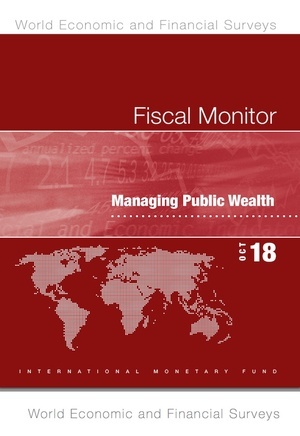

From top: The International Monetary Fund (IMF) October 2018 fiscal report; Eamonn Kelly
There are a couple of startling contradictions to Fine Gael fiscal policy contained in the Executive Summary of the IMF’s latest fiscal monitoring report: “Managing Public Wealth”.
The first is that, according to IMF economists and measurements gleaned from their global survey, privatisation of public properties is always a sure-fire loss-maker.
Contrast this with Fine Gael’s eagerness to privatise everything as the main plank of fiscal management.
The IMF conclusion was arrived at by using a different approach than that normally used in order to measure a nation’s wealth.
Rather than simply looking at income versus outgoings, the new approach uses a balance-sheet method, taking assets into account; publicly owned bodies and natural resources.
The problem identified by the IMF under the old approach was that it invited governments to focus on debt rather than taking a wider assessment of a nation’s wealth.
The report says:
“Balance sheet strength is not an end in itself, but rather a tool to support the objectives of public policy. The long-term aim of government is not to maximize net worth, but to provide goods and services to its citizens and possibly to create a buffer against uncertainty about the future. Current net worth should be seen in this context.”
Notice that in this assessment, the citizenry in and of themselves are also considered to have a net worth value.
Contrast this with the results of privatisation policy as they have impacted on health and welfare in Ireland during austerity. The casualties speak for themselves.
There may be a visible and measurable short-term gain in privatising public utilities for instance, creating the kind of figure-happy stats that Fine Gael rush to press with, but the overall value of national assets will be naturally reduced.
It’s a bit like burning the furniture to keep the fire going and pointing at the blazing fire and exclaiming, “Are you all warm now!”
The IMF report goes on:
“Similarly, cutting back maintenance expenditure reduces the deficit and lowers debt, but also reduces the value of infrastructure assets, which could cost more in the long term.”
So, cutting public spending and services and contracting out to private concerns will, as many people have already worked out, cost more in the end.
Though again the initial figures will look “nice”. Until, that is, the private contractor settles in and nails everyone to the wall with a price hike, slyly cutting level of service while they’re at it to maximize profits. Before you know it, you’re paying dearly for minimal or even no service.
And you’re stuck with it because the cost of restoring the original public service is prohibitive.
The UK Independent, reporting on this fresh approach by the IMF, said that the UK had
“…undergone one of the most drastic privatisations of any economy since the early 1980s…incentivising departments and local authorities to sell off assets to fund day-to-day spending under the premise that such an approach is necessary to cut the deficit…”
This is a similar approach to the one Fine Gael-led governments have been taking to balancing the books.
The IMF however have now contradicted this approach, warning that focusing on debt “misses large swaths of government activity and can fall victim to illusory fiscal practices”.
… that serve two functions: one, it provides conservative government with selective short-term figures that look like positive gains; and two, it delivers future profits of public assets into private hands.
Eamonn Kelly is a freelance journalist
Illusory Fiscal Practises: The IMF Debunking of Privatization (Eamonn Kelly)
