



Joe Mulholland launching last year’s MacGill Summer School
This morning.
On RTÉ One’s Today With Seán O’Rourke show…
Dr Joe Mulholland, director of the MacGill Summer School in Donegal, joined Mr O’Rourke, while co-leader of the Social Democrats and TD Catherine Murphy was also on the line..
Dr Mulholland was responding to criticism of the predominance of men on the summer school’s panels.
Earlier, Ms Murphy and her co-leader Róisín Shortall said they wouldn’t take part in the event this year unless significant changes are made to the gender-balance of panels across all sessions.
From the interview…
Joe Mulholland: “There’s be at least one woman on every panel I think. So it’s, I suppose, it’s, if you want to say 25% roughly. And I know that this is not enough, of course. And efforts have been made by me, over the years, to balance, to have a better balance, gender balance, but then we have other balances that we look after as well, political balance or socio-economic, political balance and so on. So I have done my best, those who are close to me, who have advised me here in Dublin, on this programme, know that every time I see them, I say ‘let’s think about women’.”
Seán O’Rourke: “Yeah, well, what do you say to the comment made by Catherine Murphy, when you say ‘finding women with the right aptitude’, she finds that very offensive.”
Mulholland: “Well I think that was a wrong, it was, a call last night, fairly late, and pretty jaded, to be honest and that was a totally wrong term to use and I apologise for that and I withdraw it. It wasn’t what I meant. Maybe the right qualifications or whatever but it’s sometimes difficult and, I mean, the amount of women, the number of women who are on the programme does not represent the number of women who have been invited on to the programme but for whatever, for different reasons, just weren’t available. This is towards the end of July.
“It’s an extremely difficult time. Donegal is still quite a remote place. And it makes it difficult for a lot of people.”
O’Rourke: “Joe I’m looking at a tweet here from Sarah McInerney, a colleague here on the Late Debate and also presenter on TV3 or their politics show. She says that ‘Let’s see, MacGill. You could replace Stephen Collins with Geraldine Kennedy; Pat Cox with Catherine Day; Stephen Donnelly with Louise O’Reilly; Phillip Lane with Shannon Donnery – that’s in the Central Bank – David Quinn with Maria Steen and Fintan O’Toole with Justine McCarthy. Now there you are: one, two, three…that’s six.”
Mulholland: “Well, it’s not just a question of replacing those people. I mean, all have been chosen for whatever reasons, but it’s not as simple as that and a lot of time goes into this, as you can imagine of trying to get a programme that’s coherent, cohesive and, above all that, reflects, reflects social and economic and political life in Ireland. And, okay, I have failed obviously from the point of view of the gender balance.”
O’Rourke: “Just on the numbers, Mary O’Regan has done a tot, she’s the news editor in the Sunday Business Post, on your website. Fifty-two speakers of whom 12 are women. Catherine Murphy, are you not running the risk now, of yourself and Róisín Shortall’s withdrawal – that’ll make the balance even worse and it could ruin maybe and if other people do the same thing a really reputable and a fine, I mean it’s been making a contribution for what – 30 years or more?”
Catherine Murphy: “Yeah, Seán, I’ve spoken at the MacGill Summer School and we were very happy to do it in the past but I think that there’s a point where you do have to make a stand on something and I’m quite sure and I know Joe will have put a huge, and his team, will have put a huge amount of effort into the summer school. I don’t disagree with that. But the gender imbalance is so significant and if we’re talking about the future of Ireland and a new Europe, the challenges ahead, that can’t be done without women.
“Because they have been, they have not played a central role in so many ways in the design of the past. Your own wonderful programme last night on RTÉ – in terms of No Country For Women – really demonstrates that that has to change. And women have to be an equal part of this narrative.”
O’Rourke: “And to go back to Joe. Joe Mulholland, is there anything you can do, at this stage, to retrieve the situation?”
Mulholland: “Well I mean this, as I said to somebody else earlier on, this concerns that area of Donegal, Sean, that you know well. I would hate to have to abandon the school altogether, it has crossed my mind, but it would be irresponsible to do that. There are people, we fill all the B&Bs around the place, people depend hugely on that bit of extra money to send kids to school in the autumn and…”
O’Rourke: “I know but I mean, so you wanted to go ahead, but could you not, I mean women can drive to Donegal just as easily as men to participate in this. I’m just wondering if you should throw your net out again, maybe cast it a bit wider and, you know, that imbalance is actually worse than 25%. I mean maybe you could get it up to 35% or 45% by inviting a few more speakers or even going for a few all-female panels.”
Mulholland: “Well, look, Seán, if you’ve a few minutes on your hands maybe, you would come and advise and do a bit of work for me. But I don’t, let me not flippant. I mean there’s certainly no policy of not having women. Last year, I was just looking at last year’s programme. There was one panel on health. One of our key sessions – there was three women out of four, including, indeed Róisín [Shorthall] on it and Susan Mitchell [of the Sunday Business Post] and Rhona Mahony [ Master of the National Maternity Hospital] of Holles Street. So, you know, I mean nobody, nobody commented on that and that’s fine. But there is no certainly no thinking on my mind of: that women are not as good as men. In fact, I think they’re superior in very many ways…”
O’Rourke: “And in fairness to you, Joe, in your long career in RTÉ, you always made sure there was a gender balance in women who got promoted to positions, be they as presenters or correspondents…”
Mulholland: “I tried to…based on ability, Sean. Never as tokenism. And, you know, I didn’t believe in the policy of positive discrimination. Nor would very many women believe in it. But certainly promoting women, where at all possible, and I think there should be far more women in politics and there are not as many as we want and need and in our different institutions – some of which have failed miserably…”
O’Rourke: “I’ve taken my eye off the clock…”
Mulholland: “…disfunctionality…”
O’Rourke: “I really have to leave it. Look, Joe Mulholland, Dr Joe Mulholland, director of the MacGill Summer School and also my thanks to Catherine Murphy, TD for Kildare North, co-leader of the Social Democrats…”
Listen back in full here
Earlier: School’s Out

Luke McManus tweetz:
If the 25% ratio of women to men at #MacGill2018 annoys you, you might like the 80% ratio appearing at #Stoneybatter [Dublin 7] this Friday – Clarke’s City Arms Prussia St as part of #StoneybatterFestival @StoneybatterPop
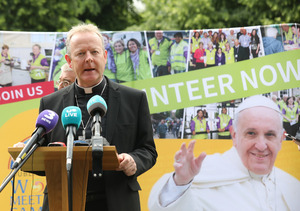


From top: Archbishop of Armagh and Primate of All Ireland Eamon Martin outside the offices of the Irish Catholic Bishops’ Conference in Maynooth, Co Kildare, last month, as the details are published for the the pastoral visit of Pope Francis; Tuam survivor Peter Mulryan and historian Catherine Corless; Ciaran Tierney
The only surprise about the revelation that survivors of institutions and clerical sex abuse are planning to protest during the visit of Pope Francis to Ireland in August is that anybody might be surprised.
There are thousands of people across Ireland, the UK, the USA, and Canada who are waking up to the injustice inflicted upon them and their families. They are determined not to be silenced anymore.
They want the Catholic Church to face up to the abuse inflicted on young mothers and their children in both Magdalene Laundries and Mother and Baby Homes throughout much of the 20th century. As far as many of them are concerned, the religious orders have never faced up to their crimes.
All across Ireland, hundreds of people believe they may have uncles, aunts, brothers, or sisters scattered across the globe.
They believe they have close relatives in cities such as Boston, Chicago, or New York who have no idea of their own true identities, as they were adopted out, illegally and for cash, by nuns whose only concern was that they ended up in good Catholic homes.
The history of Catholic institutions in Ireland in the 20th century is one of physical and emotional abuse, shame, judgement, and even baby trafficking and child abduction, as many “illegitimate” children were forcibly taken from their traumatised mothers after they were transferred to institutions all across the country.
This is not ancient history, as we saw in the emotional but wonderful scenes in Dublin two weeks ago when more than 200 former residents of Magdalene Laundries were honoured in public for the first time.
Many of them flew home from the US and the UK, because the shame of their incarceration – or giving birth outside marriage – ensured they could never return to the towns or villages they came from.
The last Magdalene Laundry only closed down in 1996. Some of the women were so institutionalised after spending three decades in these harsh institutions that they did not wish to leave even when presented with the opportunity to do so. They had given up the will to live independent lives.
The youngest woman to have given birth in a laundry is still only 40 years old. These are real, living, breathing people and now they want the truth – and justice – after so many years of secrets, lies, and shame.
The children born in these horrible places did not all end up living in Ireland. They were trafficked in their hundreds to the USA, their birth records falsified, and to this day many do not even realise that they were adopted or born in Ireland.
When we talk about the 796 ‘Tuam Babies’ we should remember that they are not just skeletons buried in and around a septic tank in a North Galway Mother and Baby Home.
They are the flesh and blood of people like Peter Mulryan, a noble man in his 70s who wants to know what became of the little sister he never knew he had for most of his adult life.
Until he finds proof of her death, for all he knows Peter’s younger sibling could be living out her life somewhere in North America, totally oblivious to her roots or where she came from.
This need to know the truth seems to be of hugely important to the survivors and their children as they reach old age. Who would not want to know what happened to a sibling if he or she was forcibly removed from a tearful mother’s arms?
Even if they knew nothing about them for most of their lives.
Birth records were falsified, an order which ran a notorious Mother and Baby home is now making money from private health care, and religious orders are refusing to hand over records until they receive legal indemnity for crimes committed in the past.
Institutions circumvented the rules to send children out for adoption and priests were moved around from one parish to another when ordinary people raised concerns about clerical sex abuse. For many victims and their families, peace will only come when they hear full apologies and they receive redress for the crimes which destroyed so many lives.
Most of all, people just want to hear the truth.
It’s a theme which recurs again and again in ‘My Name is Bridget’, the new book by journalist Alison O’Reilly which examines the desperately sad case of a woman who had two sons taken from her in the Mother and Baby Home.
Bridget went on to live in Dublin, marry a good man, and have a daughter who never knew about the two older siblings who were seized from her mother in Tuam. It was only after Bridget died that Anna discovered she had two missing brothers, who may or may not be buried in that infamous septic tank in Co Galway.
Right now, Anna, Peter, and other survivors of the Tuam Mother and Baby Home are waiting on tenterhooks to see if Galway County Council are prepared to undertake a full excavation and examination of the Tuam site.
They will be shocked and dismayed if the authorities try in any way to cover up what happened in Tuam after all the pain they endured.
Decades may have passed, but they are still entitled to find out what happened to close family members – were they buried in an unmarked grave or were they trafficked to America?
in a letter to the Minister for Children and Youth Affairs, Katherine Zappone, Anna wrote:
“This is a national scandal, not a popularity contest for who wants the tidiest cover-up. This can’t be the same as in the 1970s. How dare you,”
Anna sent copies of the letter to every member of Galway County Council to make it clear that she and other family members would not accept any kind of ‘cover up’ at the site.
Alison’s book is a very topical addition to the national debate. It shows how important identity is to the adopted and the truth is to survivors of institutions and their families.
In a powerful chapter at the end of her book, entitled Snapshots of Stolen Lives, Alison spoke to a number of survivors about their need to find the truth, justice, and peace.
“Everyone deserves to know who they are and it should not have taken this long and I should never have had to fight so hard,” said Breda Tuite, who was adopted through the St Patrick’s Guild Agency in Dublin in 1959.
It took Breda, from Dublin, years to track down her late mother from Co Kerry. For her, there was a kind of healing in visiting her grave and meeting her friends and family.
Sharon McGuigan was just 16-years old, an innocent child, and had been groomed by an older man when she became pregnant in 1985. She was admitted to the Dunboyne Mother and Baby Home in County Meath and gave birth to a daughter in February 1986.
The daughter was taken from her and adopted. Sharon had no say in the matter. Her daughter is still not ready to meet her but Sharon hopes to build a relationship with her some day.
“We should not have been made to feel so shamed and to be cast aside,” Sharon told Alison O’Reilly. “I just want to tell my story and not to be mistreated because of something that wasn’t my fault. I want an acknowledgement of what happened to women like me.”
Anna Corrigan has described the Tuam grave as a jigsaw which needs to be put back together. The survivors and their families point out that there were many institutions like Tuam all over Ireland and an awful lot of healing still has to take place for those who had no voice for far too long.
They believe that religious orders were engaged in criminal behaviour during the darkest days of 20th century Ireland and it is time the Catholic Church faces up to issues such as the shaming of pregnant women, child abductions, and the trafficking of Irish babies to the USA.
They believe that the visit of Pope Francis to Ireland will be a pivotal moment for the Catholic Church on the island.
If he listens to the people who had their identities stolen or who were separated from their families, a huge amount of healing can occur in August.
Otherwise, Pope Francis can expect very vocal – and hugely embarrassing – protests from victims who are not prepared to be silenced any more.
Ciaran Tierney is a journalist, blogger, and digital storyteller, based in Galway, Ireland.
Victims vow to protest when Pope Francis visits Ireland (Ciaran Tierney)
Rollingnews


From top: Gillian, Janet and Will at Connolly Station last night; Janet and Will on the east coast; and with Sean from charity ‘As I Am’.
Further to yesterday’s ‘Pop-Up charity Run‘ post.
Will, who is running half-marathons in every city of culture in Europe, writes:
When I woke up yesterday morning. I had zero motivation.
I hadn’t got the final agreement with any local charity.
I had received tons of messages from runners apologising for being injured.
And on top of that, the entire day, it was cold, cloudy, even drizzling at time.
But then the magic happened.
I got a call from Sean working at [autism charity] “AS I AM” saying a big YES for a partnership.
Then Janet Cole [aka ‘Janet, I Ate My Avatar’ from Broadsheet] and Gillian showed up on time.
Janet had helped me so much with accommodation and sight seeing the day before that I wasn’t really expecting her to be present today.
Gillian hadn’t planned to run at all. However, when she got done with work, saw the event, got her running gear ight away and showed up.
Also, the weather changed dramatically. 30 minutes before the race, it started to be warmer and warmer, clouds blew off and it turn out to be a gorgeous day.
My original plan was to run in north Dublin and to go back to our meeting point.
But Gillian convinced me to push the envelope to the most scenic part of Dublin, along the coast. This race was just glorious.
Donations HERE
Yesterday: Runners Needed Tonight
School’s Out
at

From top: the MacGill Summer School 2018l Catherine Murphy and Roisin Shorthall
Further to yesterday’s gender imbalanced MacGill Summer School line-up.
The Social Democrats Co-Leaders Catherine Murphy and Róisín Shortall have said they will withdraw from their respective panels at this year’s MacGill Summer School unless significant changes are made to the gender-balance of panels across all sessions.
Ms Murphy said:
“I find the comment from the organisers about it being ‘difficult to find people with the right aptitude’ quite offensive when the implication is obviously that that is the reason more women are not invited to speak at the event.
…There is an abundance of articulate and well-informed women that could have been approached to participate and weren’t. I cannot in good conscience take part in an event that has so blatantly disregarded the importance of equal female participation and for that reason I will withdraw from the session I was due to speak at unless significant changes are made across the programme.”
Ms Shortall said:
“Irish politics has come a long way from the male pale and stale boys club that it traditionally was. High-profile events like MacGill have a responsibility to reflect that change but also to recognise the wealth of fantastic and informed female voices across the Irish public life.”
FIGHT!
Yesterday: MacGill: It Ruddy Reeks

A progressively more bizarre retro painting show starring Kerri Kenney and directed by Jack Henry Robbins.
Stick with it.
Jet Setter
at
https://www.youtube.com/watch?v=kDV7smEEc5A
Founder and test-pilot Richard Browning of British human propulsion startup Gravity demonstrates the MegaMan-looking 1000bhp Gravity Jet Suit.

There’s a shabby and cruel online fad
Where a chap snaps a pic of his lad
And sends it to a stranger
Ignoring the danger
That he’ll look pathetic and sad
John Moynes
Illustration: The Guardian
