




Dadmageddon
at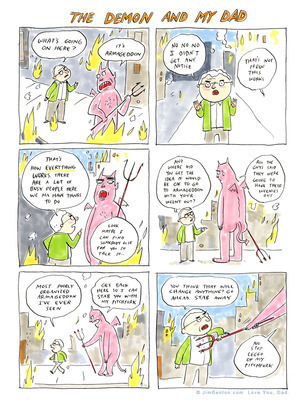


By Martin McMahon
Gigification is State-approved misclassification of employees as self-employed in order for some employers to evade PRSI obligations.
Gigification is always bogus self-employment, but bogus self-employment is not always Gigification. The difference is the approval and assistance of the State in creating bogus self-employed workers.
At a meeting between vested interests in the Workplace Relations Commission(WRC), the Gigification of punitive employees was renamed as ‘Contingent Employment’, but don’t let that fool you, Gigification has one purpose and one purpose only – to save ‘selected’ employers circa 30% on labour costs as an enticement to ‘create’ jobs.
Gigification grants illegal state aid, in the form of a secret PRSI exemption, to ‘selected’ employers. It is a secret tax break which puts compliant employers at a distinct economic disadvantage.
The employment status of workers and the rate of PRSI to be paid is entirely the responsibility of the Department of Social Protection to be made in accordance with the law, at least on paper it is.
In practice, the Revenue Commissioners make blanket decisions on the employment status of thousands of workers not in accordance with the law, but instead in accordance with a political imperative to reduce the numbers on the unemployment register by any means.
Unless a punitive employee forced into one of these ‘Special Tax Agreements’ writes to the SCOPE Section of the Department of Social Protection and specifically requests an ‘Insurability of Employment’ decision, the legal sustainability of these politically motivated ‘Special Tax Agreements’ between the Revenue Commissioners and ‘selected’ employers never faces scrutiny.
A Potted History
In 1979, PAYE workers began a series of protests against the PAYE tax system. At that time, PAYE workers were employees, and the burden of income tax, they felt, was unfairly targeted at these employees. Self employed workers paid tax through a self assessment scheme.
In the years that followed, along with changes to the income tax system, an increased focus was put on those working outside the tax net, particularly those working ‘On The Lump’.
The Lump worker is paid cash ‘off the books’ by the employer. No tax or PRSI is deducted at source. The employer pays a lump sum of money for the work the worker does each day or week, hence “working on the lump”. The employer claims that the worker is self-employed.
Working on the lump is the most basic form of bogus self-employment. Working on the lump is also known as working in the ‘Black Economy’.
Following the introduction of Selective Employment Tax (SET) in the UK in 1966, construction industry employers offloaded thousands of directly employed workers and then re-employed them in a “self-employed” capacity.
Many of these workers were Irish and the practice of off-loading employees and rehiring them as self-employed followed them home to Ireland.
In order to combat these workers working on the lump and claiming social welfare at the same time, Governments in the UK and Ireland introduced various forms of tax certificates for these workers and labeled them ‘sub-contractors’.
The social welfare and tax systems in both countries gave generous allowances for travel, clothes, lodgings, tools, etc. The worker then paid income tax on a much smaller amount than a directly employed worker and the employer avoided all responsibility.
Many employers refused to take on direct labour, as they knew that many of them would be trade unionists who would use collective bargaining to improve pay and conditions. Employers blacklisted union and activist workers.
This practice of ad hoc, specifically tailored tax agreements for the construction industry was duplicated in other industries.
The Revenue Commissioners met and negotiated several of these deals with individual employers and industry-wide representatives.
The Denny Case
In February 1992, the SCOPE Section of the Department of Social Welfare opened an ‘Insurability of Employment’ decision making process into the employment status of a young woman called Sandra who worked as a demonstrator in various supermarkets. Sandra was labeled as self-employed by her employer as were all supermarket demonstrators.
Less than 3 months later, on May 6, 1992, the SCOPE Section Deciding Officer, applying all of the available evidence and also the legal principles handed down in various court judgments over the years, issued a decision that Sandra was not self-employed as claimed by her employer. Sandra was an ordinary employee.
Employment status is never just a matter of choice.
Before 1992, SCOPE decisions were legally binding decisions. A notice would be issued to the employer and all PRSI arrears would be demanded. The employer could appeal directly to the minister to reverse the decision or appeal it directly to the courts. In both instances, the department would be required to defend it’s own decision.
This SCOPE decision however, wasn’t appealed to the minister or the courts, it was appealed to the then newly formed Social Welfare Appeals Office (SWAO).
The Social Welfare Appeals Office was established by legislation in 1991. It is an office of the Department of Social Protection responsible for determining appeals against decisions on social welfare entitlement and insurability of employment issues. The Social Welfare Appeals Office is a quasi-judicial tribunal and can, if it so chooses, consider a case ‘de novo’ or afresh.
The Department of Social Protection is required to implement the decision of an Appeals Officer which is deemed to be “final and conclusive” unless a review by the Chief Appeals Officer is requested on a point of law or fact or unless statutory appeal is taken to the High Court on a point of law.
The appeals mechanism is not independent.
The Appeals Office must adjudicate on decisions of the Department of Social Protection, of which it is a part. Appeals Officers are employees of the department, appointed by the Minister for Social Protection, and may return to another department section after working in the Appeals Office.
Furthermore, the fact that decisions on social welfare appeals are not published routinely, means that people appealing decisions are also forced to work in an information vacuum and are unclear how cases are decided. It is worth remembering that people cannot access state legal aid to advise and assist them in what can be a very complicated process.
It was into this new Office of the Department that the contentious decision of SCOPE, another Office of Department, was appealed.
The SCOPE decision was contentious because it challenged the authority of the Revenue Commissioners, so much so, that on December 15, 1992, a letter issued from the Inspector of Taxes, Tralee, indicating his intention not to pursue the question of requiring Kerry Group PLC to deduct income tax under the PAYE system from merchandisers/demonstrators/promoters.
This letter from the Revenue Commissioners exposes that the Revenue Commissioners were operating an industry wide ‘Special Tax Agreement’ to label all merchandisers, demonstrators and promoters as self-employed and were refusing to bound by insurability of employment decisions made by the SCOPE Section.
This letter was submitted to the SWAO appeal of the SCOPE decision as a ‘matter’ for the Appeals Officer’s attention. The Revenue Commissioners were clearly applying pressure to the SWAO to overturn the SCOPE decision in Sandra’s case under threat of totally ignoring any decision that would affect their industry wide ‘special tax agreement’.
An obscure, unreported Civil Court case, Cronin v Kerry Co-operative (24 June 1990), was also submitted to the SWAO appeal to justify the Revenue Commissioner’s refusal to be bound by either SCOPE or SWAO decisions on merchandisers/demonstrators/promoters.
Despite this intense pressure from the Revenue Commissioners, the newly formed SWAO held its ground and fully supported the original SCOPE decision.
The decision was further appealed to the higher courts by the appellant company. Eventually, following a six-year battle, the higher courts ruled that Sandra was an employee.
The original SCOPE decision was strong enough to survive every level of the quasi-judicial and judicial process and became one of the definitive rulings on insurability of employment widely known as Henry Denny & Sons (Ireland) LTD, trading as Kerry Foods v. The Minister for Social Welfare [1998] 1 IR 34.
It is worth noting that the details related here would never have become public had the SWAO ruled against SCOPE. The SWAO is a secret quasi-judicial tribunal, all hearings are secret and none of it’s rulings are open to public scrutiny.
This was the first and last time that the Social Welfare Appeals Office supported a SCOPE decision which challenged a pre-existing Revenue ‘Special Tax Agreement’.
The Fix
In 1993, less than a year after the SCOPE decision that Sandra was not self-employed, the SCOPE Section made an Insurability Of Employment decision that an individual courier was not self-employed as his employer claimed. This decision was immediately appealed to the Social Welfare Appeals Office by the employer.
Pillaried
at
Damian Hanley writes:
Before people question the courage of one deputy hiding behind a pillar, we must ask how many politicians in the US have hidden from people with guns before today?
SHOOT! Fight!
(Cartoon by Aidan Dowling)
(H/T: Ciaran Le Cool)
In today’s Irish Independent.
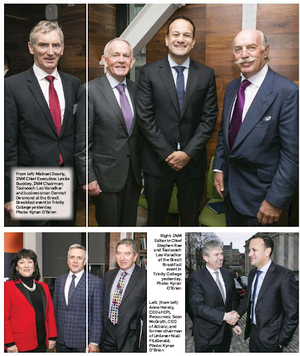
Pictures from yesterday’s Independent News and Media-organised Brexit Breakfast at Trinity College Dublin…
Including INM Editor-in-Chief Stephen Rae and Taoiseach Leo Varadkar (bottom right).
In today’s Irish Times.
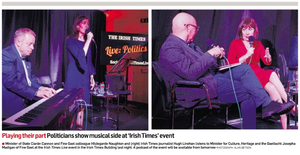
Pictures from an Irish Times Live event at the newspaper’s office on Tara Street last night…
Including Fine Gael TDs Ciaran Cannon and Hildegarde Naughton (left) and Minister for Culture, Heritage and the Gaeltacht Josepha Madigan speaking with Irish Times journalist Hugh Linehan.
Oh.
Earlier: “The Taoiseach Has Said He Wanted To Get The Media To Run Fewer Negative Stories”
Creatureware
at





STOP!
IKEA Ireland writes:
IKEA recalls GODIS PÅSKKYCKLING due to a discovery of mice at the production unit. Food safety is a priority at IKEA and as a precautionary measure, we are recalling GODIS PÅSKKYCKLING, marshmallow candy 100g.
Customers who have bought this product with best-before dates between October 23, 2018 and January 26, 2019 are urged to return it for a full refund. The best before date is stamped at the back of the packaging. No receipt is required.
Yikes.
Via IKEA Ireland
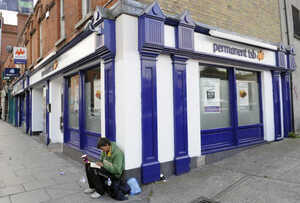
PTSB or PTSD (post-traumatic stress disorder)?
Ja Campbell,
Dublin 6.
Sale of PTSB loans (The Irish Times letters page)
Previously: ‘It’s Essential For The Long-Term Health Of Irish Banking’
Rollingnews

Shane Lynch
On The Ray D’Arcy Show.
Sinéad Harrington writes:
Shane Lynch will be joining Ray this Saturday night, to talk about his recent time in the Celebrity Big Brother house and the impact Dyslexia has had on his life.
Former World Champion Andy Lee will be on the show this Saturday night to chat about his decision to retire from boxing
The original Supernanny Jo Frost will join Ray on the couch to talk about parenting in the modern age…
…Also there will be a battle of soap stars as Claudia Carroll (Nicola from Fair City) and Isabel Mahon (Michelle from Glenroe) go head to head during this week’s lip sync battle…
*pours bleach into shot glass*
The Ray D’Arcy Show at 9.55pm on RTÉ One.
Pic: Rex


A recent aerial shot (bottom) of the 12.9km long Confederation Bridge (top) linking Prince Edward Island to mainland New Brunswick in Canada showing surface ice in the frozen strait neatly sliced into rectangles by its evenly spaced piers. To wit:
To put the rectangles into perspective, the bridge piers that are designed to break up the ice floes are 250 meters apart. That distance would also represent the width of each of the rectangles. The length of the blocks varies but, on average, the length is about 75 per cent greater than the width.
(Photo: Paul Tymstra)