Above from left: Sinn Féin spokesperson on Finance Pearse Doherty, Deputy First Minister of Northern Ireland Michelle O’Neill, President of Sinn Féin Mary Lou McDonald TD and spokesperson on all-Ireland economic matters Conor Murphy arriving at the Sinn Féin Ard Fheis 2021 at the Helix Theatre, Dublin on Saturday; Derek Mooney
For about twenty years I lived within a ten-minute walk of the RDS and Simmonscourt. This was particularly useful for the Fianna Fáil Árd Fheiseanna.
It meant I could soak up the atmosphere and anticipation in the hall during the build up to the party leader’s speech, but quickly nip home to see the full speech live on TV and catch the RTÉ news review.
This gave me a better sense of how the speech played in the world outside, as I was seeing what the people at home saw… well, those few who bother to watch these things.
It was a practise I continued whenever the Árd Fheis was in Citywest or Killarney. Once the warm-ups started, I headed to my hotel room, watched it there. Rushing down to the bar afterwards to catch up with friends and join the crush getting to the bar.
While seeing it delivered live on TV gave you a better sense of how the leader had performed, the critical difference was seeing what clips RTÉ chose to use in their news coverage. These were the pats of the speech that most punters were going to see, and that would decide what messages they took from the speech.
Invariably, the clips were the ones you had hoped they would use, the key soundbites, honed and crafted in the days and weeks before.

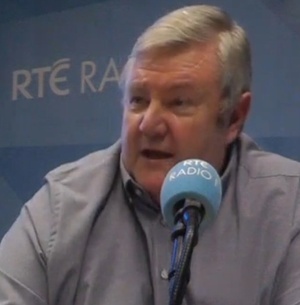
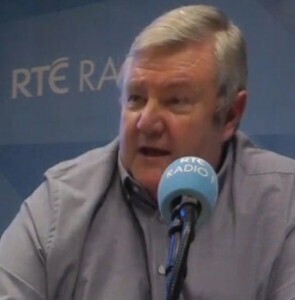
What you could not control however, though I know some did try, was the surreal doughnut that gathered around RTÉ’s David Davin-Power (above) as he broadcast live from the back of the hall.
There he critically assessed the mood of the delegates and of the entire Árd Fheis, like a political Frank Rich, offering an instantaneous review of what effectively was a theatrical occasion, though one that was more off-Broadway, than on.
From what I have seen the reviews following last Saturday’s Sinn Féin Árd Fheis have been generally positive, or at least in line with what they would have expected. Even more positive were the previews in the days leading up the gathering in the Helix theatre. Most, especially the ones in the Northern Irish and British media, focused on the Shinners heading the polls both North and South and speculated widely (or do I mean, wildly?) on Sinn Féin not just being in government, North and South, but leading it.
Doubtless the prospect of government weighed heavily on the minds of delegates over the weekend as evidenced by the party vote to somewhat change its stance on the Special Criminal Court. The change itself is nowhere near as dramatic as some are spinning, but it is probably sufficient to decommission this issue at the next election, denying both Fianna Fáil and Fine Gael yet another avenue of attack.
It is just one more step in Sinn Féin’s gradual progress to shatter the glass ceiling that many thought would keep it in single digits… and then in the mid-teens. It’s a road that the Shinners have been on in recent years, most particularly since its electoral decline in the 2019 local and European elections.
Showing a maturity of purpose and intent that seems to have somehow eluded the two other main parties, Sinn Féin took real lessons from its 2019 shellacking. It saw that the voters were looking for change, but that this did not mean just any old change. They saw that voters wanted a party, or parties, with innovative ideas and ambitious solutions, not yet another party of protest.
This is not to say that the progress has been all down to what Sinn Féin has said or done or that Sinn Féin has not occasionally drifted back to being a party of protest and whining.
While Sinn Féin has mostly seemed ready to change itself and to become a party fit and ready for government, there are still question marks over whether it can become a party of government, even a party leading government.
These are not the ones proffered by the Taoiseach when speaking with the media after his Bodenstown address yesterday. His questions have a legitimate basis, but it appears that no one around Martin has yet realised that none of this is denting Sinn Féin’s poll ratings. If anything they are helping them, especially when such imprudent sycophants such as Senator Ned O’Sullivan pull a Godwin’s Law á la Maude Flanders.
While Sinn Féin shows all the signs of being ready to do what it takes to get into government in the twenty-six counties, its fate depends on two key factors, both of which lay entirely outside its control.
The first is what Fianna Fáil and Fine Gael do. The fumbling and stumbling leaderships of the two traditional main parties is possibly a better driver of support to the Shinners than Mary-Lou, Pearse and Éoin combined.
This is being a tad unfair perhaps to Fine Gael. For almost a decade Fine Gael has had a personal stake in the growth and success of Sinn Féin. Sinn Féin is a better foil and a better political enemy for Fine Gael than Martin’s Fianna Fáil. It offers a clearer polar opposite. One that allows both Sinn Féin and Fine Gael to starkly present themselves as the only available political options as they attempt to cannibalise what remain of Fianna Fáil.
But the strategy, which has guided most of Varadkar’s manoeuvrings, has backfired… and badly. Rather than offering itself as the one true centre right alternative to a lefty Sinn Féin, Varadkar has now changed tack and is leaving Fine Gael blurred and amorphous.
Almost as blurred and amorphous as Martin’s Fianna Fáil. Sinn Féin’s progress to office is highly dependent on Fianna Fáil’s continuing stagnation and the perception that is current leader has becoming increasingly antagonistic to the idea of having any serious discussion on Unity, either in terms of how we move towards it or what the new constitutional arrangements could be in new all-island Ireland.
The second factor is the attitude of parties on the left to either going into government with Sinn Féin or propping up a minority Sinn Féin government. Will the leaders of labour and the Social Democrats be willing to let their parties become political mudguards for a highly controlled and disciplined Sinn Féin administration?
While the allure of high office may be tempting to some, I believe there is still sufficient commitment to policy principles in both parties that there is little possibility of either party going into government without major policy concessions, particularly in the area of justice and law and order.
Besides, as the Dublin Bay South by-election result showed, smaller parties on the left have little to electorally fear from Sinn Féin when they have strong and credible candidates. Though we should be cautious about extrapolating too much from By-election results, the fact that Sinn Féin could not get itself beyond 10% across almost 80% of a constituency where it already holds a seat, tells a story.
In the run-up to the by-election I genuinely believed Sinn Féin had a chance of winning the seat. They picked a strong candidate with sold local connections and a proven history. The local organisation indeed the entire Dublin and national organisation was mobilised behind her. There was a masterful get-out-the-vote operation across a large swathe of the constituency, yet the Shinners were beaten by over 2:1 by labour’s Ivana Bacik across most of the constituency.
Despite the current hype and hoopla in some circles, Sinn Féin is not on some inexorable march to government in Dublin. It most certainly is not an impossibility. But, as the latest polls have shown, Sinn Féin is still a long way short of the winning line, so it will require the continued indifference and masterful inaction of the other two parties for it to become a likelihood… for now.
Derek Mooney is a communications and public affairs consultant. He previously served as a Ministerial Adviser to the Fianna Fáil-led government 2004 – 2010. His column appears here every Monday. Follow Derek on Twitter: @dsmooney
Sam Boal/Rollingnews
Earlier: Shedding