9043127690431279904312829043128890431291904312899043128390431293

Yesterday evening.

Merrion Square, Dublin 2

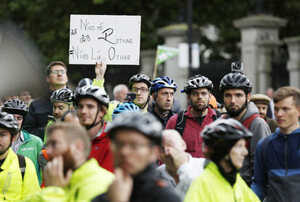
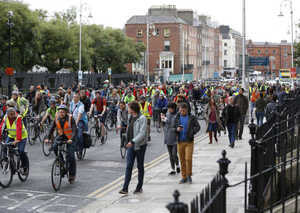
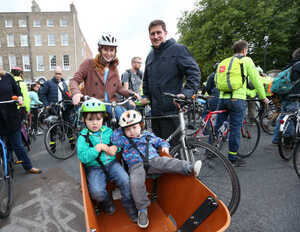
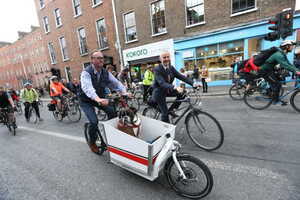
Further scenes from Dublin Cycling Campaign‘s reclaim the streets rally where cyclists, including Green Party leader Eamon Ryan TD (pic 6) and Green Dublin City Councillor Ciaran Cuffe (above in suit), called for more of the Government’s transport funding to be steered towards better cycling infrastructure in the capital.

In fairness.

Last night: Ring Ring

Previously: Two Wheels Good


picture-8

picture-4picture-3

Results from a study of Irish newspapers by Impact. From top: The 18 people who were mentioned first in each lead article in the study; and the female/male ratio of bylines and lead articles

The trade union IMPACT has carried out a study of the front pages of The Irish Times, the Irish Independent, and The Examiner.

The decision followed the publication of a paper “Seen but not Heard: How Women Make Front Page News” which looked at the national daily papers in Britain.

Lughan Deane and Patricia O’Mahony, who carried out the study, write:

We decided to look at the ways in which gender is represented on the front pages of Ireland’s three national daily broadsheet newspapers: The Irish Examiner, The Irish Independent and The Irish Times.

We analysed a week’s worth (Monday to Saturday) of each newspaper’s front page. We collected Examiner front pages from Monday the 5th of September 2016 until Saturday the 10th. We collected Independent front pages for the following week (12th – 17th Sept.) and Irish Times articles for the week after that (19th – 24th Sept.).

For each front page we recorded the number of male and female journalists whose bylines appeared and whether the lead article was written by a man or woman.

We also made note of every single name mentioned in the contents of the front page articles (as well as photo captions, etc.) and divided them according to gender.

Separately, we recorded the first name to appear in the front page’s lead article and made a note of the individual’s gender.

We counted all words within quotation marks – direct quotes – and, wherever possible, noted whether the quotes were attributed to men or women.

We counted the number of men and women represented in photographs and pictures on the front pages.

How often do female journalists secure a spot on the front page? Our analysis of bylines showed that just 21% of bylines on the front page are those of women (79% are those of men). In total, 21 of the 98 bylines we encountered were female.

…We found, in our three papers, that women only wrote (or co-wrote) the lead article 8% of the time. 92% of lead articles are written by men.  Note that the percentages [above] should only be taken as indicative of a larger pattern as the sample involved (a week in each case) is so small.

Over the three weeks and across the three papers, 235 names were mentioned within the contents of the front page articles. Men’s names dominated the contents of front page news. We found that 82% of people mentioned or quoted (192 individuals) were male and that just 18% (43 individuals) were female.

Here is the full list of names mentioned on the front pages. The female names are in red.

picture-5

We also recorded the gender of the first person to be named in the lead article on each front page (18 names in total).

Of these names 17 were male (Taoiseach Enda Kenny was the first person named on two occasions) and 1 was female. That’s 94% male and 6% female.

None of the first names in the lead articles of the Examiner or Times was female. The Independent had one example.

While percentages derived from such small numbers are not fully reliable, the pattern is indicative of a wider picture.

[Pictured top] are the 18 people who are mentioned first in each lead article.

Note that the only woman pictured is the late Caitriona Lucas, volunteer coastguard and IMPACT member, who lost her life in tragic circumstances earlier this month.

Read the study in full here

Thanks UCD English Grad Soc


screen-shot-2016-10-04-at-10-22-00

Yesterday evening.

Outside the Polish consulate on Eden Quay, Dublin.

People gathered to support the tens of thousands of protesters who yesterday demonstrated across Poland against proposals for a total ban on abortion.

Previously: Free Tonight?

Video via Rafal Kostrzewa

shanecoleman

Michael Taft

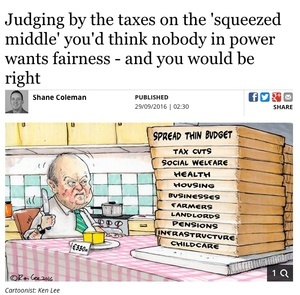
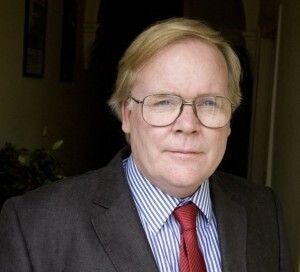
From top: Shane Colemen in the irish Independent; Michael Taft

The debate on the burden of the ‘squeezed middle’ is cynical and ill-informed

Michael Taft writes:

Newstalk presenter Shane Coleman asks:

‘So who’s representing those who earn €35,000-€75,000 – the squeezed middle?’

To be fair to Shane, he’s not the only person asking this question nor is he alone in posing this question in those income ranges. But, oh my.

The debate over the ‘squeezed middle’ is one of the more ill-informed and cynical you’ll come across. It is led in many cases by politicians and commentators who make assertions without substantiations, claims without facts; all of which leads to policy proposals that are at variance with equity and economic efficiency.

In many cases the numbers are just made up to rationalise a pre-determined policy preference.

In short, it’s a terrible debate.

The problem starts with the definition of the ‘squeezed middle’. This should be a relatively straight forward statistical issue.

If we are looking at ‘income earners’ (PAYE employees or the self-employed) we can go to the Revenue Commissioners database for a rather crude but revealing headcount.
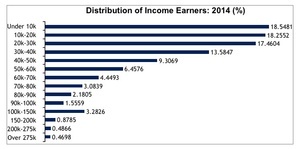
1

We can see there are a lot of low earners. 54 percent earn less than €30,000. From this we can estimate the median wage (the income level at which 50 percent earn above and 50 percent earn below) to be €27,550. Welcome to the squeezed middle. It’s a long ways off from €75,000.

There are a few problems with these Revenue numbers.First, ‘married couples with both spouses working’ are counted as one tax unit. Therefore, in this category, an income unit of €30,000 could actually mean that each spouse in the household earns €15,000 (or any other variant).
Second, these numbers include pensioners who have taxable income such as an occupational or personal pension, investment and property income. Most pensioners would be at the lower end of the table.

Third, the table includes churn. People who come into the tax net by taking up a job may do so only half-way through the year so the tax unit may refer to six months. Similarly, with people exiting the workforce.

We can try to adjust for some of this by disaggregating couples with two incomes. When this is done, we find the median wage falls to €25,200. We still have, though, the problem with pension income and churn.

A number of commentators prefer to focus on ‘full-time’ workers. I’ve never been convinced of this approach as it excludes so many part-time or near-full time workers.

Nonetheless, let’s work this, adjusting for couples with two incomes and excluding all those earning below €15,000. Even doing this we will be including some part-time workers (e.g. someone on €20 per hour working 20 hours a week will be above this €15,000 threshold).
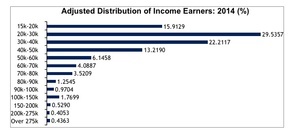
2

Even when excluding all income earners below €15,000 (about 27 percent of all income earners), we still find a significant number earning below €30,000 – over 45 percent.

From this we can estimate the median wage to be €32,050 with 50 percent earning below that amount. The middle is still very low.

So what is the squeezed middle?

The OECD uses a formula to define the broad middle: between one-third below to two-thirds above the average (median) wage.

Using the median wage for all income earners (the first table above) we find the squeezed middle to be between €18,500 and €46,000.

Using the median wage for adjusted income earners above €15,000, the squeezed middle is between €21,500 and €53,500.

This puts the issue of helping the squeezed middle in a new perspective.

We would have to look at things like the minimum wage and living wage, strengthening and extending Joint Labour Committees for all low-paid sectors, increasing social protection programmes such as the Family Income Supplement – in addition to affordable childcare, affordable rents and lower public transportation costs.

Note that most of this doesn’t even get mentioned in the debate over the squeezed middle.
But there is a big, big caveat in all this.

There are a lot of people in society who are not included in the Revenue database because they are not PAYE employees or self-employed: most pensioners, carers (mostly women working in the home), the ill and disabled who can’t work, and those out of work. They should count, too. If they did, the squeezed middle would be a lot, lot less.

For instance, in 2014 the median household income was €40,336. It should be remembered that this includes all income from all people in the household, including social protection income (e.g. Child Benefit, rent supplement, etc.).

And the figure above includes employers’ social insurance (an accounting convention). If you remove that the median household income is closer to €37,700. 50 percent of households earn below that amount.

No, the squeezed middle does not go up to €75,000 or anything like it. If you earn €75,000 you are in the top 10 percent earning bracket. If you earn €50,000 you are in the top 22 percent earning bracket.

This is not to say there are not issues in these above average households. There may be a number of children, high debts from a Celtic Tiger mortgage, etc. But we need to keep a perspective. And to do that is by first getting a robust handle on what we are talking about.

IF we do that, we will have a better chance of getting the policy right.

Michael Taft is Research Officer with Unite the Union. His column appears here every Tuesday. He is author of the political economy blog, Unite’s Notes on the Front. Follow Michael on Twitter: @notesonthefront


521927_335384696563324_2073964228_n

Dr. Strangely Strangethe return of legendary folk freaks

What you may need to know…

01. Started in 1967, folk experimentalists Dr. Strangely Strange were among the tenants of legendary Dublin rock lodgings The Orphanage, the same circle of people that produced Phil Lynott and Gary Moore among others.

02. Signing with Joe Boyd, producer/manager for the Incredible String Band, the band released debut LP Kip of the Serenes via Island Records in 1969, and the following year, recruited Moore for follow-up record Heavy Petting. The band disbanded in 1971 after a European tour, and have since reunited on a number of occasions inbetween other work in the arts, including for third LP Alternative Medicine in 1997.

03. Streaming above is one of the band’s calling cards, Strangely Strange But Oddly Normal, from the band’s first full-length.

04. The band plays its first gig in Cork city in over four decades this Sunday at the Kino, as part of IndieCork festival. Tickets €12, including a screening of a short documentary on the band filmed in 2007 before the performance.

VERDICT: One of the bands that helped set the scene for all manner of alternative music and experimentation in this country.

Dr. Strangely Strange

Broadsheet.ie