
Anti-monarchy group Republic is erecting billboards in Scotland
In Britain some folk want to wean
Their country away from the Queen
Though not many, they choose
To be buoyed by the news
Of the royals, which has not been too clean
Pic: Republic



Anti-monarchy group Republic is erecting billboards in Scotland
In Britain some folk want to wean
Their country away from the Queen
Though not many, they choose
To be buoyed by the news
Of the royals, which has not been too clean
Pic: Republic















More to follow.

Thank Philomena it’s Friday.
What better way to bask in this glorious Indian Summer than to kick around this week’s voucher-less music question.
The theme this time is your favourite song whose title or lyrics refer to royalty/monarchy (as in kings, queens, princes etc).
Here’s mine.
Reply below for the craic.
Please include video links if possible.
Lines close on Saturday at Midday.
Nick says: Good luck!
Pic: Bunker Vinyl, Cork
Meanwhile…
The results are in.
Last week’s esteem was won by The Ferg, who chose The Bear by My Morning Jacket as the most underrated song of the 1990s.
The Ferg wrote:
“Sneaking in to the ’90s in June of ‘99 is the hauntingly wonderful ‘The Bear’ from My Morning Jacket. It’s about stepping back from the edge, “There’s still time..” I saw them live in Queens [New York] just before de ‘rona and the epic voice of Jim James is just as incredible in person.”
Nick says: Well done, The Ferg, and thanks all.
Last week; Win Nick’s Esteem

Free next Wednesday?
‘Go mBeirimid Beo’ (That we may live to see) presented by Oisín Mistéil (top).
Are you ready for the end?
Deirdre Ni Chostain writes:
Can we really prepare for an apocalypse? Or are we better off dead?
On a national journey that will bring him from a disused nuclear bunker in Galway to the only Survivalist store in the country in County Cork, Oisín Mistéil is determined to ask the awkward questions about how prepared we are for Armageddon.
Oisín will meet with preppers and nuclear physicists, with environmentalists and monastic historians. His aim? To discover how previous generations dealt with these existential threats and to ask how prepared we are for those of the future.
Troid!
Go mBeirimid Beo on Wednesday, September 8 at 9:30pm.

The Voice of Diet Culture
Tell me what you ate for dinner,
Because I totally hate my figure.
And I see you’re getting thinner….
So maybe you’re onto a winner.
What did you eat for dinner?
Tip 1.
Replace your meals with practical hobbies,
Like reading a book or fainting.
Tip 2.
Close your eyes.
Take a deep breath.
So you can’t tell the difference from an apple to a slice of bread.
From feeling alive to feeling dead.
Relish in the feeling of emptiness.
Tip 3.
Swallow the good.
Spit out the bad.
Hang ornaments from your collarbones.
Build a staircase around your lung.
Don’t you know?
Bones is the new vogue.
Tip 4.
Burn your body down.
Play Russian roulette with your esophagus.
Your underarms sway,
You don’t want wings!
You cannot fly.
Tip 5.
Remember you only exist in numbers.
The scale is the deciding verdict on how you should feel.
At your lowest you’ll be a fruit at its prime.
And it’s okay if you start tittering on the sharp edges of decay.
We wait for bananas to rippen before we eat them anyway.
Wrestle your body.
It’s a battle ground not a home.
It’s a temporary home not a lighthouse.
Your kind and stomach will fight for years.
Even if your heart just wants peace.
Just like you wanted another piece….
Your body will learn to tolerate.
Previously: Sylvia’s Mothering
Pic: Allstock
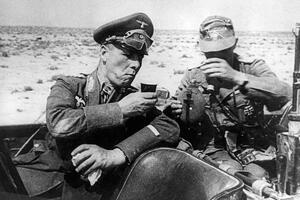

From top: Nazi General Edwin Rommel (at left); David Langwallner
Philosopher Isaiah Berlin‘s famous parable or table top discussion, ‘The Hedgehog and The Fox‘ (1953) is about different forms of intelligence. The Hedgehog knows one big thing, the fox many things. Perhaps the ideal human intelligence ought to combine both?
I have always been fascinated by the ‘Desert Fox’, Erwin Rommel. The reasons are obvious in my case. I have always been a Junker at one level but never quite a member of the establishment. I endorse the remark of Groucho Marx that one should never be a member of a club that would have one as its member. I also have an innate sympathy with the underdog and he was certainly in that position in the impossible war of The Afrika Corps. The man who won against impossible odds. A far better general than Montgomery.
Now, all judgments at one level must be context-specific. So, the negative. He was a National Socialist and a card-carrying member of the Nazi party. He was also a German General and initially very close to Hitler. He was a military man and, described by Desmond Young in his definitive biography, the perfect fighting animal. It is quite clear that he was a great military strategist, resourceful, winning against odds and brilliant in the game of bluff and counter-bluff.
The relationship between the Anglo-Saxon and Germanic race has always been complicated. Similar Hapsburgian blood in their royal families, thickened by dynastic and familial inter breeding didn’t help. They were never natural enemies, but twice got pitted against each other. So, the officer class of both establishments always had respect for fellow officers of the same perhaps ruthless disposition – mitigated by an old-fashioned sense of compassion or honour.
As illustrated by the performance by Von Stroheim as the German Commander in Renoir’s ‘La Grande Illusion‘ (1939), some of the Junker class had a measure of civility. Regarding the rules of combat and proper treatment of prisoners during wartime, it is quite clear that most American, German, Japanese and to a significantly lesser extent British generals did not observe them, but Rommel largely did.
‘La Grande Illusion,’ a film of the first world war, says a lot about the need for pacifism and the somewhat courtly treatment of prisoners of war. It also demonstrates the futility of any war or any form of conflict that descends into tribalism, nationalism and chauvinism which is where we are now headed.
Renoir elaborated in commentary on the film that all cultures are cliquish and have their own rules, their own protocols and their own way of dealing with those who do not observe the rules of the game or the rule of law.
When it opened, a largely right wing audience in France went berserk, like the reception in the Abbey Theatre to ‘The Playboy of the Western World’ in 1907. Renoir’s acid comment was in effect that these people were doomed and the audience reaction showed that “people who commit suicide do not do so in front of witnesses.” He had touched a raw nerve.
Rommel, though not Renoir, was a tolerably-civilised Junker and given the awfulness of the military mindset and the circumstances, a tolerably civilised human being compromised by his service to awfulness. The real mystery about him relates to his knowledge of the Van Stauffenberg plot and his final disenchantment with his mentor Hitler. He either knew of, or did not disavow, or plotted with the removal of Hitler – hence his death by cyanide pill in the back of the car.
As a new form of corporate and military industrial barbarism takes hold, the actual rakes of the game have shifted. Normal laws have given way to executive action, ouster clauses, emergency legislation driven by the pandemic and many of the decision makers now rough-hewn combatants engaging in inconsequential thinking that might be viewed historically in hindsight as a combination of blinkered vision and indeed war crimes or crimes against humanity.
When the rules of the game have become replaced by real or fake wars in an age of disinformation then the narrow tinsel of legality has broken down. Johnson venerates Churchill and references him like the Bible to in effect trumpet and blow up his own reputation. Churchill was a great man but also a war criminal not least in sanctioning Bomber Harris and the bombing of Dresden with the death of many innocent civilians as documented in Kurt Vonnegut’s ‘Slaughterhouse.’
So, Rommel does matter in a perilous age.
He was with a few contrary incidents very decent to prisoners of armed conflict and was a civilised European gentleman. Ultimately, he had enough of a barbaric and unstable regime and his subtle but recognisable opposition was enough.
Currently even that scant level of heroism within the establishment is perhaps enough. The last remnants of civilisation. And Renoir the hedgehog saw clearly in 1939 that we are on the brink of a precipice as we are now. People such as Rommel the Fox are needed to instill moderation. And for their unique skill sets of both military tactician and humanist.
David Langwallner is a barrister specialising in public law, immigration, housing and criminal defence including miscarriages of justice. He is emeritus director of the Irish innocence project and was Irish lawyer of the year at the 2015 Irish law awards. His column appears here every Tuesday and Friday. Follow David on Twitter @DLangwallner
Getty

Behold: three galaxies in a row. Very similar to one another. Right – that’s what they want you to think. To wit
Toward the right of the featured Hubble image of the massive galaxy cluster Abell 3827 is what appears to be a most unusual galaxy — curved and with three centres. A detailed analysis, however, finds that these are three images of the same background galaxy — and that there are at least four more images. Light we see from the single background blue galaxy takes multiple paths through the complex gravity of the cluster, just like a single distant light can take multiple paths through the stem of a wine glass. Studying how clusters like Abell 3827 and their component galaxies deflect distant light gives information about how mass and dark matter are distributed. Abell 3827 is so distant, having a redshift of 0.1, that the light we see from it left about 1.3 billion years ago — before dinosaurs roamed the Earth. Therefore, the cluster’s central galaxies have now surely all coalesced — in a feast of galactic cannibalism — into one huge galaxy near the cluster’s centre.
(Image: ESA/Hubble & NASA, R. Massey)