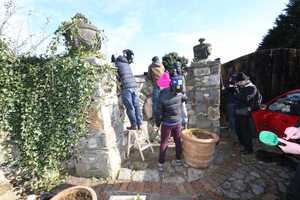
 Gorse Hill, Killiney, last week (top) and Dr Julien Mercille (above)
Dr Julien Mercille writes:
Since 2009, there have been 3,865 home repossessions in Ireland (1,114 were ordered by courts and 2,751 were voluntarily surrendered or abandoned).
Also, the Central Bank has just released new figures showing that there are still more than 100,000 homes in arrears, or 15% of mortgage accounts. The evidence suggests that banks will seize even more homes in the near future.
If an opinion poll was taken today asking Irish people, ‘Can you name one of those repossession cases?’, probably 95% would answer ‘the rich guy in Killiney whose Gorse Hill mansion Vincent Browne showed us on television… the one with a tennis court, swimming pool, stone lions, and a nice view on the Bay’.
The ‘rich guy’ is Brian O’Donnell, a solicitor and developer who not so long ago controlled a €1 billion property empire but went bankrupt in 2013.
When Bank of Ireland moved to seize his €7 million palatial house over an unpaid debt of €71.5 million, a group calling itself the New Land League tried to block the repossession.
It just so happens that the New Land League, set up in 2013, is led by Jerry Beades, who is also a developer and a former member of Fianna Fail’s National Executive who collaborated closely with Bertie Ahern in the not so distant past.
According to press reports, he also accumulated multi-million euro bank debts over which he has been in legal battles with the banks.
The media has paid so much attention to that story that by now we know a lot about the intricate details of the lives of the O’Donnells, Jerry Beades, Gorse Hill itself and the New Land League. Yesterday, in a long Sunday Independent front-page ‘Exclusive’, ‘first-ever’ interview, the children of the O’Donnells told their stories. And that passes for investigative journalism.
One issue is, why is the media so focused on this case, but not on the thousands of others who have or are at risk of losing their house?
For example, just as the Gorse Hill soap opera is unfolding, a Limerick father called Ger Lonergan who is undergoing treatment for cancer risks losing his home due to a mortgage debt of €32,000.
He became unable to make payments due to illness and was diagnosed a few months ago with cancer. Permanent TSB has asked for a possession order to seize the house in which he lives with his wife and two daughters. Mr Lonergan says he gets a disability payment of €78 a week.
Whatever the details of this specific case, it’s not hard to imagine many other similar ones in the country. And ‘imagine’ is the right word, since we haven’t heard much about them.
The reason is that our mass media is not representative of popular interests. It cares about those of the better off and the stories that concern them, but not so much about the conditions faced by ordinary people.
That’s why all newspapers have ‘Business’ and ‘Money’ sections, but no ‘Poverty’ or ‘Human rights’ or ‘Deprivation’ sections. There are ‘Sports’ and ‘Lifestyle’ or ‘Living’ sections, but those don’t challenge Ireland’s power structure or injustice (they’re just about shopping and entertainment), so they may be printed.
The same goes for sensationalist stories like Gorse Hill. Narrowing down the discussion to the swimming pool and the paintings in the house, while not making links or comparisons with ordinary people at risk of losing their homes saves the government and bankers some embarrassment over kicking out ordinary and sick people out of their homes.
Another effect is that whenever the important issues of repossessions, evictions and mortgage arrears are brought up in public discourse, the picture conveyed is one of arrogant rich people living in mansions and too stubborn to vacate their house that they bought thanks to property speculation during the housing bubble years.
Many of us will have little sympathy for such individuals and might even secretly cheer for the courts and banks to kick them out of their house.
The result is that issues of repossession and arrears are misrepresented and turned upside down, and thousands of people whose lives are directly affected by them will not receive the attention they deserve.
@JulienMercille is lecturer at UCD and the author of The Political Economy and Media Coverage of the European Economic Crisis: The Case of Ireland. He will provide evidence to the Banking Inquiry on the role of the media during the housing bubble years.
Related: Banks attempt to repossess 7,000-plus homes (irish Times)


![IMG_0253[1]](http://cf.broadsheet.ie/wp-content/uploads/2015/03/IMG_02531-e1425891522923.jpg)