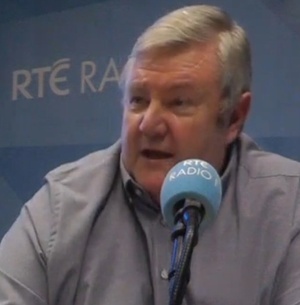
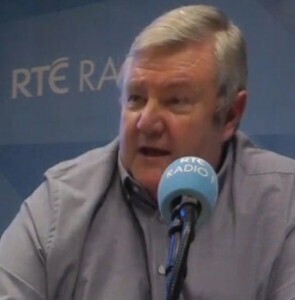
 From top: Fake political polls and fake political pollsters are two different things, argues Derek Mooney (above)
While All The President’s Men remains the best Watergate related movie, there are some credible challengers. Indeed a new 5-part TV series, the White House Plumbers is currently in production. Directed by VEEP writer and producer David Mandel, it stars Woody Harrelson as Howard Hunt and Justin Theroux as Gordon Liddy, the leaders of the crew of “plumbers” who broke into the Democratic Party HQ in the Watergate office complex.
Another contender is the quirky “Nasty Habits”, a film which manages not to mention Nixon, the White House or even Watergate. Instead, this adaptation of the Muriel Spark satire: “The Abbess of Crewe” which transposed the Watergate scandal to an English Benedictine convent, moves the action again, this time to Philadelphia and an order of nuns led by the Nixonian Sr Alexandra, played by Glenda Jackson.
Alexandra has schemed her way to the top of the cloister by secretly taping the confessions of her fellow sisters. She has her Ehrlichman and Haldeman like henchmen in the guise of Sisters Walburga and Mildred, plus the globe-trotting missionary Sr Gertrude, who shuttles around the world’s trouble spots, á la Henry Kissinger, played brilliantly by Melina Mercouri.
In one scene Alexandra calls Gertrude asking how she can defend her actions while protecting her tapes. Gertrude advises her to tell them it is a paradox. What’s a paradox? asks Alexandra. Gertrude replies:
“a paradox is something you must live with.”
I mention all of this as Sr Gertrude’s “paradox” came most to mind as the furore over party polling raged in the newspapers and on the airways, last week.
Ministers were rushed out to label Sinn Féin’s 2015 polling “sinister”… but, no sooner had certain party HQs sent TDs out to condemn it all, than the same HQs were revising their positions and conceding that they’d done it too, though there had stopped it in 2007… or 2011… or 2015.
Every time I talk here about the latest national polls, I remark that political parties do not do their polling in the same way as national opinion polls.
It is a simple truth that political parties do their polling at constituency level. There is nothing wrong with polling. There are rules by which it is done. The primary rule is that you protect and maintain the anonymity of the people polled. This rule applied long before the arrival of GDPR.
But doing constituency polls costs money and the bigger parties have looked to cut the costs, while safeguarding the accuracy of the results and the integrity of the process. Nothing revealed over the past week has shown that any of them have undermined either aspect.
That said, the revelations about how folks represented themselves at the doors have been embarrassing, though not as embarrassing as how the main parties have had to change their stories and admit to doing what they accused others of doing.
Parties using volunteers makes sense when you consider that the biggest single cost element in any poll is collecting the data. So, why would a party with a strong volunteer base pay an agency to hire 50 – 60 people to spend a Saturday morning going door to door, asking 500 – 600 people to anonymously fill in sample ballot papers? It has experienced volunteer canvassers who are well used to going door to door that it can send to do the leg work.
So, while those on the doorsteps may be volunteers, is it fair to label them as fake pollsters? Their task is to gather the representative samples as requested, by going to the streets in the constituency identified by the pollster who crafted the poll. The critical number crunching work is done afterwards, either by experienced pollsters working in-house or by independent professionals hired in from outside.
The polling itself is real, not fake. The results are tabulated fairly. The individuals polled are not identified. No one ever knows how they each voted on their sample ballot paper.
So, the main issue arising from the polls done by Leo Varadkar, Sinn Féin etc., is how the people going door-to-door represented themselves.
While some parties and individuals seem to have concocted elaborate backstories with fake company names, fake business cards, fake IDs, and 70-page manuals, others had the cop-on to send out experienced and savvy canvassers with the know-how to be obtuse when asked, who sent them. Rather than producing a fake business card, they shrugged and said: I’m not sure, I think its one of the big parties. We were just asked to go door to door. If you’d prefer not to participate; that’s no problem .
All of which leads us back to the central paradox.
The fairness, accuracy and impartiality of the poll result is ensured and protected by the person being surveyed not knowing who is doing the polling.
As any professional pollster could confirm, if the person surveyed knew the poll was being conducted by, or on behalf of, Fine Gael or Labour, then it is possible that it will skew the respondent to give that party a higher preference than they might have otherwise. Therefore parties and independents doing these polls are reticent about saying “it’s us” when they go to the doors.
The easiest way out of this dilemma is to go to one of the many polling and market research agencies in town and pay them to look after the whole process from start to finish. In effect, that seems to be what most parties now do.
Perhaps, it is also due to a combination of parties finding it tougher to get people to volunteer in the way they used to and voters being more questioning and sceptical about responding to someone coming to their door seeking their opinions for a poll than they were a few decades back.
Thus, the volunteers who were once sent out to do polling are now deployed selling €50 national draw tickets. In my opinion, it’s not a better use of their time or energy.
So, while it is not unfair to label the fictitious polling companies as fake, that does not mean the polls were fake or that the people doing the legwork were anything other than sincere and honourable.
We should be careful about generalising the fake pollsters claim into one of fake polling. Fake polls are a vastly different thing.
One of the most pernicious examples of fake polling is push polling. Used a lot in the US elections in the 80s and 90s, this form of negative campaigning involves parties or groups calling voters by phone and claiming to be from a usually fictitious polling company.
Working from a carefully prepared script they ask the voter “if you were aware that candidate X of party Y was a drug user… or a serial cheater… or whatever… would you still vote for them.”
The purpose of the poll isn’t to gather responses, it’s to start a rumour going about the other party’s candidate and drive support away from them. One of the most egregious examples was the smear campaign mounted against Senator John McCain in 2000 in South Carolina as he sought he Republican nomination against George W Bush.
That’s a fake poll with a malicious purpose. There are other kinds of fake polls. Fake polls that verge on the benevolent – and I am going to own-up to my role in one of these.
My first election run was way back in 1985. I was a Fianna Fáil candidate in the Rathmines city council ward. This was back in the day when Fianna Fáil could comfortably win two seats out of four across Dublin. As the second candidate selected at convention, it looked like my political career was set to take off at age 22.
However, within days of being selected party headquarters decided to add not one, but two other candidates to the ticket. My chances had not just been halved; they’d been slashed even further as one of those added was a publican whose premises on the Harold’s Cross Rd was barely 500 yards from my family’s small hotel.
I was in big trouble. I was the youngest candidate but also the most impecunious one. I was going to have to do something big to be myself noticed – but something that didn’t cost much money. My campaign manager and I decided to organise a fake poll, but without the need for fake pollsters or polling companies.
Armed just with a few sheets of Letraset, a typewriter, some scissors, a bottle of glue (for sticking, not sniffing) and access to a photocopier, we set about creating an opinion poll showing me set to win the second Fianna Fáil seat.
Key to this was a detailed report from an old (and real) opinion poll done a few years earlier in the neighbouring Dublin South-Central. We took the cover spreadsheet, removed the candidate names and area headings. Thus Crumlin became Rathmines, Drimnagh became Rathgar and Walkinstown became Dartry.
Now we had the poll, but how to get it out there? Luckily, there are certain people who have an abiding need to tell everyone and anyone how much they know. My constituency organisation was blessed with several of them.
So we photocopied our freshly baked poll and circulated it, directly and indirectly, to certain members urging them not to share it. Within days it was in the local free newspapers under the headline Mooney set to win second FF seat.
So, our fake poll got it the result we wanted. Only it didn’t. We forgot that in politics, as in physics. for every action there’s an equal and opposite reaction.
The local newspapers came out a full week before polling day. So, my cherished running mates had both the time and the resources to redouble their efforts in the final days. You couldn’t move in Terenure, Rathgar or Rathmines for personal literature, which back then was a bit of rarity.
My fake poll backfired. I came fourth out of the four. My first foray in electoral politics was a failure and I haven’t touched a fake poll since. Well, not intentionally.
Derek Mooney is a communications and public affairs consultant. He previously served as a Ministerial Adviser to the Fianna Fáil-led government 2004 – 2010. His column appears here every Monday. Follow Derek on Twitter: @dsmooney
Getty