“It has been a long road in the quest for justice for the people in the Visitors’ Gallery who, over a lifetime, have carried the damage done to them by the State. Like other Deputies, I would like to acknowledge that they are giants on behalf of their peers.
They are true survivors on behalf of their brothers, sisters, mothers and those who did not make it this far. There is real hope for them that this will be the beginning of the end. It will never undo the damage that was done but we can acknowledge, address and learn from it. In that sense, the commission is only the end of the beginning because what happens next is the critical test of whether we are at an historic juncture.
There is a right way and a wrong way to do things. Yesterday, when Deputy Maureen O’Sullivan questioned the Taoiseach about unresolved issues relating to the Magdalen laundries, he talked around them too much. He tried to justify what was done by saying this was the first Government to look at this 60 year old crisis through the McAleese report and he said the Government parties had been listening carefully.
However, by saying that, he proved he had not been listening carefully because the Justice for Magdalenes group has made the point well that the McAleese report was narrow in its remit and many of the issues the women need addressed remain to be addressed because the inquiry did not investigate the abuse and did not deal with burials and so on. I do not know whether this commission of inquiry will deal with these issues. While the Justice for the Magdalenes group says it has concerns, it will give evidence before the confidential committee.
The Minister has explained well that the terms of reference are flexible and are capable of being expanded. I accept that to a point but we should look at this project and not come up with the conclusion before we start. We have to inform the process and that is what the first part is about. That is a valid argument but a person does not need to be Sherlock Holmes to know that the Magdalen laundries and the ten outstanding institutions included in the amended terms of reference will turn up in this inquiry because they were part of the network that dealt with women and girls who had babies outside of marriage. On that basis, if the Government was listening, the Minister would include them now because if the commission is going to be what the Minister says it will be, it will deal with them anyway. That would be an important acknowledgement and I appeal to him to address that.
The commission is a tribute to much of the work he has done in this regard and it has the potential to be a hugely important body of work. Experts have been assembled and, for example, Professor Mary Daly is unrivalled in her field and she can play a huge role in delivering an important social project on the history of women who had children outside wedlock. However, there are two dangers in that.
The first is that by spending a great deal of time on history, it will be used as a cover to justify or legitimise bad behaviour that no history could ever condone because while we can say it was a sign of the times and attitudes are different now, it is only one side of the equation. People were more in awe of the Catholic hierarchy, women had fewer choices economically in raising children and it was a different time but that cannot be an excuse for the torture and cruelty perpetrated by individuals in those institutions. When we look at history and say we are all to blame and society is to blame, sometimes that means nobody is to blame and people do not get the justice they deserve. We have to factor that into the equation.
All these issues are relative but we must also recognise that it was not long ago that these events happened. When we use the hugely offensive term, “rehabilitation for women” in these cases, we talk about mother and baby homes when everybody knows a woman went in and she did not come out with a baby in most cases. The baby either did not make it or ended up in the hands of people claiming to be its natural parents or was adopted against the wishes of the mother. These issues need to be resolved. I echo the concerns about the adoption issue which is a huge body of work that needs to be addressed. I do not know whether the commission should do that but it needs to be dealt with.
People have been hugely hurt and damaged by this. They have placed their trust in the Minister, which is an incredibly significant responsibility because their trust is precious. It has been abused and betrayed many times by people in this State and they cannot afford to have it abused again.”
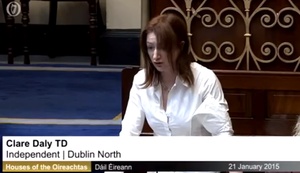
Clare Daly discussing the Terms of Reference for the forthcoming investigation into the Mother and Baby Homes in the Dáil this afternoon.









![SUN: SUN-PAGES-NEWS [1RM] ... 22/01/15](http://cf.broadsheet.ie/wp-content/uploads/2015/01/SUN011RM221.jpg)