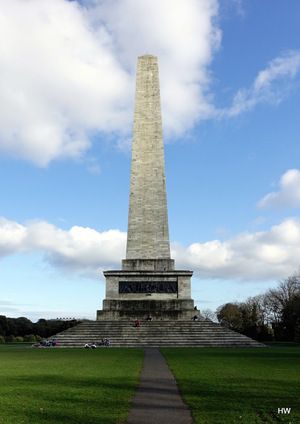
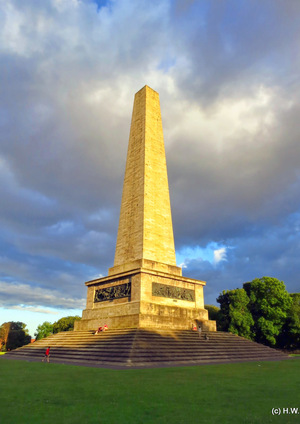
The Wellington Testimonial.
When Dubliners mention “The Monument”, they are of course referring to the Wellington Testimonial or the Wellington Monument in the Phoenix Park grounds beside Chesterfield Avenue. Arguably, both names for “The Monument” are correct as Sir Arthur Wellesley was very much alive when the construction work began but he was quite dead before it was completed. It was built between 1817 and 1861 to commemorate the victories of Arthur Wellesley, 1st Duke of Wellington.
Arthur Wellesley was born in Ireland in 1769. His place of birth is disputed, being born either in Mornington House in Dublin (now the Merrion Hotel) or in the town of Trim, Co. Meath. Daniel O’Connell’s quote describing Wellesley’s Irishness as, “just because you are born in a stable does not make you a horse” is very true.
He was quintessentially a British warrior, statesman, imperialist and aristocrat. He never considered himself Irish, he was from Ireland, but he was not of Ireland. He was part of an Anglo-Irish caste whose first allegiance was to the British Crown. He described himself as part of the “English garrison” and Ireland “in a view to military operations must be considered enemy country”
There is no doubting his courage or military successes. He had an illustrious military career after joining the British army as an ensign in 1787. He seen his first action in Flanders in 1794 He then served in India from 1797 until 1805. After a number of victories enforcing British power in India, Wellesley returned to Ireland band became Chief Secretary in April 1807 until he resigned the post in April 1809. From 1808 until 1814, he led the British forces across Portugal, Spain and France, winning many crucial victories against France and earning him the titles of Viscount Wellington of Talavera and Duke of Wellington, from the British Crown.
On 18 June 1815, Wellington led the British and Allied forces to victory over the French in the decisive battle of the Napoleonic Wars at Waterloo. Where “Napoleon met his Waterloo”. Wellington subsequently had a major political career becoming Prime Minister during the reign of George IV after being Commander in Chief of the British Army.
To commemorate “The Iron Duke”, Wellington’s military victories during the Peninsular War, a testimonial committee was formed in Dublin on July 20th, 1813, by the Earl of Roden. He first suggested his idea of a monument at, ‘a meeting of several noblemen and gentlemen of the Kingdom of Ireland’ at the Rotunda in Dublin on 20 July 1813. Wellington’s continuing military success and his major victory over Napoleon at the Battle of Waterloo in 1815 meant continued public support from that echelon of society in raising the necessary funds for the building of a monument.
A competition was held and a large number of potential designs were submitted by artists from all over the United Kingdom. Seven of the designs were shortlisted for the Wellington Testimonial. Models of the designs were put on public display at the Dublin Society’s House on Hawkin’s Street. Eventually, Sir Robert Smirke (1781-1867), design for an obelisk was chosen, a notable architect, he designed many major public buildings, including the main block and facade of the British Museum.
Smirke’s obelisk is a fine imposing structure of 62 metres in height, built of crystalline Kilgobbin granite, tapering upwards consisting of a four-sided shaft with a pyramidal apex, on a three-stepped monumental pedestal. There were also plans for a large statue of Wellington on horseback, accompanied by guardian lions placed on individual pedestals, but eventually after construction began the lack of funds ruled that out.
On 18 June 1817, the Lord Lieutenant, Lord Whitworth, the Crown’s senior representative in Ireland, laid the foundation stone for the testimonial with much fanfare at a ceremony held for the purpose: “The Lord Lieutenant … was attended by several officers of distinction and an escort of dragoons … The ceremony was attended by a vast concourse of carriages, and of equestrian and pedestrian spectators; the day being particularly favourable there were exhibited considerable beauty, rank and fashion. … The Lancers made a beautiful and warlike appearance… After the ceremony of laying the stone, 21 rounds were fired.”
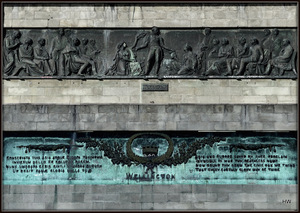
Around 1820, the British Government provided brass cannons captured at Waterloo. After they were melted, they were used to mould the 3-D style bas-reliefs around the base of the monument. If you take a walk around the monument, the bas-reliefs display vibrant images titled, the “Battle of Waterloo”, “Civil and Religious Liberty” and the third the “Indian Wars”. The fourth has an inscription, in Latin and English: –
“Asia and Europe, saved by thee, proclaim
Invincible in war thy deathless name
Now round thy brow the civic oak we twine
That every earthly glory may be thine.”
Support for building the monument had faded somewhat by the early 1820s and due to a lack of funding, it was finally completed in 1861, nine years after the duke’s death.
On completion not everyone enjoyed the artistic merits of the monument as this early exchange relates,
Mr. Osborne: “Anyone who has been in the Phoenix Park must have seen the gigantic Milestone which is placed there in defiance of all rules of art and taste…”
Lord Palmerston: “Upon matters of taste men ought to be permitted to differ…the Monument in the Phoenix Park is in good taste.”
Mr. Osborne: “The Noble Lord must be an admirer of Milestones” -(Commons Debates, 1860)
So, today “The Monument” is a feature of Dublin, it is the tallest stone obelisk in Europe and it stands proud dominating the skyline all around it. Whatever your views of Wellington, it is part of our history and well worth a visit the next time you are in the Phoenix Park.