Further to disquiet over the sale of state seaweed company Arramara Teo.
Senator Trevor Ó Clochartaigh spelled out some of the issues in the Seanad today forcing an extension to the consulatation process.
Senator Trevor Ó Clochartaigh: “The Minister of State is possibly aware of the recent sale of the State-owned company called Arramara Teoranta that was in State ownership for quite a number of years. The company is a seaweed processing factory based in Kilkieran, Connemara. We have been told by Údarás na Gaeltachta that it was sold to a Canadian company. We wish the new company well and have no issue with the purchase whatsoever.
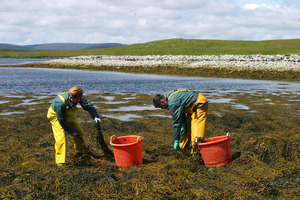
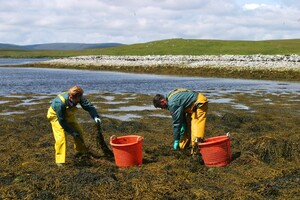
We have an issue with the licensing regime. My understanding is that the licence regime that covers the process is based on the 1933 Foreshore Act. The legislation states that the State owns the seaweed on our shores and, technically, the people who want to cut seaweed require a licence. It appears to us that the law has not been implemented to the letter until recently. However, there is a tradition, certainly in places like Connemara where I am from, for people to have a stripe or space on the shore to cut seaweed and sell it to the factory. Recently we have become aware that the National Parks and Wildlife Service, I think, wrote to at least one seaweed cutter informing him that he needed a licence if he wanted to continue cutting seaweed. On foot of that we noticed that a number of private companies had applied for a licence to gain the right to harvest seaweed along the foreshore from Kerry to Donegal.
We also know of a licence application that covers the area from Belmullet to Clare. Local seaweed cutters are quite concerned about the issue and are worried that it may affect their rights to cut and sell seaweed to the companies that operate in the industry. Before Arramara Teoranta was sold to Acadian Seaplants it applied for a licence for the area. A number of very large public meetings have been held to discuss the matter where the seaweed cutters, along with many public representative, expressed their concerns.
The local seaweed cutters stated that they would like an input into the resource and its management. They are very concerned about sustainably managing the resource. They are also concerned that the seaweed is cut well, that the best is made of it and that they can make a living.
There is a concern that if one company receives a licence it would have a monopoly and thus dictate the terms such as the times for cutting and the price. In addition, if it was not happy with a certain cutter it could put somebody else on his or her stripe of seaweed and get him or her to do the work. A number of smaller companies that work in the industry are very concerned that they will be squeezed out of the business.
My understanding is that these licence applications must go before a sub-committee in the Department, the sub-committee then makes a recommendation to the Minister and then the Minister has the responsibility of signing off or granting a licence to the cutters, company or the people who applied. I ask that none of the licences be granted until there is full public consultation with the seaweed cutters and people involved in the local communities.
This is necessary to see if this is the best model and the most sustainable way of maintaining the industry. Locally, the seaweed cutters have suggested that they would prefer a fair trade scenario where a co-op or organisation, comprising the seaweed cutters,was set up and would apply for a licence. If a licence was granted they would be able to negotiate with a number of different players in the industry to get the best possible terms and conditions for them and their workers. That is my question for the Minister of State and I hope she will look favourably on the request.”
Jan O’Sullivan TD: “…I urge people with a particular interest in, or a tradition of involvement with, seaweed harvesting to use the opportunity afforded by the public consultation process to make their views on the applications known to my Department on the applications in question. These consultations are expected to begin very shortly. They will be advertised in the local and national press and published on my Department’s website. I am aware of the interest that some applications have attracted and of the one referred to by the Senator. My Department is in the process of making all applications that are deemed complete available on my Department’s website and is issuing instructions to applicants on the public consultation procedures. Given the level of interest in these applications, I have decided to extend the consultation period from 21 working days to 30 working days…”
Transcript via Kildare Street
Sale of State seaweed company ‘shrouded in secrecy’ (Aine Ryan, Mayo News)