
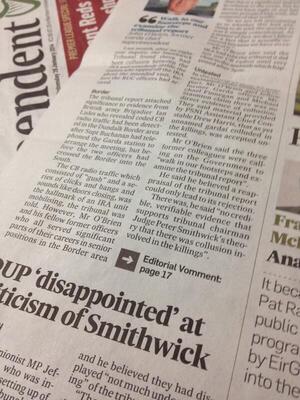
Bit concerned about what I might find on pg 17 of today’s Irish Times. “Editorial Vomment”? pic.twitter.com/68tvA702p3
— Mark Tighe (@mktighe) January 29, 2014



Bit concerned about what I might find on pg 17 of today’s Irish Times. “Editorial Vomment”? pic.twitter.com/68tvA702p3
— Mark Tighe (@mktighe) January 29, 2014

Ok, settle in. This is Batman and Robin (1997) we’re dealing with here. The one with George Clooney.
In their ongoing series of movie takedowns, CinemaSins presents their longest profile featuring the highest sin count for any movie, ever.

Only the dedicated! Gareth Brooks fans queuing in Cavan from early hours early morning #Cavan #GarthBrooksCrokePark pic.twitter.com/rlgG3TmmyQ
— The Anglo-Celt (@theanglocelt) January 29, 2014
First, it was Dungannon on Sunday morning.
Meanwhile…
Around 50 Garth Brooks fans have gathered on Foyle St in Derry for tickets that go on sale tomorrow morning at 9am. pic.twitter.com/cQ7PD2kiZT
— Dean McLaughlin (@Dean_Journalist) January 29, 2014
Queue for Garth Brooks tickets already outside Merchants Quay in Cork this morning. Hope those lunatics have thermal underwear…
— AnneMarie (@AnnMo13) January 29, 2014
Meanwhile, in Clare…

Via The Clare People
Previously: I Could Have Missed The Rain But I’d Have Had To Miss The Dance

I submitted a Special Notice Question today in relation to the RTE payout/ #pantigate issue. It was refused. Text to follow. (1/2)
— Catherine Murphy (@CathMurphyTD) January 29, 2014
The apology and payment of damages by the national broadcaster to a private organisation without substantive just cause and… (2/3) — Catherine Murphy (@CathMurphyTD) January 29, 2014
the dangerous precedent for public discourse this action sets.” (3/3)
— Catherine Murphy (@CathMurphyTD) January 29, 2014
Meanwhile…
In an open letter to RTE, Brian Barrington, a legal expert on equality and human Rights, writes:
“…it is now incumbent on RTE to provide clarification on what it will not permit to be stated in other contexts also. RTE should therefore make clear what it will and will not tolerate in the following scenarios:
a. a person states that women should not be allowed to work outside the home. Is it permissible on Irish Television to offer the opinion that the person is a misogynist, even if one makes clear that he or she believes that misogyny includes discrimination against women?
b. a person states that Ireland should have fewer immigrants. Will RTE censor any person who states that the speaker is xenophobic?
c. a Northern Ireland politician objects to an Orange Order march, stating that the Orange Order is sectarian. Will RTE prevent the broadcast of such utterances and provide compensation to leading lights in the Orange Order?
If, however, any of the above is permissible, will RTE explain why it is not equally permissible to state that a group that campaigns against same sex marriage is homophobic?
Full letter here
Meanwhile…

“In its apology to the Iona Institute, RTÉ stated “is an important part of democratic debate that people must be able to hold dissenting views on controversial issues”, in terms presumably agreed in advance with the Iona Institute.
What these words tell us that it isn’t just a definition of marriage or homophobia that the Iona Institute seeks, but the power to enforce definitions that maintain proper order, including the definition of democracy.
According to the idea of democratic debate shared by RTÉ, the Iona Institute and Irish Times columnist Noel Whelan (and many other people), democratic debate doesn’t need to account for inequalities and prejudices enforced by dominant institutions.
It doesn’t need to account for the power to summon lawyers to threaten and prosecute.
It doesn’t need to account for the history of violence perpetrated against oppressed minorities and communities and the social wellsprings of such oppression.
It doesn’t need to account for conflicting interests and motives (‘it is also a very important part of democratic debate that individuals do not constantly have their motives and intentions called into question’)
It doesn’t need to account for the fact that calls for tolerance and respectful debate and liberal persuasion are a great deal easier in these parts when you are invited to speak up on behalf of the oppressive tendencies of the State, not against them.
By Definition (Cunning Hired Knaves)
Hat tip: Gavan Titley and Buzz


The Window House in Honshu, central Japan by Yasutaka Yoshimura architects is a three storey ‘weekend retreat’ on Sagami Bay with views of Mount Fuji.
Perched on piloti (to guard against flooding) right on the shoreline, the building (whose footprint is just 24 square meters) is designed to create minimum obstruction for the residents nearby, which it does by way of a narrow profile and two huge windows front and back.
It’s not for the shy.

Ah here.
Last year RTÉ’s The Consumer Show found that the average price of a small popcorn is €4.19 across the 37 cinemas owned by Ireland’s six big cinema chains.
It also quoted industry sources who said the standard 2oz small portion of popcorn costs 50c to produce, meaning cinema-goers who eat popcorn are being hit with a 700% mark-up.
Today, Paul Smith writes:
“On my last visit to my local cinema [above] I noticed that, not just happy with a 700% mark up, they now want to push up their profits even more. They now play “kiosk bingo” at the till points, as a staff incentive to increase sale (in return for alcohol)…
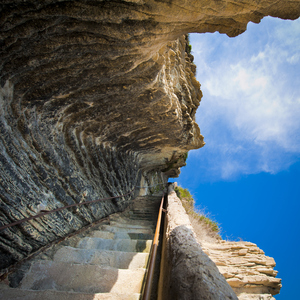
Or down?
An altophobia-bothering view of The Stairway Of The King Of Aragon at Bonifacio in Corsica by photographer Allard Schager.

[EU Justice Minister Commissioner Viviane Reding with Alan Shatter at Dublin Castle last year]
“We are calling on Member States to show greater flexibility and are issuing proportionate guidance to the five countries concerned so that citizens can get back on the electoral roll of their home country.”
EU’s Justice Commissioner Viviane Reding today.
This may change everything.
‘The European Commission has today issued guidance to EU-Member States which have rules in place leading to a loss of voting rights for citizens in national elections, simply because they have exercised their right to free movement in the EU. Five Member States (Denmark, Ireland, Cyprus, Malta and the United Kingdom) currently apply regimes which have that effect.
The main justification for disenfranchisement rules – that citizens living abroad no longer have sufficient links with their home country – seems outdated in today’s interconnected world.
Today’s guidance issued by the Commission aims to tackle the problem in a proportionate way by inviting Member States to:
1. Enable their nationals who make use of their right to free movement in the EU to retain their right to vote in national elections if they demonstrate a continuing interest in the political life of their country, ncluding by applying to remain on the electoral roll;
2. When allowing nationals resident in another Member State to apply to keep their vote, ensure that they can do so electronically.
3. Inform citizens in a timely and appropriate way about the conditions and practical arrangements for retaining their right to vote in national elections.
Complete ballots or a vital intervention?
YOU vote decide.
Commission acts to defend voting rights of EU citizens abroad (EC)


