



Fit To Print
at
Some mainstream media coverage of #COVID19 in #Ireland is adding to the high levels of stress and anxiety amongst the population. pic.twitter.com/YNf49wgCi3
— Michael McNamara TD (@MlMcNamaraTD) February 4, 2021
This afternoon.
Dáil Eireann at the Convention Centre.
“We have an arm of the government practically going out to Dublin Airport to burn witches live on air. I’m talking about RTÉ. It’s an absolute disgrace. It is oppressive and it is driving anxiety in this state what RTÉ is doing.
“There are massive problems with free media in Ireland.The Irish Times have their hand out looking for money from the government. God Knows they’re entitled to it, they’ve been doing your bidding for a year.
“But where is the free media to come from if the only source – I’m not talking about all media – but the primary source of income is the Department of Health, is the government?
“Of course they [RTE, Irish Times] are doing the government’s bidding, of course they’re driving the narrative, of course they are attacking people who question what is going on.
“It is oppressive and it is damaging the fabric of our society.”
Independent TD for Clare Michael McNamara
FIGHT!
Earlier: Wish You Were Here


How much?
Kiora writes:
Here we go again. Look at the price, look at the condition. Shameless and possibly illegal…
Doom Laden
at

This afternoon.
Liberty Lane, Dublin 8.
Street art dedicated to late helmeted rapper MF Doom.
Artist unknown.

Dan Boyle
Recently I listened to Susie Dent, the well known lexiographer associated with the Channel 4 programme ‘Countdown‘, state that the term ‘literally’ is now accepted in its figurative as well as its literal sense.
This saddens me. I see it as another cheapening of discourse.
For several years we have been living with counter argumentation that feels it needs no association with facts or truth. If it confirms an already held bias, by being confident in asserting such arguments, they acquire their own truth.
We have learned to confuse passion with anger or invective. We have come to see what had been thought of as abuse as some type of strength of character.
We have lost the ability to see that the views of others can and do have validity. We fear being seen as weak if we admit that our own views can and should change, if better arguments exist, or if we are seen to be misinformed.
We have created a world where expectations must be met immediately and in full.
Maybe it’s because I grew up in a system of politics where change, if it occurred at all, was often painfully slow. A system where obstacles were more successful in impeding progress.
The cycle that I have witnessed in overcoming change has seen the process of new ideas being subjected to indifference, to derision and then towards acceptance.
Mine is a political generation that has seen change as being hard won. A generation that has had to be vigilant against attempts to roll back victories that have been positive and progressive.
The pace of change since the turn of the millennium, both in terms of amount and depth, has been of a level greater than I have ever experienced before in my life.
I have come to appreciate how much better we are doing in achieving change. My previous experience of change being obstructed or being painfully slow, has made into something of an incrementalist.
We incrementalists are these days seen as the enemy, by those who see themselves as being the new vanguard of the revolution.
Having lived most of my political life overseeing zero or inching change, I have come to appreciate any positive deviation in policy direction to be significant change in itself.
Unlike the prevailing mood I don’t want it all now. I have come to believe that expecting such can be an impeding factor in bringing about change.
As well being an incrementalist I have also become a pragmatist. For some this magnifies the disdain in which I should be held.
To believe that battles should be picked and chosen, that to seek ultimate wins by accepting in the short term some battles can’t be won, is seen as betrayal by the self declared righteous.
These days it seems that expectations are not defined by our values, but by how quickly we can impose our beliefs on others.
Of course reactionary forces continue to exist. They are most prevalent where ignorance and deceit hold sway. Moral superiority is not the way of dealing with their contagion. Nor is having progressives vent their collective spleen against each other for not being bold or pure enough.
Change is coming. We should acknowledge each element of change as and when it occurs. To divide our energies and blur our focus, is to deny and delay change.
This isn’t the time for that.
Dan Boyle is a former Green Party TD and Senator and serves as a Green Party councillor on Cork City Council. His column appears here every Thursday. Follow Dan on Twitter: @sendboyle

Frank also joins @joeliveline from Gran Canaria and is defending his decision to travel during Level 5 restrictions.
He says he feels safer there, “You’re not suffering any mental anguish, the weather’s good, the pubs are open and the hairdressers are open.” #Liveline
— Liveline (@rteliveline) February 4, 2021
Una joins @joeliveline from a very sunny Gran Canaria.
“I can see a blue sky, beautiful shrubbery, a pool…my own patio where I have breakfast outdoors.”
Una calls in praise of @Ryanair, without which she wouldn’t have been able to go on holidays last Saturday. #Liveline
— Liveline (@rteliveline) February 4, 2021
This afternoon.
RTÉ Radio One’s Liveline sets rona-fearing listeners on sun-soaked seniors.
Meanwhile…
Pensioners galvantin’ in Gran Canaria during the Winter of our Discontent wih a storm out in mid Atlantic #liveline Gold. Even better our golden oldies happy pay Covid €100 travel fine. National meltdown as can withdraw State pension from local ATM.
— Richard Moore (@Moorerichardpr) February 4, 2021
Galvantin’, Joe.
Hot Wheels
at



Behold: the 1989 Aston Martin V8 Volante Zagato Convertible – one of only 37 made between 1986 and 1990, assembled by hand with a hand-stitched leather interior.
A rare Aston indeed (with just 549km on the clock), this vehicle spent most of its life on display before receiving a ground-up restoration with new brakes, suspension, a 315bhp engine upgrade, left hand drive conversion and replacement of every item degraded in the last 32 years.
You covet its inexplicable styling and Bentley Magnolia colour scheme.
You’re humming the chorus of Kylie’s ‘Hand On Your Heart’.
But you can’t have this car, because it sold this week for €170,000.
Peckish
at
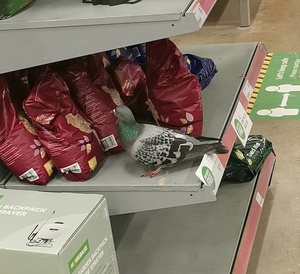 ‘sup?
‘sup?
Homebase, Nutgrove Shopping Centre, Rathfarnham, Dublin 14.
JDizzle writes:
Straight to the good stuff…


From top: Jennifer Whitmore TD and Taniaste Leo Varadkar
This afternoon.
The Dáil at the Convention Centre, Dublin.
Social Democrat TD Jennifer Whitmore raised the destruction of testimonies given by survivors to the Mother and Baby Commission of Investigation. Witness testimony was quickly erased without detailed transcripts being made.
Deputy Whitmore said:
“Tánaiste, 550 survivors gave their testimony as part of the mother and baby homes commission. Those recordings were never fully transcribed ad they have since been destroyed. This is despite assurances from the minister in October that survivors would be able to access their own story.
“And also a clause in the 2004 Commission of Investigation Act that the commission is required to retain all evidence it receives.
“It’s been reported that the DPC [Data Protection Commission] has contacted the commission regarding the destruction of these files. However the commission is due to be dissolved on the 28th of February which is only a few weeks away. I think it’s really important that we don’t fail these survivors again, Tánaiste.
So I would ask will the Government immediately extend the term of the commission to enable for a full investigation of the destruction of these files and to enable the recovery of any information.”
Tanaiste Leo Varadkar Leo Varadkar replied:
“Thanks, deputy. I only heard about that the other day and was quite surprised to hear it, quite frankly. But it is something that I known the Minister for Children is now aware of and it’ll be for him, as to whether or not it makes sense to further extend the term of the commission.
“I think it is important to say again that the Mother and Baby Home Commission is independent of government. It was established by the Oireachtas. It’s not controlled by the Government, or the creature of Government. Commissions, by their very nature, just like tribunals, are independent bodies.
“And I think perhaps one of the flaws in the process is an independent body, like a commission, can spend five years hearing evidence, examining evidence and then makes its report but then is not there to explain it.
“And you’re there, as a Government minister, left trying to explain a report that you had no role in actually drawing it up. I don’t blame the commission for that in any way but I think if we’re going to do another inquiry on another similar issue, we [inaudible] with a better way to do it.”
Previously: Mother and baby homes: Audio recordings of personal interviews have been destroyed (Irish Examiner)

‘For When I Die’.
Filmmaker Paul Power writes:
My short documentary For When I Die has been made public. It screened at Galway Fleadh, DIFF, Indie Cork, Still Voices and Dingle Film festival. It also won at the International Young Directors Awards in Cannes.
It’s about Jennifer Sleeman (top as a young woman), who is going to die. But we all die. How to accept and prepare for death is something we don’t want to talk about much. Jennifer has no such problem – even going so far as to buy her own coffin. This documentary explores Jennifer’s outlook on what a good life and a good death means to her. I hope ye enjoy…
In fairness.