
Tag Archives: coronavirus

Professor Ronan Collins

This morning.

RTÉ Radio One’s Today with Claire Byrne.

Professor Ronan Collins, a consultant geriatrician at Tallaght Hospital in Dublin, spoke to Claire Byrne.

The host began by asking Prof Collins if he believed pubs which don’t serve food should be allowed to reopen.

They then spoke about recent news reports that 70 people aged over 75 have tested positive for Covid-19 over the past fortnight.

Prof. Ronan Collins: “It’s not about pubs and drink as such, it’s actually about the pubs opening, the pubs are part of our normal life and that I suppose I would agree with the Tànaiste to a degree that we do have to get back to living and that includes normalising life in as far as possible.”

Claire Byrne: “That’s across the board and not just pubs then?”

Collins: “Absolutely, because, you know, to be fair, listen, again I think it can be easy to dichotomise showing scenes from, like Killarney last week or maybe scenes from Temple Bar. But there’s a different reality to this as well. First of all, I agree with you. The current situation is a little bit of a farce from what I’ve observed in terms of people serving food and what is going on.

“But if you go down to many places now in the small villages, small towns and indeed I have family who have lived in these areas themselves, all they have as their community centre, and it’s not even about drink, it’s about where people meet, have a chance to exchange some news, you know, support one another. And we’re faced into winter and I think, we do have to learn how to live with this virus.

“The one thing I would make, just as a personal comment, you know, I think all of our views have matured as the situation has progressed but the one thing I’ve learned myself is that we have lost, as a society, the skills of how to live with a pandemic. I heard our Taoiseach last night saying “unprecedented”. It’s hardly “unprecedented” that we have a pandemic. We had four of them in the 1900s and ironically, in the last 20 years, we’ve had four or five threatened or actual pandemics. This was always coming and we have lost our skillset as a society of how to live and cope through a pandemic.”

Byrne: “Well, look, I know people will be worried today because of that news that there have been 70 cases in the over-75s age group and I want to ask you about that next…”

Collins: “Claire, are these cases or are they positive swab results? Because most of us in the hospitals are not seeing this big surge of cases. Now the truth is, and I’m not, I don’t want, in any way, to be compared with some, kind of, more radical commentators on this but if you do swab more people, you will find more cases, inverted commas, of people who have shown positivity on a swab. These people may not even be ill. Some of them are very mildly and are very self-limiting illnesses and I think there’s a degree of, kind of…”

“I think it would be helpful actually, if these bulletins are going to continue every night and I’m not sure about the wisdom of that going forward either. It is important to keep public aware…but I’m not sure having a day-by-day count every day is helping necessarily either at the moment.

“I mean I think hospitalisations are a good marker of actually…”

Byrne: “I mean they’re down. We know they are down.”

Collins: “Yes, so, I mean, you don’t want to be terrorising people either. There is a real danger here, you know, that the greater good of society will not be served by continuing to adopt the ultra-conservative approach. Death rate is a very important outcome of this pandemic. But it is not the only outcome of when we come through this pandemic and how society looks like afterward.”

Byrne: “So you seem to be saying that older people need not to be afraid by this news?”

Collins: “Well, listen everybody needs to be afraid. Because it’s a serious infection and it is a more serious infection as you get older. Although age, in itself, and I keep on making this point, age, in itself, is not the greatest risk factor for determining how seriously unwell you become with this. It is a big factor but it’s underlying illnesses, is actually a major determinant of mortality and things like that.

“So I mean we all need to be afraid. Listen, there’s people of my age who died from this and you became quite unwell yourself, I believe, with the virus. I’m working with a doctor here at the moment who lost her father recently who is not that much older than me so I’m not trivialising this at all. This is a serious infection but we do also have to understand that there is a society at whole that needs to move on.

“We have to learn how to live with this virus. There is not a vaccine next month, there is not a vaccine in two or three months. There may be a vaccine in a year, we don’t know yet. We are going to have to learn how to live with a pandemic and, you know what, it’s a little bit of a wake-up call, to us. Many people in Africa have to live with the threat of serious infection and we forgot, I think, since the time of maybe the TB outbreaks and the Polio outbreaks in Cork and serious outbreaks of Rheumatic Fever, etc, all very serious illnesses but we have forgotten, as a society, of how to cope and live with the threat of infection.”

Earlier: Soz

Pic: YouTube

Protest in Berlin against Covid-19 restrictions; German Health Minister Jens Spahn 

This morning.

Germany will not need another national lockdown over the winter, says the country’s Health Minister Jens Spahn who also admitted Berlin’s lockdown was “too harsh”.

Via irish Times:

Germany should not have closed shops and hairdressers in the coronavirus lockdown, its health minister has admitted, triggering demands for an inquiry into decisions taken early on in the pandemic.

Federal health minister Jens Spahn’s admission that Berlin’s lockdown was too harsh has surprised many and infuriated those hit hardest by the shutdown.

The remarks will be grist to the mill of the 40,000 people who demonstrated in Berlin at the weekend against ongoing Covid-19 restrictions as overblown.

“With the knowledge of today, I can tell you no hairdressers would have to close and no shops,” he said. “That will not happen again. We won’t need visitor bans in care homes, either.”

German lockdown was too harsh says health minister (Derek Scally, Irish Times)

Getty

Meanwhile….

Via The Guardian:

Victoria police is facing criticism for its arrest of a 28-year-old pregnant woman in her Ballarat home on Wednesday over a Facebook post, with the Victorian Bar labelling it “disproportionate”.

The criticism comes after the assistant police commissioner, Luke Cornelius, defended the arrest, saying officers acted “reasonably”.

Cornelius admitted that the arrest of a pregnant woman made for “terrible optics”, but defended the heavy-handed approach, warning that hundreds of officers would be deployed to make arrests on the weekend.

Victorian Bar criticises arrest of pregnant woman for Facebook lockdown protest post as ‘disproportionate’ (The Guardian)

Yesterday.

Clare Fianna Fáil TD Cathal Crowe calls out young, Irish, Covid-faking and almost treasonous TikTok users.

Good times.

The impact of the rona on the third level sector. Across both years, of the total income loss of €348 million, 46% (or €160 million) is due to a loss in fee income from international students.

FIGHT!

Financial implications of COVID-19 for Ireland’s university sector (Oireachtas.ie)

Meanwhile…

Ah here.

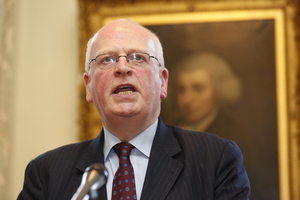
From top: Covid-19 Isolation and Step Down Facility in the Conference Centre at Citywest Hotel Dublin on March 29; Former Attorney General and ex-Minister for Justice Michael McDowell

This morning.

Via Michael McDowell in The Irish Times:

We haven’t really heard as to whether the HSE has increased the availability of intensive care capacity and secured additional supplies of ventilators and personal protective equipment.

Have they trained additional personnel in the meantime?

Is the emergency facility in Citywest still on stand-by?

Are the once-sequestered private hospitals still available on a contingency basis?

In other words, have we radically improved our hospital services so as to counter any second wave of Covid-19 or are our hospitals more or less still in the same position as they were in mid-March?

If not, why not?

Do the recent upticks in community transmissions really represent an existential threat to the HSE’s capacity to deal with the virus?

The fatality rate, the hospitalisation rate and the rate of admission of Covid-19 patients into intensive care do not, as of now, appear to be in crisis.

Meanwhile…

The pandemic cannot be blithely dismissed as a problem of the “capitalist system” or as a good opportunity to create a utopian different society – it is an economic crisis which challenges the poor, the middle class and the wealthy alike. But people are economically vulnerable as well as being vulnerable to infection.

Michael McDowell: Public will not endure another lockdown (Irish Times)

Rollingnews

Firm but fair?

Or breaking a butterfly on a wheel?

Only YOU can decide.

Meanwhile, the tweet may be referring to  report on August 26 from the US Centres for Disease Control (CDC) which stated only six per cent of people who died from COVID-19 did not have any other listed cause of death.

The New York Times reported:

The CDC data table is based on an analysis of death certificates that mention COVID-19 as a cause. For 6% of the deaths, COVID-19 was the only cause mentioned, the CDC notes.

The other 94% list COVID-19 and other conditions together. Among those deaths, there were, on average, 2.6 additional conditions or causes per death, the public health agency said.

…A death isn’t excluded from the COVID-19 tally just because the person was obese or had diabetes or dementia. Someone with heart problems can still be killed by COVID-19, and the death certificate could mention both as contributing.

FIGHT!

Earlier: What Am I To Do?

This morning.

Fintan O’Toole repeats what many have been saying since March.

Only the words are bigger.

Fintan O’Toole: Absence of Covid defences at Dublin Airport is startling (Irish Times)

Rollingnews

Last night.

Meanwhile…

 Minister for Health, Stephen Donnelly

This morning.

“I will be introducing legislation shortly which will add a table of penalties to the 1947 health Act, which essentially will allow for more appropriate measures: for example a €20, a €50 or €100 fine.”

“We would be looking, for example, with non-compliance on face covering wearings for example of having fines – it’s what other countries do.

“The current powers in Ireland, the 1947 Act, is unwieldy in this case”.

“We will be looking at bringing in a new schedule of fines, including for other compliance measures.

Minister for Health Stephen Donnelly.

Meanwhile…

Professor Philip Nolan, Chair of NPHET

Speaking on RTÉ’s Morning Ireland, Professor Philip Nolan, Chair of NPHET said limiting discretionary contacts over the winter is also necessary if we want to keep schools and workplaces open.

He was speaking after local restrictions put in place for Co Kildare in early August to combat a spike of coronavirus were lifted yesterday evening.

Prof Nolan said a national approach to limiting discretionary contacts “and not going wild and allowing the virus to transmit while we are socialising” is a better approach in the first instance than regional restrictions on movements.

County-wide lockdowns work and need to happen quickly – Nolan (RTÉ)

To recap:

You’re wearing your mask wrong.

Fines!

Stop socialising outside of work.

Rollingnews

A garda checkpoint on the M7 filter for Kildare Village in County Kildare

Rejoice.

This afternoon.

Thanks, Kildare.

Let’s not have this happen again.

We’ll speak no more of it.

Kildare Covid-19 restrictions lifted with immediate effect (RTÉ)

Rollingnews


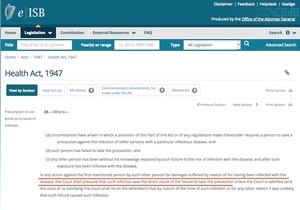
From top: Section 43 of the Health Act 1947; Barrister Tony McGillicuddy

Yesterday.

On RTÉ’s This Week.

Barrister Tony McGillicuddy spoke to Carol Coleman about gardai receiving powers to enter people’s homes.

It followed the Cabinet last Friday rejecting proposals for criminal penalties for people organising gatherings of more than six people but Tanaiste Leo Varadkar later saying a ‘civil offence’ may be introduced.

Carole Coleman: “Could you explain for us briefly what a civil offence is? And how it is investigated or prosecuted?”

Tony McGillicuddy: “Yeah, there is no such thing as a civil offence, Carole. It’s a contradiction in terms. I mean, under our Constitution and our laws, we have statute laws and then regulations which fill in the details of those and they can be enforced either through civil orders that are made in the courts or else by a criminal sanction if those provisions are made criminal law offences.

“So there’s two streams. And we have that at the moment with our regulations on, for instance, wearing a facemask in shops or shopping centres. So that is a provision. The power to make that order is in the Health Act 1947. The minister made the relevant regulations to make that a requirement of all persons. And if a person is in a shop today and they’re not wearing a facemask, a garda can approach that person and give them a direction that they must wear a facemask.

“If that person doesn’t wear a facemask after getting that direction from a garda, that is a criminal offence and the garda can arrest that person and can prosecute that person. So it’s the failure to comply with a direction of a garda to wear a facemask in a shop that would then be a criminal offence.”

Coleman: “They’re now planning to involve gardai in the house parties or the house gatherings. So what you’re saying is that it would become the law of the land but not a crime. What use would this be in say a flagrant breach of the house gathering rules?”

McGillicuddy: “Yeah, I mean, it is possible, that there could be a requirements set out in regulations or in a primary piece of statute law, whereby a person would be prohibited from having a gathering of six people in their household from three or more households. And they could then decide not to make it a criminal offence, they could just say it’s in statute, it’s in the law of the land and it doesn’t have any criminal sanction.

“I think the only thing that I can see that might have an importance at the present time is that there’s a very interesting provision in the Health Act 1947 which has not received public commentary up to now.

“It’s Section 43 of the act and that outlines that if a person, if there are requirements for a person to take certain precautions to avoid Covid or other infectious diseases, and if they don’t do so, and if a person then, in their household, becomes infected with Covid, that person who has attended, as an invitee at their house, could sue them for damages. And it would be presumed in law that they obtained the infection from attending at their house unless the householder can prove otherwise.

“So you could have a situation whereby the Government will say ‘well, we’re gonna make this the law of the land, we’re not going to impose a criminal sanction but if you invite more than six people into your house of a night and if one of them subsequently finds out that they have Covid, they could sue you for damages’. And it would be up to the householder to show that they hadn’t been infected at their house that night.

“And I think if members of the public knew that that presumption in law could act against them, in such a scenario, that might have its own coercive effect on people organising house gatherings.”

Coleman: “OK, well that’s very complicated and lots to be discussed there, barrister Tony McGillicuddy, thank you very much for joining us.”

Anyone?

Listen back in full here

RollingNews