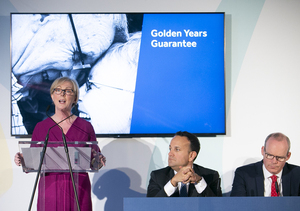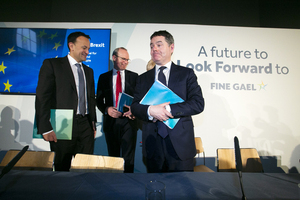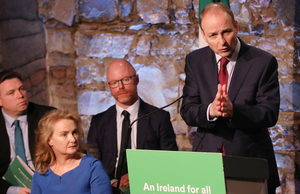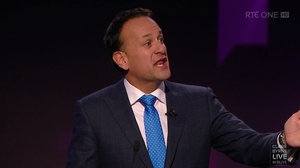


From top: Leaders’ debate panel; Leo Varadkar, Micheál Martin, Mary Lou McDonald, Eamon Ryan, Brendan Howlin, Roisin Shorthall and Richard Boyd Barrett
Last night.
Leaders’ debate on Claire Byrne Live on RTÉ One.
Anyone?
Meanwhile…
Claire Byrne: “Who is left enough for you then?
Richard Boyd Barrett: “Well I think people have to prove that they’re genuinely committed to left-wing principles and indeed the promises…”
Byrne: “Sinn Féin?”
Barrett: “…the promises that they make before an election. And my appeal would be to people who would see themselves on the left, is not to use the votes that they get in this election where, for the first time, in the history of the State, more than 50% of people are expressing a desire for a Government without Fianna Fáil and Fine Gael, not to take that vote to prop up one or other of those two parties who’ve dominated this state, for its entire history, a two-party state for its entire history.
“I believe there’s an appetite for change, not least because those two parties in recent years have left us with a bitter legacy of the worst ever housing crisis in the history of the State, a disastrous state in our health service, crucifing cost of living for huge numbers of people…”
Byrne: “You’re setting yourself up for a life on the opposition benches so it makes no odds what you say in your manifesto, of what you say to voters, cause you’re going to never going to be in a position to…”
Barrett: “I genuinely believe we could have a left Government and I actually think there is a growing, an unprecedented appetite for a left Government but I think you would throw away that opportunity, as was done by the Labour party the last time, which was a disaster for them electorally, apart from anything else, and indeed the Greens before them, almost destroyed themselves by going into coalition with Fianna Fáil.”
Later
Claire Byrne: “Are you happy with the Help to Buy scheme? Because I did read about it and I brought this in with me because it’s quite extraordinary.
“The Parliamentary Budget Office said 41 per cent of the people who use that scheme already had enough money for a 10 per cent deposit. These people didn’t need the scheme and could be seen as a deadweight loss?”
Leo Varadkar: “You could see it that way but, you know, I think it’s a good economic policy and a good social policy to help everyone to help buy their own home. And the biggest problem that people have now, or one of the biggest problems people have now is getting a deposit together.
“Now the Help to Buy scheme has already helped 15,000-16,000 people to buy their first home. We want to make it more generous so that you can get your tax back. It’s the income tax you paid for the past four years, you get it back up to 10 per cent of the value of the house or €30,000.
“That means people can get the deposit but that’s only any good to you if there’s a supply of new housing and actually that’s something that’s changing. It’s a change that I’ve led…”
Later
Richard Boyd Barrett: “First of all, if you want to solve the housing crisis, don’t do as both Fianna Fáil and the Greens, and then Fine Gael/Labour did, under Nama, is sell off €40billion or more worth of land and property assets to property speculators and vulture funds.”
Long applause.
Barrett: “Ok, that’s the first thing. Then…”
Claire: “Hang on a second, just, just, your manifesto says that council houses, everybody should be entitled to them?”
Barrett: “Absolutely. All across Europe, and Austria was mentioned, all across Europe the State builds public housing and whether you’re a doctor or a professor or whether you’re someone on very low income, you can apply for social housing and your rent will be set according to your ability to pay. And that removes the stigma around social housing that doesn’t exist in the rest of Europe.
“We have created a stigma around social housing because you have to be under what is now a very low income income threshold in order to be eligible for it. Another thing you could do is have the publicly owned banks not charging double the interest rates for people who want to buy their own home and take out a mortgage which is what’s happening in this county at the moment.
“Somebody who takes out a mortgage from banks that are owned by the State, and were bailed out by the State, are paying over the course of a 30-year mortgage about €56,000 more than they would by a European counterparts because basically the publicly owned banks are racketeering on the back of people who are trying to buy homes.”
Applause.
Later
Micheál Martin: “We need, urgently, to provide housing for people. We all know people who come into our clinics who are living with their parents in box rooms, with their kids. It’s overcrowded, people have ill health. It’s shocking. And they’re a no statistic but they’re essentially homeless.
“So what Fianna Fáil are saying is yes, it’s urgent, it has to start next year. And it has to be social housing and it has to be affordable and we have to commission local authorities to go out and do it.
“Do you know at this very moment, local authorities can’t build anything above €2million without getting permission from the Department of the Environment? A year ago, we said to Fine Gael, change that, give them the autonomy to go out there and start building significant housing projects without seeking…this is an emergency. This is urgent and it’s quite shocking…”
Claire Byrne: “But, but Micheál…”
Martin: “…sorry now…”
Byrne: “But there’s nobody here, there’s nobody here not saying that it’s not a…you know everyone seems to agree…”
Martin: “Four years ago, we were told the homeless problem would be solved, it’s gone up 60% now.”
Mary Lou McDonald: “But Micheál? Micheál Martin backed the Fine Gael government.”
Martin: “Hold on a second.”
McDonald: “Micheál Martin told us time and again that he had secured housing budgets.”
Martin: “No we didn’t…what we said was…”
McDonald: “But actually he had secured the resources.
Martin: “No we didn’t actually…”
McDonald: “So Micheál Martin now wishes to distance himself from the fiasco and the disaster of this Government’s housing policy and, yet, he was the co-author of it. And I think it’s important to say that out loud.”
Applause.
Later
Richard Boyd Barrett: “I fully understand why rural Ireland – which has been rundown and has seen post offices taken off it, bus services taken off it, is suffering from depopulation, and big and growing and regional imbalances – would want to hang on to their Garda stations.
“I personally do not believe that we can police our way out of the rising level of crime, violence, organised crime, and so on. I think if we could, the United State would have done it which is one of the most policed societies in the world where we actually have more people in prison, we have more organised crime, we have a bigger drug problem.
“So I don’t think that’s the answer. What I do…”
Claire Byrne: “Your colleague, Ruth Coppinger, said it’s ridiculous to blame people who take cocaine at the weekends for fuelling gangland violence.”
Barrett: “Yeah, I don’t think it’s about what individuals consume. Any more than whether anybody got drunk once or took anti-depressants explains the problems…”
Byrne: “But if there’s no market, there’s no gangland, surely?”
Barrett: “No. The problem is there is a demand, it’s a reality in our society. But we have driven it into the criminal underworld. And we’re criminalising a lot of our youth making the situation even worse. I think that’s counter-productive. I do think we need to look at models like the Portuguese model where decriminalisation has led to less drug-related deaths…”
Byrne: “But more gardai is not for you?”
Barrett: “And one other point Claire that’s terribly important and it was a big point emphasised I saw in Drogheda and it’s certainly the case in many parts of Dublin where these are real problems, is that the cuts to the Drugs Taskforce, the cuts to community development projects, to community and youth outreach workers have been a disaster in terms of failing…”
Micheál Martin: “Absolutely, absolutely…”
Applause.
FIGHT!
Watch back in full here
Previously: Applause For Thought (February 2016)