A passive aggressive defence of Joe Schmidt’s “kicking game” is the theme for RTÉ’s Jonathan Ryan-narrated promo ahead of Ireland versus Wales in Cardiff Arms Park Nua, Wales, today.
Mike Ross, Tommy Bowe, Jared Payne and Devin Toner (top) with Rose of Tralee, Maria Walsh (inside centre), at the all new Loopin terminal 1, Dublin Airport prior to their departure to Cardiff, Wales for their six nations match at the Cardiff Arms Park Nua.
It was the year the Hurricane blew away a young Stephen Hendry to win the Irish Masters Snooker Championship and Samuel Beckett passed away.
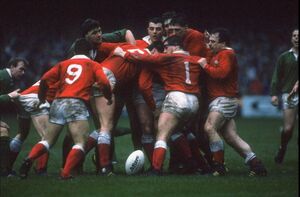
It was also the year a resurgent Ireland team traveled to the Cardiff Arms Park determined to banish the waning Welsh to a third successive defeat.
Noel Mannion’s block, clutch and gut-bursting carry paved the way.
Eileen Battersby wrote in the following Monday’s Irish Times:
Noel Mannion, grabbed the ball inside his own half and with the grace of a stampeding dray horse, showed the Welsh backs – and the rest of Wales – exactly how serious their rugby problems are when he scored 70 yards later.
“What have things come to when they can’t catch a number eight?”, asked the shaken Welshman in the sheepskin coat.
“The pay gap between men and women in Ireland has widened in recent years, with women earning 14.4 per cent less than men for their work, most recent figures show.”
“Data from Eurostat, the European Union’s official statistics body, reveal women earned almost a sixth less per hour than men in 2012, up from 12.6 per cent in 2008.”
Wee’ Barry McGuigan, Live Aid, and Optimus Prime dominated our thoughts.
When many young people were forced to roll up their sleeves. And go sockless. Such was the pernickety fashion of the time.
And Ireland’s second ‘Tripler’ of the ’80s was within kicking distance.
The earlier fixture, postponed by a flurry of snow, led to this Ireland team famously decamping to O’Donoghue’s of Merrion Row, Dublin for a session St George-busting strategical think tank and wedgies.
It worked.
Irish coach Mick Doyle (top sitting far right) said:
“The lads were plucky, they wanted to win and it showed in the last 15 minutes, particularly in the way they tried to avoid doing the the expected things…”
Meanwhile, in the following Monday’s irish Times.
Rugby sage Edmund Van Esbeck was beside himself.
The strife is done now and the battle won: the tumult and the shouting have died away, the carnival is over but the memories will linger on.
Illustrious players and memorable matches have graced Lansdowne Road turf for well over a century now, but the happenings at this aristocratic among rugby grounds last Saturday will be indelibly etched into the history of the game and the minds of all 50,000 people who saw Ireland beat England by 13 points to 10. The prize for that victory is the Triple Crown and International Championship…
Some of you think England are the next best side in the 6 Nations Championship after Ireland.
Some of you would even like to see England’s Mike Brown in green.
Alan Quinlan, commenting on the Ulster Bank rugby survey said:
Once again the Ulster Bank Rugby Survey has thrown up some very interesting results from fans across the country. Most interestingly for me is our backing of England in this year’s World Cup but no doubt that will be forgotten during this weekend’s contest
Shunned by the Oscars, myself and Alan Whelan have just launched our short(ish) film about Ireland and climate change.
Meanwhile, the New York Times reports:
“For years, politicians wanting to block legislation on climate change have bolstered their arguments by pointing to the work of a handful of scientists who claim that greenhouse gases pose little risk to humanity.
One of the names they invoke most often is Wei-Hock Soon, known as Willie, a scientist at the Harvard-Smithsonian Center for Astrophysics who claims that variations in the sun’s energy can largely explain recent global warming. He has often appeared on conservative news programs, testified before Congress and in state capitals, and starred at conferences of people who deny the risks of global warming.
But newly released documents show the extent to which Dr. Soon’s work has been tied to funding he received from corporate interests.
He has accepted more than $1.2 million in money from the fossil-fuel industry over the last decade while failing to disclose that conflict of interest in most of his scientific papers. At least 11 papers he has published since 2008 omitted such a disclosure, and in at least eight of those cases, he appears to have violated ethical guidelines of the journals that published his work.