
On RTE Six One and TV3 5.30 news about what #snowden would face in the Irish asylum process
— Irish Refugee Counci (@IrishRefugeeCo) July 2, 2013
Related: Edward Snowden, Asylum and Ireland (Human Rights In Ireland)



On RTE Six One and TV3 5.30 news about what #snowden would face in the Irish asylum process
— Irish Refugee Counci (@IrishRefugeeCo) July 2, 2013
Related: Edward Snowden, Asylum and Ireland (Human Rights In Ireland)

The closing moments of an encounter between an irish woman and two men, both black, Waterford last night.
Man 1: “It’s nothing got to do with you?”
Woman: “I didn’t raise this.”
Man 2: “I did, I did.”
Woman: “All apes come from Africa.”
Man 2: “All the monkeys and shit, you know.”
Woman: “Yes, all monkeys are, right, you should be in the trees actually.”
Man 1: “You’re awful.”
Man 2: “Yeah?”
Woman: “Swinging out of the trees.”
Man 1: “Go away.”
Woman: “You’re not…you’re uncivilised, you are. And do you know I spent six months, sorry…”
Man 1: “No, I’m not talking to you.”
Woman: “I spent six months in America, right, and most, the most crime that, in America, is committed by African Americans.”
{Inaudible}
Woman: “He knows that.”
Man 1: “Everyone is different.”
Woman: “No, the most crime in America is committed by African Americans.”
Man 2: “Let’s go. Bye, nice talking to you.”
Woman: “I know that you’re walking away from…”
Geoff writes:
The lads were sitting outside a chipper when this woman came over and started to verbally abuse them. The language is horrific. I’m absolutely disgusted that people still hold views like this. Her views are not welcome in this country.
 It wasn’t all fun.
Sibling of Daedalus writes:
Following on from the post about the funeral bouncy castle in Galway, this may be a continuation of the old Wake Games, very popular in the west, back in the day (1880s).
The games reflected the dark side of the Irish psyche, and included ‘The Slipper’ (smacking someone on the hand very hard with a wet piece of cord), ‘Getting a Trade’ (impersonating an employer abusing an apprentice) and ‘The Purchase of the Sheep’ (role-playing sheep having their wool pulled out by a prospective buyer). Then there was bachelor-shaming game, The Silly Old Man:
An early demonstration of Ireland’s refusal to let single people rest in peace.
Source The Funeral Customs of Ireland (pages 280-281)
Pic: National Library of Ireland
Thank you @EamonGilmore for great job. Time to take over #EU Presidency. Difficult task, nice bell pic.twitter.com/m0fUKtCHRD
— Linas Linkevicius (@LinkeviciusL) June 25, 2013


But not in Ireland.
Having opted out of the revised laws governing the Common European Asylum System and not signed the Receptions Condition Directive.
This is because signing it would mean Ireland would have to allow asylum seekers work after a certain period of time, should they still be waiting on a decision on their application.
And, as Justice Minister Alan Shatter said, we can’t be having that.
Ireland Will Not Benefit From EU Migration Law Advancements (Brophy Solicitors)
Previously: Shutting Out The Asylum Seekers

But one comes away from the document feeling that there is much more that could be said about what Apple is up to in Cork.
Take, for example, this Catch 22, offered baldly as a statement of fact:
“AOI is incorporated in Ireland and based in Cork; thus, under US law, it is not tax resident in the US. AOI is also not tax resident in Ireland because it does not meet the fact-specific residency requirements of Irish law.”
Dublin rejects Apple tax avoidance claims, (Jamie Smyth, Financial Times)
Previously: Anything Good Behind The FT Paywall?
Pic: T-Shock

History professor Cara Delay, from College of Charleston in South Carolina, above, has discovered evidence of approximately 120 criminal trial cases involving abortion, on the island of Ireland, from 1900 to 1970.
These were prosecutions under the 1861 Offences Against the Person Act, which continues to be the basis for Ireland’s current ban on abortion.
She obtained information about the cases from the National Archives in Dublin and the Public Record Office of Northern Ireland (PRONI) in Belfast and looked at this area because she has found there has been no academic investigation carried out in relation to abortion in Ireland before 1967, when abortion was decriminalised in Britain.
Professor Delay gave a lecture on her preliminary research in UCD recently and her findings include details of the different types of women who sought abortions, mainly as a last resort; what steps they took to terminate their pregnancy before seeking abortions; the different approaches taken by married women and single women towards termination; and the way in which women obtained information about abortions.
She found that almost half of the women who attempted abortion from 1900 to 1970 were married, almost all of whom already had children. Eighty per cent of the women who were charged with infanticide were single, and almost all of those who were prosecuted were found not guilty – despite evidence to the contrary, including cases where women even admitted the charges. This was especially the case in the North.
From her lecture:
The cases.
The cases involved charges of abortion, conspiracy to commit abortion, attempting suicide, blackmail, and charges of murder or manslaughter, when the woman seeking abortion died. The cases involved women from all walks of life.
A blackmail case in Dublin, in 1965, involved a 40-year-old housewife who demanded £100 from a Mrs X, after she threatened to reveal that Mrs X had had a backstreet abortion in 1940.
One case, in 1944, involved a woman called Kerry who was called to testify in a trial against the man who helped her terminate her pregnancy. She was very reluctant to discuss her reproductive history and was even hostile in court. When the prosecutor asked Kerry “As a result of your associations with this man, did you find yourself in any particular condition at the end of November, 1944?” Kerry said nothing. He tried again and said: “Do you understand my question?” but was again met with silence. At that point, the judge stepped in and enquired if Kerry had any difficulty in describing her condition. Reluctantly, finally, Kerry replied that she had “missed a period”. After Kerry resisted several more attempts to question her, the judge dismissed from the courtroom all the young men who were not vital to the case, to make it easier for her to speak.
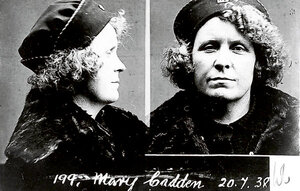
Married mother-of-six Helen O, who died in 1956, after having an abortion (from infamous abortionist Mamie Cadden) was 34.
Irene A was 26 and a student who had a self-induced abortion in 1965.
Margaret M was a 25-year-old single woman who lived in Dublin but received a surgical abortion in London was having an affair with her married employer.
In 1948, a woman who pleaded guilty to giving abortions to at least eight women in Co. Laois had among her clients a teenage girl, still living with her parents, and a married mother-of-two.
In 1948, Wilhelmina, aged 40 and a wife and mother, sought an abortion when she became pregnant with her 6th child.
In 1942, a 28-year-old woman in Tipperary, who had been married for 8 years, died while attempting to put an end to her 9th pregnancy.
How people came to be charged
Abortion in early 20th century Ireland almost always went unnoticed and attempts came to the attention of the Gardaí in a number of ways. First, if a woman obtained an illegal abortion and then suffered a haemorrhage or got sick, and thus needed a doctor to come to her house or had to go to hospital, a Garda would normally be notified in that process.
Secondly, some doctors who would have been approached by women seeking abortion, and refused to help them, notified the Gardaí.
Thirdly, neighbours or relatives could inform Gardaí. But this was very rare. It was more common that neighbours and family gathered together to hide the abortion from the authorities.
Also, an abortionist who was caught would get a lighter sentence if they informed the Gardaí of other abortionists. This happened in a series of sensational cases in Dublin in the 1940s, in which an entire underground abortion network was dismantled when one abortionist was caught.
Illegal Abortion and irish historians
Prof Delay finds that the sexual and reproductive lives of married women in Ireland has remained something of a mystery. She asserts that even though Ireland boasted the highest marital fertility rates of Europe by the 1930s, we still know very little about the reproductive lives of married Irish women.
She acknowledges that there are no reliable statistics about the number of women who obtained or tried to obtain illegal abortions up until 1967, after which most Irish women were travelling to Britain, thus making the study of the area extremely difficult.
However, she asserts that many historians have seen abortion as unpalatable, dangerous, ethically disturbing or, even, a foolish family planning option. Some scholars in the past have described abortions as ‘careless gambles’ that women took at ‘the spur of the moment’ and thus not conducive to historical analyses.
She also finds, in the study of women’s sexuality in 20th century Ireland, historians have focused mainly on single women, reflecting the State and Catholic Church’s concerns, especially in the 1920s and 1930s about what they considered the problem of unmarried women’s sexuality – namely “illegitimacy, unmarried mothers, the apparent spread of venereal diseases, prostitution, levels of sexual crime, deviancy, and the dangers of sociability, particularly in dancehalls and the motor car”.
Prof Delay also asserts that, even though scholars have overlooked the topic, there is a place for Irish abortionists in popular culture – particularly nurse and midwife Mamie Cadden, top, who was sentenced to death in Dublin, in 1956, after one of her clients (Helen O) died, following an illegal abortion.
Delay describes most of what has been written about Cadden, whom has been the subject of TV documentaries and crime books, as ‘uncritical’, saying: “The depiction of Mamie Cadden in Irish popular culture reveals a fascination with her appearance and reported glamour”.
She recalls how Ray Kavanagh has written a biography of her in which he repeatedly talked about her “massive, dyed blonde hair” and “flashy red sports car”, while David Kiely’s book on Irish female killers, entitles his chapter on Cadden ‘The Blonde Midwife From Hell’.
Prof Delay explains that Kavanagh depicts Cadden as a one-dimensional, plucky feminist crusader, intent only on helping women, who was subject to an unfortunate witch hunt at the hands of the puritanical Catholic state.
On the other hand, Prof Delay recalls the work of historian Diarmuid Ferriter, who wrote a little about Mamie Cadden in his book Occasions of Sin, in which he almost dismissed her as an “incompetent abortionist presiding over botched operations”.
Prof Delay concludes these depictions of Mamie Cadden demonstrate the way in which authors construct an image of abortionists as either heroes or villians. However, she says, in reality, their lives were much more nuanced.
Ultimately, Prof Delay concludes that the research on abortion before 1967 focuses on the work of the abortionist and not on the women seeking abortion. But she concedes that this is because of a lack of statistics on the number of women who sought and obtained illegal abortions.
Married women: Abortions; Single women: Infanticide
Although she has not completed her research, Prof Delay believes she has already detected a pattern and found that married women tended to seek abortions while single women tended to carry out infanticide.
She asserts this is because single women had fewer options than married women i.e. finance, committed partners, access to abortion networks, and the time the abortion was required.
Abortions were rarely, if ever, a woman’s first choice
Prof Delay has found that backstreet abortions were almost never a woman’s first choice. Several women who did eventually become pregnant had tried ‘methods of contraception’ with their partner to try and prevent her from becoming pregnant. The Irish abortion trial records are very silent on the use of contraception, which was illegal in Ireland form 1935 to 1980.
In fact, Prof Delay has just found one case where it’s mentioned explicitly. It involved a man, who was a student at Trinity College Dublin. He said he got contraception from a friend through some kind of network that went from Belfast to Trinity, whereby students were supplied with contraception.
So if no contraception was used or methods were tried but failed, what was the next step?
In almost all of the cases that ended up in court, a self-induced miscarriage, sometimes alone and sometimes with the support of knowledge of relatives or friends, was attempted. Women tried to induce themselves through ‘folk methods’, which included physical harm and hot baths.
From oral histories, some women believed that if they had baths or drank gin they could ‘do away with the baby’. Or if they could jump from a chair, instead of stepping down, they would lose the baby. One woman reported how her mother tried to have a termination by eating washing soda.
Prof Delay explains that these methods were not novel or unique to Ireland. They had been used for generations.
One woman, Sheila D, in 1950 in Dublin, who was later tried for a surgical abortion, first tried gin and hot baths, while her lover had told her to try very high jumps.
When physical harm or folk methods didn’t work, women turned to drugs. These would include swallowing Epsom salts, disinfectants, Dettol, Jeyes Fluid and laxatives.
She says ‘traditional abortifacients’ included quinine, Pennyroyal and Ergot, and were obtained through chemists. (Helen O had taken quinine tablets before going to Cadden).
Cases involved a Donegal woman, in 1932, was charged after she attempted to miscarriage by taking “six pills, the nature of which is unknown, two Beechams pills and a bottle of Castor Oil”.
A case from Monaghan in the Coroner’s Book, in 1962, discusses the death of Rose who died after she consumed large amounts of Savan and Juniper to induce miscarriage. According to the coroner’s remarks, Rose’s sister admitted that Rose had taken drugs to terminate a pregnancy six years earlier and was successful in that attempt.
Lastly, women turned to surgical abortions.
So How Did Women get information about abortion?
Prof Delay says word of mouth was the main method of communication about abortion but there was a lot of advertising for ‘female pills’ in Ireland at this time, even though they were outlawed.
 Irish Times 1881
She notes in the Irish Times, in the late 19th Century and early 20th Century, it featured advertisements of Pennyroyal pills. These advertisements eventually became evidence in certain trials.
Dr Hooper’s Female Pills, which were created in Britain in 1743, were advertised every month in the late 1920s and early 1930s, in the Irish Chemist And Drugist magazine.They were described as ‘the best medicine ever prescribed for young women when afflicted with irregularities’.
Beecham’s Pills, a cure-all for everything, including wind and stomach pain in the stomach, were advertised as being the answer to: “Restoring females to complete health. They promptly remove any obstruction or irregularity of the system”.
However, when abortificiants failed, women then sought more invasive methods.
In rural areas women asked a family friend or local nurse while in Dublin there were ‘professional abortionists’ with ‘thriving practices’.
The dangerous methods included syringing a woman with soapy water and disinfectant, or opening the womb with an instrument such as a knitting needle.
Prof Delay found evidence of a trial of a Co.Laois abortionist, where one woman testified that she received two abortions from the woman: one for a pregnancy two months along and one for an advanced pregnancy, at 8 months. Such evidence indicates that the line between abortion and infanticide was very, very blurry.
In her research, Prof Delay has also come across some letters.
She found a 1944 letter from a single woman, called Carmel, who had an abortion. She had been seeing a man Denis for a few weeks. One of the letters she wrote to him:
“Dear Denis,
As I’ve been feeling desperately ill all week, I’ve been wondering whether it would be possible to give the operation done next Sunday afternoon. I have had to knock off work three times this week and of course there are questions being asked. I have been taking very strong doses of Ergot and this has left me very week, as I was warned it would do. And standing eight hours a day doesn’t improve matters. Please don’t think I am complaining after all, I haven’t done so up until now. But, frankly, I’m in dread of losing this job. Anyhow I will keep the appointment on Sunday morning at 11 for an X-Ray. I’ll fall in with any suggestion you make.”
Carmel had a surgical abortion but ended up in Holles St as an emergency case and, a few months later, wrote another letter to Denis:
“Dear Denis,
You’ll be relieved I’m …that everything is successful over, with no apparent ill effects. I ended up as an emergency case in Holles St hospital! These last four months have been like a horrible nightmare. I cannot tell you how relieved and happy I am to know that the worry and sickness is at an end. The operations were naturally painful and an horrific source of strain. However, that was my side of it and I would like to think I faced up to it as decently as you did to yours. Very many thanks for you help, Denis. Good luck and good wishes.
Carmel.”
In almost all of the correspondence Delay has studied, women portrayed abortion as their sole responsibility.
In her research, Prof Delay also finds that the networks, in which women sought help, were almost exclusively female.
She recounts one case from 1940, where an 18-year-old woman Nell turned to her grandmother for help after she found out she was four months’ pregnant. Nell’s grandmother told Nell’s mother, Mary. Mary turned to her two best friends, Margaret and Emily. The three women attempt an abortion on Nell, using soap and water, on Mary’s kitchen floor. The procedure went horribly wrong and Nell died. While she lay dying, likely from an embolism, Margaret and Emily ran down the road and knocked on the door of a retired maternity nurse, who lived two doors down. The nurse told them to get another nurse, who lived five streets away. The second nurse arrived and said ‘get the doctor’. The doctor came and said ‘call the guards’.
Illegal abortions now.
Prof Delay says that more and more women are turning to abortifacients and home-based self-induced abortions. She recalls how in 2009, the Irish Medicines Board confiscated over 1,200 abortion pills that were being bought online and imported into Ireland. She also recalls how Choice Ireland has argued that now there is an ‘abortion pill black market’ that’s thriving in today’s economic crisis, as it’s cheaper for women to buy pills on the internet than travel to Britain.
Prof Delay is on a Fulbright scholarship in UCD to conduct her current research on her project Desolate Journeys: Reproduction and Motherhood in Ireland, 1950-2000. Essentially she will be investigating Irish women’s experiences of reproduction, contraception, abortion and motherhood in late 20th Century Ireland.
Listen to her lecture ‘Noxious Things’: Illegal Abortion Cases in 20th-Century Ireland here.
Thanks Mick Liffey

 “Mash potato!”
“It’s on the dance floor…”
“Sure, I don’t drive that far for my holidays…”
If these phrases have special meaning in your life you may know that Carton House in County Kildare (above) is home to the Montegomerie Golf Course and the O’Meara Golf Course.
AND that they will be hosting the Irish Open 2013 on June 27-30.
To celebrate, the Carton House’s public relations people have offered us one, yes one FOUR-ball to give away.
That’s YOU and three friends/relatives/etc. walking in the footsteps of golfing legends and others who have played the course, the ground staff and whatnot.
To enter just complete this sentence.
My three fellow ‘ballers would include {insert names] because________
Lines close at 4.45pm
No cash, favours, green fees, etc. were given for this post but….
Sarah from Insight wishes to add:
Carton House has hosted some of the world’s finest golfers at the 2005 and 2006 Irish Opens. Carton House is home to two magnificent golf courses The Montgomerie Golf Course and the O’Meara Golf Course.
The Montgomerie Course, designed by 7 times European Order of Merit winner Colin Montgomerie, will be the 2013 Irish Open course, hosting some of the world’s finest golfers. The ‘Monty’ is a 7300-yard “links style” journey across sweeping firm fairways, cavernous bunkers and impeccable greens.”
So there.

“Meanwhile, Ireland, already an attractive destination for multinational companies, is making it even easier for them to avoid taxes.”
“Last year, for example, Irish revenue authorities agreed to let Google make billions of dollars in royalty payments directly to a Bermuda subsidiary, helping to cut the company’s tax bill by at least $2 billion a year, according to U.S. and overseas securities filings. Previously, Google had routed those payments through a shell company in the Netherlands to avoid a 20 percent Irish withholding tax on payments destined for island havens. According to a person with knowledge of the arrangement, Ireland agreed to accept an additional tax well below 20 percent in exchange for the favorable treatment.“
Jesse Drucker on Bloomberg.
Europe Eases Corporate Tax Dodge as Worker Burdens Rise (Bloomberg)
Previously: Anything Good Behind The FT Paywall?
How Google’s Double Irish Tax Scheme Works
Mark Stedman/Photocall Ireland

Restaurants Association of Ireland spokesman Neven Maguire championing the benefits of keeping that 9% VAT rate.
The #KeepVat9 campaign is being launched this morning.
RAI Chief Executive, Adrian Cummins sez:
“VAT at 9% has had a positive effect on all aspects of the restaurant sector specifically, but also the wider tourist industry generally. This is why the RAI fervently believes it would be foolhardy to get rid of it. Reducing VAT to this level is a real success story so the RAI is sending a clear message to Government saying Keep VAT at 9%”
YOU decide.
