Tag Archives: Mick Wallace

Screen Shot 2015-07-02 at 12.25.34

https://www.youtube.com/watch?v=KqJGjf2Oi58

Independent TD Mick Wallace in Dáil this morning

Independent TD Mick Wallace raised concerns about Nama during Leader’s Questions in the Dáil earlier today.

“The Northern Ireland loan portfolio, Project Eagle, involving over 850 properties with a par value of €4.5billion, was sold to US private equity firm, Cerberus Capital, for less than €1.5billion – a surprise winner of the tender. Tánaiste, in June 2012, following consultation with Minister for Finance, Michael Noonan and Mr Sammy Wilson, MLA, Nama reappointed Mr Frank Cushnahan and Mr Brian Rowntree to the [Nama] Northern Ireland Advisory Committee.”

“A few weeks later, a report by a Northern Ireland auditor’s office seriously questioned the stewardship of the Northern Ireland housing executive which led to the resignation of Brian Rowntree and Frank Cushnahan.

The report found breaches of a housing executive’s guidelines, in the sale of at least 27 land deals, executive board given wrong or no information relating to key property deals, favoured property speculators were allowed to buy land well under market value. Interest from other parties were not declared or considered and, at times, no reasons offered for some off market sales. Tanaiste, these two individuals stayed in Nama – one of them up until the summer of 2014…..

Later, Mr Wallace spoke again – before his microphone was turned off by the Ceann Comhairle Sean Barrett.

Wallace: “The legal firm acting for Cerebus Capital, who actually purchased the Northern Ireland loan portfolio for €1.5billion was Tughans, of Belfast. Now it’s been reported that during a routine audit of Tughans…”

Sean Barrett: “Sorry this is not an inquisition. This is Leader’s Questions. Would you put a question? You’re out of your time.”

Wallace: “It’s reported Tánaiste…”

Barrett: “You can’t use the chamber to make cases against people who are not here to defend themselves and you know the regulations as well as I do and you’ve been reminded often enough. Now please stick to the Standing Orders or else I’ll have to cut you off. As your question.”

Wallace: “Ok. Ceann Comhairle we’re talking about billions of taxpayers’ money…”

Barrett: “This is not, there are other places to make these charges but not in the House here where people are not here to defend themselves. I don’t know anything about these people but there’s a rule and I have to apply the rules now please adhere to them.”

Wallace: “I’m not telling anything that’s…”

Barrett: “I’m just asking you to adhere by the rules of the House. If you wish the rules to change, bring them to the Committee of Procedure and Privileges. Now would you please put your question to the Tánaiste.”

Wallace: “Tanaiste, do you have any concerns that a routine audit of the solicitors’ firm that looked after  that particular deal, where €4.5billion of assets were sold for €1.5billion with a massive loss for the Irish taxpayer, a routine audit actually showed up where €7million in Sterling ended up in an Isle of Man…”

Barrett: “Deputy Wallace.”

Wallace:It was reportedly earmarked for a Northern Ireland politician or party…”

Barrett: “Would Deputy Wallace give all those details to An Garda Síochána? That is what it is there for.”

[Microphone  turned off]

Readers may wish to recall how, a few weeks ago, Independent TD Mick Wallace raised concerns about Nama in the Dáil.

On June 16, Mr Wallace told the Dáil:

“When NAMA was set up, the plan was that it would not flood the market with stressed assets. This was a special purpose vehicle that would await some form of recovery before maximising the assets in the interests of the taxpayer. That is not what has happened. For some strange reason, NAMA has been in a hurry to fire sale assets for less than their real value despite the fact it is a rising market.”

“…I will give two examples. An office block on Mount Street was sold off market in 2012 by NAMA to US fund Northwood for €27 million. In 2014, Northwood sold it for €42 million. Most of the money was financed by NAMA in the first place. This is in a country where small and medium-sized businesses cannot get a cent out of financial institutions. NAMA sold the Forum building in the IFSC in 2012 to US private equity firm Atlas Capital for €28 million. Less than two years later, it was sold for €37.8 million, a 35% profit. If the Taoiseach thinks this is good business, I think otherwise.”

Screen Shot 2015-01-29 at 10.42.23

https://www.youtube.com/watch?v=iXOyuYLFaBU

Yesterday, during Leaders’ Questions, Independent TD Mick Wallace asked Taoiseach Enda Kenny about certain matters relating to the gardaí.

On two occasions, Mr Wallace asked Mr Kenny when he was made aware of Garda malpractice in Athlone and what he did about it when he became aware of it.

Mr Kenny said he wasn’t sure what Mr Wallace was talking about.

Mick Wallace: “Much talk of police reform has not materialised. The Guerin report was published in May 2014, nine months ago, but only now is a commission of investigation being established. Its terms are too narrow and it will go through the Houses without debate. Will it even be completed before the next election? Will the Fennelly commission be completed before the next election or will it be kicked down the road? When will the report on the independent review mechanism be published? In July, the Minister stated the majority of cases would be reviewed within 12 weeks. That was a long time ago. The independent Garda authority was supposed to be up and running by the end of 2014. We have not even seen the first draft of legislation. The Garda Inspectorate’s report into serious crime, published on 11 November, has not even been discussed here yet. Debate has been stifled on policing issues. Since 11 November we have tabled 16 Topical Issue matters on policing matters but none of them has been taken.”

“The latest penalty points fiasco has reinforced the fact that indiscipline is rampant in the senior ranks of the Garda. As Maurice McCabe stated at the weekend, the penalty points system is broken and the Government is putting sticking plasters on it. There is no law and order with regard to senior management. There are no sanctions when they break the rules. This is not just about penalty points. If this is how the law is applied to the penalty points system, how is it applied when it comes to charging someone, arresting someone, and taking someone’s complaint seriously? The Garda Inspectorate’s report went to great lengths to point out the Garda widely ignores its own policy. Indiscipline is rampant. What is the Government doing about it?”

“In light of all this indiscipline and given that investigations into allegations of very serious wrongdoing, including Garda involvement in the drug trade, are ongoing in a number of Garda divisions, will the Taoiseach give us an assurance that the promotions and movement of senior gardaí will not include gardaí from these districts before investigations are complete? Will the Taoiseach confirm or deny whether Inspector John McDonald, who is in charge of the fixed charge processing unit in Thurles and who has been responsible for multiple terminations at a huge cost to the State, has been placed on a promotions list?

Deputies: Out of order.

An Leas-Cheann Comhairle Michael Kitt: “Please, Deputy, do not name these people.”

Wallace: “I would like the Taoiseach to listen carefully to my next question. Will he tell the House when he personally was first made aware of very serious Garda malpractice in the Athlone area, and what action did he take?

Durkan: “Out of order.”

Kenny: “I cannot answer all of the questions Deputy Wallace has raised. Am I to understand he is naming people who have been recommended for promotion, whom he alleges have been involved in criminal activities?”

Frances Fitzgerald: “Is that what he is saying?”

Kenny: “That is the import of what he is saying.”

Wallace: “I am asking—–”

Kitt: “The Taoiseach has the floor.”

Kenny: “If I understand what Deputy Wallace is saying, people involved in criminal activity are being nominated for promotion. Am I to understand that is what he is saying?”

Wallace: “If the Taoiseach checks the record that is not what I said.”

Kenny: “What did you say?”

Wallace: “I asked whether the person responsible for the fixed charge notice system in Thurles, who has been responsible for multiple terminations, is on a promotions list.”

Durkan: “You named the person.”

Kenny: “I do not have any information about who is or is not on a promotion list. I am glad the Deputy clarified the comment that he made.”

Wallace: “The Taoiseach can check the record later.”

Kenny: “The Deputy raised a number of issues. The Guerin report will follow the inquiry that the Government has agreed to set up. That will be set in place after today. The Fennelly inquiry is under way. The sole member wrote to me looking for an extension of time until the end of this year, and I have granted that. I support, if possible, the production by the inquiry of earlier reports in respect of a number of specific matters.”

“The review commission received 307 cases, some of which go back 30 years, and the vast majority of those have been examined by the panel of senior counsel and junior counsel appointed to review those cases. I assume that when they have completed their work they will bring that to the attention of the Minister for Justice and Equality very quickly.”

“I understand that the changes that have been made in respect of fixed penalty notice are significant and that there are now three senior personnel who are entitled and authorised to relieve penalty charges where they might be applied for whatever particular reasons. Yesterday the Government appointed a judge to oversee that practice, to give it further transparency and accountability.”

“Regarding the issues that I have missed in the Deputy’s long list…”

Fitzgerald: “The Garda authority legislation.”

Kenny: “When is that due to be ready?

Fitzgerald: “It is due shortly.”

Micheál Martin: “The Garda authority is due in here very shortly.”

Wallace: “The abuse of the penalty points system was so endemic that independent bodies have had to be created to keep an eye on things. The Taoiseach is not accepting the fact that there is massive indiscipline in the senior ranks of the force. Can he explain why there has been so little opportunity to debate policing matters since last summer? Can he also explain why the Government has no appetite for depoliticising policing in Ireland, despite the recommendations of the likes of Professor Dermot Walsh? Anyone who read Conor Brady’s book over Christmas would have noted that the politicisation of policing in Ireland has gone on since the 1950s at a really bad level, and that is part of the huge problem we are facing. Until the Government decides to depoliticise it and we have an independent police authority that acts as a buffer between the Government of the day and the police force, we will continue to have these problems. The former Minister, Deputy Shatter, would still be in power and would still have his job if there had not been such a flawed system, and the Government is not correcting it.”

I remind the Taoiseach of my last question to him, which he did not answer. I asked if he could tell the House when he was first made personally aware of very serious Garda malpractice in the Athlone area and what action he took.”

Kenny: “I am not clear on what the Deputy is talking about in respect of the Athlone area. He will have to give me further detail on that, and if he wishes to do so, he can give me it me after the completion of the Order of Business.”

Mattie McGrath: “Somebody might have picked it up.”

A Deputy: “What about you, Mattie?”

Kenny: “In respect of the independent policing authority, this is the most radical shake-up in the justice system since the foundation of the State. The appointment of the Garda Commissioner was subject to open competition and was a completely independent system for making that recommendation for appointment by Government. All promotions of senior personnel are done by a panel for which completely independent people apply. It is not a politicised system any more because the situation is completely independent, and there has been the most radical shake-up since the foundation of the State.”

“Out of 400,000 penalty points issued every year, about 2.9% are quashed, in accordance with the system that applies, where that is valid. There are only three people who can now quash penalty points. Since the new system was introduced, only seven cases have been referred for further analysis under this new system. In anybody’s language there has been a serious shake-up, and it has been for the better in terms of accountancy, accountability and transparency in a system that is very important for people.”

Previously: The Wrong Side Of The Thin Blue Line

Meanwhile In The Dáil

Related: Claims Shatter ‘muzzled’ Garda inquiry debate (Juno McEnroe, Irish Examiner)

Garda over penalty point office in line for promotion (Philip Ryan, Irish Independent)

Transcript via Oireachtas.ie

90368194

Mick ‘Grizzly’ Wallace on Kildare Street, Dublin this morning.

Prickly to the touch.

(Mark Stedman/Photocall Ireland)

90368267

Leo Varadkar at the National Concert Hall, Dublin this afternoon.

Sale on at Reiss.

(Sam Boal/Photocall Ireland)

90368242-1

President Higgins in hemp suit and new Ambassador of Canada Kevin Vickers at Phoenix Park, Dublin this afternoon.

Shillelagh, shamrock-festooned hat and large buckle (out of picture).

(Sasko Lazarov/Photocall Ireland)

CallinSHatWallAlan Shatter (left) and Mick Wallace on Prime Time

Independent TD Mick Wallace appeared on RTÉ’s Prime Time on May 16, 2013, to talk about the penalty points report and the appearance of former Garda Commissioner Martin Callinan at a Public Accounts Committee meeting earlier that day.

During their discussion with presenter, Pat Kenny, Mr Shatter accused Mr Wallace of having been stopped while driving by the gardaí in May 2012 and claimed he benefited from garda discretion.

The Data Protection Commissioner subsequently found Mr Shatter broke the law by disclosing personal information about Mr Wallace on the show.

Mr Shatter’s appeal of this ruling was dismissed this morning.

Mr Wallace said he felt that decision was a good one but that he does expect the former minister to challenge it because “he doesn’t like hearing no, so more than likely it will end up in the High Court,” he said.
He said that when the appeal was on, he had noticed that Mr Shatter’s legal team had been at pains to stress that the former minister had been damaged personally, politically and financially, by the Data Protection Commissioner’s decision, and he was eager that it be overturned for fear that Mr Shatter could be pursued for damages.
Mr Wallace said that if the Judge [Judge Jacqueline Linnane] had found against the Data Protection Commissioner this morning, it would have weakened his (Mr Wallace’s) position in pursuing the matter any further.
However, he said that the statement from Judge Linnane was very strong and he will be taking legal advice now to see how to progress from here but that he is considering pursuing the former minister for damages.

Shatter loses appeal over data breach (RTÉ)

renditionScreen Shot 2014-12-18 at 00.24.01

Yesterday, during Leaders’ Questions, Independent TD Mick Wallace raised concerns about the US military’s use of Shannon Airport in light of the recent CIA torture report.

During his exchange with Taoiseach Enda Kenny, Mr Wallace said a former US marine will come forward with information in the New Year.

Mick Wallace: “Although there is always much talk about transparency here, as under the previous Government, secrecy seems to be the order of the day. Last week, I asked the Taoiseach about surveillance being carried out by the British Government’s communications headquarters, GCHQ, on cables in the Irish Sea. I asked whether the Government had sanctioned it; if so, under what legislation; and if not, what it will do to protect citizens’ rights. The recent report on torture by the CIA also involves much secrecy around Shannon Airport. The US Senate’s report on the CIA’s use of torture has made little of American assurances that military aircraft passing through Shannon Airport do not carry military arms. The dogs in the street know they do.
Given the extent of the report, it is pretty clear that Shannon Airport has been used for rendition flights as part of the torture programme. Normally, when talking about something that happened on Fianna Fáil’s watch, as this did, the Government is jumping up and down to kick Fianna Fáil around. I am surprised the Government is not seeking to investigate this. Given all the information that has come our way regarding Shannon Airport, rendition flights and the CIA torture programme, does the Taoiseach not think it is time we had a full investigation into everything that has happened in Shannon Airport since 9/11?”

Pat Breen: “Where is the evidence?”

Joe Carey: “There is no evidence.”

Pat Breen: “The Deputy tried his investigation when he jumped the fence.”

Niall Collins: “The Deputies opposite are very quiet. Do they not represent Shannon at all over there?”

Joe Carey: “The Deputy should stay off the runway.”

Ceann Comhairle Seán Barrett: “Quiet please.”

Enda Kenny: “The Ministers for Justice and Equality and Foreign Affairs and Trade have been in touch constantly with the authorities from the United States in respect of rendition. Deputy Wallace will appreciate that this matter has been the subject of discussion in this House many times in recent years. I am unsure as to the kind of full investigation he is talking about. Clearly, the relationship between the United States and this country, no more than many other countries, deals with those issues. If the Deputy is suggesting the Government is not being told the truth about every flight that goes through Shannon, I would like to hear some evidence of the Deputy’s proof of this. He states that every flight was carrying arms and weapons.”

Wallace: “I did not say they all were.”

Richard Boyd Barrett: “He said “some””.

Kenny: “The Deputy might explain to me what sort of investigation he is talking about, because there have been claims about this in the House on many occasions previously. They all were investigated and down-to-earth—–”

A Deputy: “Like HIQA.”

Kenny: “—-and all of them were discussed in the House in respect of the truth of the matter and transparency.”

A Deputy: “The Taoiseach means the Government asked the Americans.”

Kenny: “Perhaps Deputy Wallace has some information I do not have.”

Wallace: “I have plenty of information about it.”

Harrington: “Share it.”

Wallace: “WikiLeaks has revealed a considerable amount in the past couple of years regarding the same subject. Amnesty International also has done so.”

Breen: “There is no proof Deputy.”

Barrett: “Please.”

Wallace:If the Taoiseach thinks not enough information has been brought forward already, I expect to have a former United States marine come forward in the new year who has passed through Shannon on a regular basis. He will give evidence to the fact that Ireland is in breach of international law in respect of things that have gone on in Shannon and how the United States has used the place.

Finian McGrath: Deputy Breen should be worried.

Wallace: “Given the assurances the United States has provided to different people around the world about what it does and does not do and given the extent of the CIA torture programme, has it any credibility left in this area? Since the events of 11 September 2001, the United States has completely contravened human rights law. It has abandoned it and has lost its moral value in this area.

Barrett: “A question please.”

Wallace: “Torture is illegal.”

Carey: “It is torture being in here listening to the Deputy.”

Wallace: “The murder of innocent civilians in foreign countries is illegal. Unwarranted surveillance of the Irish public is illegal in this State. Is the Government really serious about doing things differently than its predecessor? I ask because some transparency is needed on this entire area.”

Barrett: “Sorry Deputy, you are over time.”

Wallace:If Members bring more evidence to the Taoiseach in the new year, would he consider establishing an independent investigation on what has gone on at Shannon?

Kenny: “I thank Deputy Wallace. He asked whether the Government will do things differently than before and he has evidence of this even within the past fortnight. On foot of the new information that came forward in a recent television programme, as well as other documentation, the Government made a decision in respect of reopening the case with regard to what are known as the hooded men where torture was involved. Obviously, as Deputy Wallace is well aware, that original decision had implications for other cases around the world. I do not have any information about the former member of United States marines of whom the Deputy speaks but if that person is coming forward and is making available information of which the Government is not aware, obviously it will be happy to hear that information from the person involved. Moreover, the Minister for Foreign Affairs and Trade will take that up directly with the American authorities. Last week, I dealt with the question of the cables, their ownership, the requirement for High Court judges and the fact that unwarranted surveillance is not legal and clearly, the Government would take a serious view of that. Of course, there is the question of major companies requiring information to be had or in issues of criminal activities where, under conditions, that information can be made available. Our country always has tried to measure up to the highest standards in respect of international law and if Deputy Wallace’s contact has information that is not available to the Government, the Department or to the authorities, the Government will be glad to hear it in the new year.”

Transcript via Oireachtas.ie

Previously: For The Record

Facilitating Torture

B4Wq3S-IEAEVOCQ

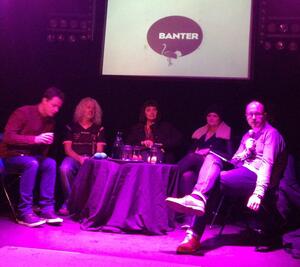
Rory O’Neill, Mick Wallace, Ann Marie Hourihane, Louise McSharry and Jim Carroll at the Banter Review of 2014 earlier this week

On Monday night, the Banter Review of 2014 took place at the Twisted Pepper in Dublin during which host Jim Carroll spoke with Rory O’Neill, aka Panti Bliss, Independent TD Mick Wallace, journalist Ann Marie Hourihane and 2FM presenter Louise McSharry.

During the debate, Mr Wallace spoke about the events over the last year regarding the gardaí and how former Garda Commissioner Martin Callinan and the former Justice Minister Alan Shatter lost their positions. He also spoke about the role of the media in the Garda story.

Towards the end of the debate, Mr Wallace claimed: “There are people in the top echelons of the Garda Síochána that have made loads of money from the movement of drugs.”

And he referred to the cases of two gardai, understood to be Nicky Keogh and Jack Doyle, whom he has previously spoken about in the Dáil.

While reading a transcript of some of the debate, readers may wish to bear in mind that, in May – when Mr Wallace raised the case of former garda Jack Doyle – he claimed a garda involved in his case is a current Assistant Garda Commissioner.

Jim Carroll: “Shattergate, let’s talk a bit about Shattergate, Mick. That whole GSOC bugging thing, the gardaí, it’s like, you know, you were instrumental in bringing that story to the light. Did it take a lot out of you? Did it take a lot out of you that people didn’t believe what was going on? Did it take a lot out of you that, watching what was being happening to the two whistleblowers and the fact that there was only yourself and Clare Daly, and maybe a handful of others in the Dáil who were bringing this up, week in, week out?”

Mick Wallace: “Yeah, well, it was tough going for about nine months all right. We started in October 2012 and we were fairly well rubbished by the media, right across the board and nobody was really interested in the story and it’s like as if no-one believed us or believed the whistleblowers at the time. And it was, it’s a bit mad how it all worked out in the end. You know, it was about 19 months afterwards that [former Justice Minister Alan] Shatter went and it was kind of unusual the way it all happened because Shatter, truth be told, was actually one of the most able ministers in there. He was very, very strong, very intelligent. He was really very good at a lot of the jobs he was doing but, for some strange reason, he refused to deal with the challenges of policing and we brought more and more of the issues to the table and, to tell you the truth, we didn’t bring a quarter of what information we actually have from serving guards, ex-guards, members of the public of some terrible things that have been going on and still going on in the country that involve malpractice on behalf of the guards and corruption.

It was unusual…I think part of Shatter’s problem was that, if you watch back and we had some fantastic, we used to really enjoy him because he was great value, he was. And it was always a real battle with him because he is very smart and he was real, he knew his job inside out and it was brilliant just to stand up and go at him and let him come back at us because he invariably did. I think the fact that, especially, myself and Ming [former TD, now MEP Luke Flanagan], it was myself, Ming and Clare Daly really that dealt with the issue from the start and Shatter really had a problem with the idea that myself and Ming, with our long hair and the jeans and we were kind of rough looking as far as he was concerned, you know, and the idea that we had the audacity to actually even challenge him and his job was an issue for him. And I think it may have been part of his problem. I mean whenever we raised any aspect of it and whenever we threw any bait out there, he always went for it. He was fearless and he couldn’t get at us enough, right? It was great.”

Ann Marie Hourihane: “Do you miss him?”

Wallace: “I do miss him, yeah.”

Carroll: “You do sound like a scorned lover there.”

Wallace: “But, it’s actually, the funny part about it is right, but listen it was highlighted that our police force is dysfunctional and indisciplined and the truth of the matter is that it’s the same today. I have to say Frances Fitzgerald is a woman that I really like but she hasn’t made one iota of a difference and we’ve seen bugger all legislation since Shatter went. We’ve seen or just kicked the can down the road.

There’s a queue of Garda stuff coming down the tracks and it’s all been pushed out, pushed out, pushed out, they don’t want to talk about it, they don’t want to talk about it. And, we’ve tried to raise different issues, for example with the topical issue thing, it’s where you put in an issue to discuss before 10am on any morning. But she refuses to take it from us whereas Shatter was, ‘no bother, let me at ’em’. So there was far more discussion about it when he was there.

The latest reports, I mean we’ve had about seven reports at this stage and each one seems to be worse than the next. In the last few weeks, we have raised some of the issues about, they’ve changed the legislation on GSOC but it is so disappointing that it’s frightening and the new police authority, which isn’t going to be independent now is going to be a complete waste of time, it’s been a huge disappointment but it’s interesting – you were talking about water there at the start, and about how one issue can get carried away and the media go hell for leather for it but they have completely lost interest in policing. Now whether we can get it back remains to be seen but I’m convinced that if our media were really strong and independent themselves, I think they could play a massive role in making society better in Ireland. I think that they have massive potential to make a big difference and I don’t think that’s a potential that’s realised.

Since I went into the Dáil, a couple of things I suppose have disappointed me more than others but obviously the politicians spend most of their energies trying to get reelected is obviously one, in everything they say or do, but I have been disappointed with how the media operates. I think it leaves a lot to be desired and I think if any of ye, I mean obviously, I do, the Irish Times is obviously the best paper that we have. But if you go into the Dáil of a Wednesday morning at 9.30am and stay there until 9.30pm at night, which it’s a 12-hour day on a Wednesday, you go in there and listen for yourself as to what actually happens in there and then read the Dáil pages the next day – I don’t think it reflects what actually happened in there but there’s different forces all the time at play, I’m not blaming necessarily the journalists. I mean media is in a difficult place. Obviously the fact that 40% of it is controlled by Denis O’Brien is a big issue, it’s a big problem. But even RTÉ, I do not think that they challenge the Government in a manner that they should anymore…”

Later

Wallace: “Sadly, the problems in our police force are much worse than you know and, as I said to you earlier, we haven’t actually put out a quarter of the stories into the public domain but there is a serious amount of the drug trade at the moment in Ireland controlled by our police force which might frighten some of ye and not more of ye. We’ve had guards come to us and tell us and try to get us to deal with it. We’ve raised some of those issues and they haven’t got much traction yet. Some of them we haven’t. But it’s, I’m telling ye, it’s, it’s the big problem is that the structure at the top is very disappointing. Most guards will admit to you that the guys who got promotion over the last 20 years were not the ones who should have got promotion most of the time, not all the time, but a lot of the time – the wrong ones got promoted. And the nest that [former Garda Commissioner Martin] Callinan built around him is problematic and we thought that, and most of the people, people like Professor Dermot Walsh, who would probably be the most renowned expert on policing in Ireland, he was adamant as well that the hierarchy had to go the same as they got rid of them in Northern Ireland. But we’ve chosen to actually keep them in place and I can tell you, from many of our stories and accounts we’ve got from people and from guards, many of the hierarchy have unclean hands.”

Carroll: “Does that include the story that you were saying there about the drugs trade, how high does it go up?”

Wallace: “There are people in the top echelons of the Garda Síochána that have made loads of money from the movement of drugs, yes, there is. And that’s problematic. Noirin O’Sullivan is a very presentable appointment. She is charming and she’s smart and she comes across well. So, she’s actually a very good appointment for the Government. But a very bad appointment for the future of the guards in that I’d not many people would expect serious change. We’ll see surface changes but we won’t see anything like the kinds of changes that are actually required if we are to develop a police force that we would like to have. A massive problem with policing in Ireland is that it’s very heavily politicised and this is going to continue unfortunately – they’ve just picked their hand, they’ve handpicked somebody to head the independent police authority, it was a non-transparent, secretive selection system.

They refused to pick an outsider to lead the force forward and they’ve, if you look at the new rules that came in around GSOC, the ones they’re going to bring in round the police authority, the one common trend running through it all is that the Government’s control of policing stays well in place. Now this is a big problem. If the guards couldn’t get an hour’s overtime for the last three years to do ordinary civil work, there’s been no end and no limit to what guards were available to go to water protests and to the installation of water meters by a private contractor. This was not made by a Garda force, this is a political appointment, a political decision. So when you have the Government of the day, the politicians of the day that are in charge, pulling the strings of the guards, that’s not a good way for a police force to work.

A healthy police force would make their own decisions, they would be transparent in how they’d behave, there’d be human rights-proofed and they would be accountable to the citizens of Ireland, rather than to the politicians who have the majority in the Dáil when this is what you have at the moment and that represents no accountability worth talking about. And that’s how Shatter got in trouble because it actually went back to him. The Garda Commissioner is answerable to the parliament. The parliament is controlled by the Government of the day who have a majority. The Government invests the power over the Commissioner in the Minister for Justice. If Shatter had stood up and said that the Commissioner was a bold boy it would be Shatter’s fault, it would be his problem. He couldn’t hold the Commissioner to account, he couldn’t criticise him, it would be same as criticising himself and that’s… The problem…Shatter would still be in power if our police force wasn’t so politicised.”

Later

Audience member [Irish Times journalist Dan Griffin]: “Mick, that claim you made earlier about senior gardaí benefitting from the drugs trade sounds fairly damning, much more so than the penalty points controversy. Why haven’t you gone public with that? Can you not stand it up? Or do you plan to go public with it properly?’

Wallace: “Ok. We actually have but you haven’t heard about it. Two weeks ago, I brought up in the Dáil about a guard in a station in Mullingar. For two years he watched a senior guard in his barracks go to Dublin once a week and bring drugs back in his squad car and store them in the barracks and he used keep them there and give them to the drug dealer, who was a woman that he was having a relationship with, and she was the main drug dealer in the area. And he’d give them to her as she needed them and it was used as a depot for the drugs. A guard came forward, still doing his job, and he wrote out, he came to us with his story. We raised it in the Dáil about nine months ago. About six months ago, GSOC started looking into it. Noirïn O’Sullivan said she was very concerned about it. Six months have gone and, last week, he rang us again, two weeks ago, he contacted us and told us that he was being intimidated at work. His life was being made hell and he’s heard nothing back, despite the six months of work being done into his case.”

Griffin: “But is it systematic, across the guards or is it just that one kind of incident that you’re aware of?”

Wallace: “No, I brought up an incident last year which you probably didn’t hear about either, a guard in Cork, was based in Cork. He watched drugs being taken off boats and gardai supervised the offloading of them. He went to his chief superintendent and told him the story and he was told, ‘oh god, you better go to Dublin with that story’. He went to Dublin with the story and, the following week, he told his story in Phoenix Park. He went back home the next day and he turned up for work and a guard blocked his way into the garda station and said to him, ‘oh jaysus, Jack, you don’t work here’. [Jack said] ‘what do you mean?’ [Garda said] ‘Jack, it’ll be fine, it’ll be fine, it’s all over, it’s all over but listen everything will be taken care of, you’ll get your redundancy, the whole lot.’ He never worked for the guards again. I brought that story to the Dáil twice in the last 12 months but it hasn’t, you haven’t seen it because it hasn’t been covered by the media. And there’s a lot of other stories. There’s a number of cases where guards take, they capture drugs. We know of a case where drugs were coming in, maybe five suitcases of cocaine might come in and it would be organised to let four through, the guards would catch one suitcase with some chaps that would be heading off in one direction with the suitcase. Their leader was never caught. And the suitcase they would catch, they would bring it and there’d be a big show and the media would be brought down to show, ‘oh, there was a big drugs find yesterday and here’s all the stuff’. The stuff goes back in a box and fellas have come to us and told us that they were dealing in drugs, they were caught by the cops, they weren’t turned in and the cop says, ‘we’ll be back to ya’. They come back two weeks later and say, ‘here, sell this for us and bring us back the money’. There’s a good bit of that going on.'”

Carroll:“When you go through that, it sounds like something out of Love/Hate, you know? It sounds totally utterly unreal but yet it’s been witnessed and these people are standing over it?”

Wallace: “Yeah, look it, and the reason there’s so much problems in the guards is because the hierarchy is wrong. It starts at the top, not the bottom and it’s a big problem and I tell you what, most people in Ireland, there’s a lot of people in Ireland who don’t have a problem with the guards because the guards don’t give them a problem but if you are on the wrong side of that line, and God help you if you are, but if you are, then life can be difficult in dealing with our police force. If you’re on the right side of that line, getting your penalty points terminated is only one of the small advantages that you actually inherit. So the police force is something different for different people. There’s a great line in one of Bruce Springsteen’s songs, he said ‘Down here it’s just winners and losers and don’t get caught on the wrong side of that line’. Well there’s a lot of people on the wrong side of the line with our police force I’m afraid.”

A podcast of the full debate will be posted on This Is Banter on Monday.

Previously: Blowback

Meanwhile, In The Dáil (May 8, 2014)

Meanwhile, In The Dáil (May 15, 2014)

The Thin Blue Timeline [Updated]

Thanks This Is Banter

CallinSHatWall

You may recall when former Justice Minister Alan Shatter and Independent TD Mick Wallace appeared on RTÉ’s Prime Time on May 16, 2013, to talk about the penalty points report and the appearance of former Garda Commissioner Martin Callinan at a Public Accounts Committee meeting earlier that day.

During their discussion with presenter, Pat Kenny, Mr Shatter accused Mr Wallace of having been stopped while driving by the gardaí in May 2012 and claimed he benefitted from garda discretion.

The Data Protection Commissioner subsequently found Mr Shatter broke the law by disclosing personal information about Mr Wallace on the show.

This morning, RTÉ reports:

Former Minister for Justice Alan Shatter has begun an appeal against a decision of the Data Protection Commissioner that he breached the Data Protection Act.

Mr Shatter says the information about Mr Wallace was given to him orally by the then Garda Commissioner when no other person was present.

He said he did not make any written note of what he was told and retained the information solely in his head.

His lawyers said he was concerned about how the Data Protection Act could be used to regulate information retained solely in a person’s mind.

Alan Shatter begins appeal over Data Commissioner finding (RTÉ News)

Previously: Breaking The Law On Prime Time

How Did He Know?

wallacem

https://www.youtube.com/watch?v=sqpcyRc4Yjo

Mick Wallace TD interrogates Enda Kenny over the government’s efforts to solve the ongoing myriad crises within An Garda Síochána during Leader’s Questions today.

All in good time apparently.

Once they’ve finished installing the meters.

Thanks Justice Against Corruption in Ireland (Facebook)