
Tag Archives: PAC

PAC 036_90505399Screen Shot 2017-03-14 at 12.04.48

The Public Accounts Committee is launching its report on the sale of Project Eagle.

Now.

The chair of PAC, Fianna Fail TD Seán Fleming said:

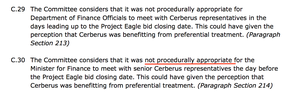
“The committee considers that it was not appropriate for Nama, as the contracting body, to meet with Cerberus representatives the day before the Project Eagle bid closing date. It could have given the perception that Cerberus was benefiting from preferential treatment.

“Also. The committee considers that it was not procedurally appropriate for the Minister for Finance [Michael Noonan] to meet with senior Cerberus representatives on the day before the Project Eagle bid closing date. This could have given the perception that Cerberus was benefiting from preferential treatment.”

Facebook live link here

Read the report here

Previously: ‘Not Appropriate’

Eagles, Vultures and Turkeys

UPDATE:

Screen Shot 2017-03-14 at 12.22.39Screen Shot 2017-03-14 at 12.26.41Screen Shot 2017-03-14 at 12.32.52

Screen Shot 2017-03-14 at 12.51.56

From top: Daniel McConnell, of the Irish Examiner; Hugh O’Connell, of The Sunday Business Post, and Josepha Madigan, Fine Gael TD and member of PAC

You may recall how, on Sunday, February 12, in The Sunday Business Post, Hugh O’Connell and Jack Horgan-Jones reported on a draft working paper by the Public Accounts Committee into Nama’s sale of Project Eagle.

They reported:

The paper said it was “not appropriate” for the Department of Finance to meet with the ultimately successful bidder, Cerberus, in the days before the closing date for Project Eagle bids. It similarly states that it was “not appropriate” for Noonan or Nama to meet with Cerberus the day before the Project Eagle bid closing date – and that this could be perceived as “special treatment”.

This morning.

PAC’s report no longer states the Department of Finance and the Minister for Finance Michael Noonan’s behaviour was ‘not appropriate’. Instead, their behaviour was ‘not procedurally appropriate’.

Why was it changed?

From the press conference…

David Davin Power (RTE): “You found that Michael Noonan meeting Cerberus wasn’t ‘procedurally appropriate’ and I know there was a contention about that on the committee. Fine Gael members voting against it. But Michael Noonan says that he never had an adequate opportunity to respond to what was ultimately an adverse finding against him and that he’s been unfairly treated, effectively, by the committee.”

Sean Fleming: “Well, he said that, based on the original working document that said it was ‘inappropriate’ but the wording in the report published today refers to the procedures that allowed that meeting to happen. It was procedurally inappropriate. So it’s not quite the same as what was in the original report. And that word is there for a reason. Because this committee is precluded from finding specific fault against an individual person. And we’re looking at the process of that meeting, not specifically the person who attended. I would [inaudible] the distinction between the finding in relation to Nama, where we say it was inappropriate, because we were finding that the body, the corporate body of Nama, rather than that one person, acted inappropriately. But we can’t use that particular word due to legal restrictions, in relation to one individual.”

Davin Power: “But why did you seek to use that word if it was legally suspect in the first place…”

Fleming: “The committee never sought to seek that. There was a working document prepared after some 30,000 sheets of paper presented to the committee and after 11 public hearings. The committee never used that particular wording. The only wording that the committee settled on is the wording in the report.”

Davin Power: “Could you ask one of the Fine Gael members [of PAC] to respond to that point? Are you happy…[inaudible].”

Fleming: “Peter [Burke], if you’re happy?”

Peter Burke: “Thank you very much. First of all, I think to use the words ‘procedurally inappropriate’ is not fair. I would point out that the Minister did attend the PAC meeting, even though he’s not legally required to do so. He spent five hours under intense questioning. He brought forward all information and answers and answered everything very clear and concise and to see a situation whereby he was actually denied natural justice because the response that’s in the report is to a media leak which appeared on the Sunday Business Post. So, in other words, he never got due process or was questioned on the content of this assertion.

“And, to point out, Section 9 of the Nama Act is very clear. That it is independent in its functions in terms of its role with the minister and previous people have brought this up, including our chairman when the act was [inaudible] in the Dáil in 2009, in terms of to keep it outside of the realm of politics, I mean that was very, very important. And to suggest that it’s procedurally inappropriate, one has to ask: what is the procedure? And there is none. If the minister has clear legal separation and there is a former US secretary of the treasury coming over to Ireland to discuss, from banking to insurance to asset management, I think it would be unwise for any minister not to meet him.”

Later

Burke: “… the commercial activities of Nama are driven by the board. The minister has no role in this. And even, as a process, it was mentioned that the minister should have called off the sale, but at that time, he’d no legal power to do so. And there’s departmental legal advice, which was mentioned at the committee here, in relation to that.”

Daniel McConnell (Irish Examiner): “But are you not playing politics with it now? Are Fine Gael not playing politics with the PAC, for the first time in its history, in 94 years, you caused a vote at the PAC, purely to protect the standing of Michael Noonan?

Burke: “No, Danny, that’s not correct. If we look at this, in a fair and balanced fashion. If a minister, who is not legally obliged to attend the PAC, does so of his own free will, in the interest of fairness, in the interest of transparency, on foot of that, that he is denied the right to due process, to respond to a charge that was put to him, that he was never asked one single question on, I think that’s an incredible part of this report. That the minister was denied that right to respond to an assertion that he was never…”

McConnell: “So, who put it in the report initially then? Because this is important. Who put the initial finding of ‘inappropriate’ in the report? Was it a civil servant?”

Burke: “Here is a draft document

McConnell: “So a civil servant…

Burke: “…which was leaked to the Sunday Business Post…”

McConnell: “So it was a civil servant  who put it in, is that what you’re saying?”

Burke: “It was a draft document, I can’t answer that….”

Fleming: “I will answer that, and I will call on David Cullnane [Sinn Fein] next. I, as chairman of the Public Accounts Committee, supervised directly, personally..”

McConnell: “So it was your, that was your, that was your language?

Talk over each other

Fleming: “…reporting in the first instance. What I do want to clarify, people mightn’t have go to it. We put a specific appendix in the report, on page 86, on the issue. We record fully and faithfully everything in respect of the minister’s response. First of all, in that, when we came to that issue of whether or not, at our meeting, and it’s all documented there [inaudible] we had three or four meetings, and Peter and his [Fine Gael] colleagues proposed wording to say, rather than it was ‘not procedurally correct’, to put the wording it was ‘not advisable’. So the board members were satisfied that the report should say it was ‘not advisable’ of the minister. That was voted down and the other wording was put forward.”

“But I just want to respond, before I call on David Cullinane, it was fortuitous in a way that there was a leak because that did give the minister to respond and the content of the letter received by the minister was examined closely by the parliamentary legal office in this house. And [inaudible] essentially responded to any allegations that we were about to make. Even though his letter came in before we concluded. And I do want to say, this is the transcript, the 82-page transcript of the meeting, of the Public Accounts Committee on Thursday, the 6th of October 2016. And I have to say that that meeting, the minister and the people on his side were the only people aware in the room, at that time of the meeting with Cerberus. No member of the committee was aware that a meeting ever happened. And the minister gave no indication whatever of that meeting. To suggest we didn’t ask him something about which we knew nothing about is unusual. He had four and a half hours at the meeting when we invited him in to talk about the sale of Project Eagle. And he spent four and a half hours discussing it and made no reference to that meeting. And there is the transcript if people want to check it.”

Later

Hugh O’Connell (Sunday Business Post): “Do you think you may have dropped the ball, as a committee, in not asking him if he had met Cerberus? And secondly, when you did become aware of it, why didn’t you ask him about the meeting via correspondence?”

Fleming: “The answer to that is we didn’t drop the ball because we weren’t aware the game had happened. Right? No member of the PAC were aware, at the time, that that meeting…”

Josepha Madigan: “Sorry, that’s incorrect. It was subject to FOI, the minutes were actually given in correspondence on the 4th of November…the 8th of November [2015] to the committee, so they were fully aware of…”

O’Connell: “So, why then, did you not write to Michael Noonan and ask him: why did you have this meeting? And what was the purpose of this meeting?”

David Cullinane: “There was a note that was given to the committee under the Department of Finance that set out the official notes taken by officials, in terms of that meeting. And those notes clearly show that Project Eagle was raised and it was raised in the context of Cerberus raised and they were told that it would be best dealt with at a meeting later that day with Nama which we believe that was also inappropriate. So, there was reference to Project Eagle in that meeting. And…”

O’Connell: “Why didn’t you ask him then? Why didn’t the committee call him back in?”

Alan Farrell: “That’s entirely inaccurate…it is entirely inaccurate….you’ve got your dates mixed up, David.”

Previously: Spotlight Falls On Noonan (March 1, 2016)
Screen Shot 2017-02-21 at 12.26.29

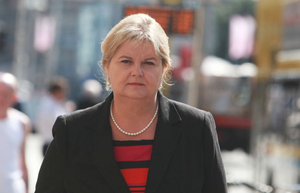
Former CEO of Rehab Angela Kerins outside the High Court last July

Further to former CEO of Rehab Angela Kerins losing her High Court action against the Public Accounts Committee in January…

RTE reports:

Former CEO of the Rehab group Angela Kerins has asked the High Court not to award costs against her for her failed legal challenge to the Dáil’s Public Accounts Committee.

Lawyers for Ms Kerins told the three-judge divisional High Court the case was an “exceptional one”.

…This morning, lawyers for Ms Kerins began submissions in her application regarding costs of the action.

Senior Counsel John Rogers said he would be asking the court to depart from the norm where the losing party bears the costs of the action.

Kerins asks court not to award costs against her (RTE)

Previously: Check Your Privilege

Rollingnews

Screen Shot 2017-02-20 at 10.26.01

Minister for Finance Michael Noonan

Yesterday.

In the Sunday Business Post.

Further to the newspaper’s report last week that the Minister for Finance Michael Noonan, the Department of Finance and Nama have been heavily criticised in a draft report by the Public Accounts Committee – in relation to Nama’s sale of its Northern Ireland loan book, known as Project Eagle…

And that, specifically, it was “not appropriate” for Noonan or Nama to meet with Cerberus the day before the Project Eagle bid closing date…

Jack Horgan-Jones and Hugh O’Connell reported:

Noonan has rebutted the finding, contained in the committee’s draft working paper and published by this newspaper last week, that it was “not appropriate” for him to meet with the US fund prior to its €1.6 billion purchase of Nama’s Northern portfolio. The draft said this could be perceived as “special treatment”.

…In a letter to the committee last week, Noonan expressed “great concern” over the draft findings, saying they were “extremely damaging” to him. He maintains that the meetings were not inappropriate and that he was never given a right of reply.

But committee members are doubling down this weekend. “Everybody agrees the fact that he met them is a problem. Everybody understands. Nobody can say it was a good idea to meet Cerberus on the day of the bids,” a PAC source said.

“The point of that whole meeting, the potential impression that meeting gave, will remain in [the report] . . . The essence of that meeting happening at that time and the impression of that meeting and having such access at that critical time will be in the final report.”

Another committee source said that while the language around the finding may change, it is extremely unlikely to be removed altogether.

Fine Gael TDs on the committee have indicated they will attempt to block any report which states that Noonan did not act appropriately.

PAC stands firm over criticism of Noonan-Cerberus meeting (Jack Horgan-Jones, Hugh O’Connell, The Sunday Business Post)

Rollingnews

Screen Shot 2017-02-14 at 10.42.06

Minister for Finance Michael Noonan

In case you missed it.

At the weekend…

Hugh O’Connell and Jack Horgan-Jones, in the Sunday Business Post, reported:

Michael Noonan, the Department of Finance and Nama have all been heavily criticised in a damning secret report prepared for TDs investigating the sale of Project Eagle.

Nama’s controversial €1.6 billion sale of its Northern Ireland loan book three years ago is the subject of a number of damaging conclusions in a draft working paper to be discussed by TDs on the Public Accounts Committee (PAC).

It ultimately concludes that Nama’s sales strategy could be described as “flawed” and it has been “unable to demonstrate” that it got value for the Irish state.

The paper said it was “not appropriate” for the Department of Finance to meet with the ultimately successful bidder, Cerberus, in the days before the closing date for Project Eagle bids. It similarly states that it was “not appropriate” for Noonan or Nama to meet with Cerberus the day before the Project Eagle bid closing date – and that this could be perceived as “special treatment”.

The Public Accounts Committee will meet in private at 5pm tomorrow and then in public at 10am on Thursday.

Report: Noonan acted inappropriately – Nama sale flawed (Sunday Business Post)

Nama failed in corporate governance of Project Eagle, says draft PAC paper (Sunday Business Post)

Previously: Spotlight Falls On Noonan

Rollingnews

screen-shot-2016-11-22-at-12-01-36

screen-shot-2016-11-22-at-12-07-15

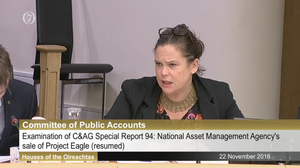
Patrick Long, of Lazard and Co Ltd and Mary Lou McDonald, deputy leader of Sinn Féin

This morning.

At a meeting of the Oireachtas Public Accounts Committee.

Patrick Long, of Lazard’s – Nama’s loan sales advisor on the sale of Project Eagle – is answering questions in relation to the Project Eagle sale.

From the meeting…

Watch proceedings live here

screen-shot-2016-10-25-at-11-03-27

John Collison, deputy head of asset recovery at Nama at time of Project Eagle sale

Today.

Nama officials are appearing before the Public Accounts Committee to discuss the sale of Project Eagle in light of the Comptroller and Auditor General’s report into the sale.

Those appearing include John Collison, deputy head of asset recovery at Nama at the time of the sale; Michael Moriarty, now the current head of asset recover at Nama; Alan Stewart, senior divisional solicitor; and Donal Rooney, former chief financial officer at Nama.

Meanwhile…

*popcorn*

Today’s proceedings can be watched live here

Previously: 

Nama’s Project Eagle Anomaly

‘You Give Limited Information To Get The Answer That You Want’

screen-shot-2016-09-29-at-15-36-49ctjy6asweaawjdk

Nama’s chief executive Brendan McDonagh and a letter from Michael George, managing director of Fortress Capital, to Andrew McDowell, Taoiseach Enda Kenny’s former economic adviser, at 3.04pm on February 13, 2014

Further to the appearance of Nama officials – including chairman Frank Daly, chief executive Brendan McDonagh and audit committee chair and member of Nama’s Northern Ireland Advisory Committee Brian McInery – before the Public Accounts Committee yesterday…

US investment fund Fortress was the only underbidder in Nama’s eventual sale of Northern Ireland loan portfolio, otherwise known as Project Eagle, to Cerberus.

You mayrecall the following sequence of events, as outlined in the Comptroller and Auditor General’s report on the sale:

Nama approved a proposal to sell Project Eagle at a minimum price of £1.3bn over two meetings on December 12, 2013 and January 8, 2014.

On January 8, 2014, Lazard and Company Ltd were appointed as the loan sale advisor for Project Eagle.

On February 13, 2014, it was reported in the press that Pimco had approached Nama, back in 2013, to buy the whole Northern Ireland portfolio and, a day later, selected bidders were allowed to access information on the loans in a data room.

On March 12, 2014, Pimco withdrew from the loan sale process – after informing Nama of a  £15million success fee arrangement involving a member of Nama’s Northern Ireland Advisory Committee, Frank Cushnahan, London law firm Brown Rudnick and Belfast-based Tughans solicitors.

On April 3, 2014, Nama approved the sale of Project Eagle to Cerberus who also used the services of Brown Rudnick and Tughans solicitors.

You may also recall reports that Fortresss had to make a representation to the Department of the Taoiseach on February 13, 2014, before it was invited into the bidding process some five weeks after it had begun and Nama’s denial of the same.

During yesterday’s PAC meeting, Fine Gael TD Noel Rock had the following exchange with Brendan McDonagh.

Noel Rock: “When were Pimco initially informed there was going to be a sales competition?”

Brendan McDonagh: “Pimco were told, I think, post the board meeting in January 2014. We’ve always maintained to Pimco, that there was never going to be an exclusive off-market sale directly to them.”

Rock: “Okay. All right. Do we have the minutes for that board meeting?”

McDonagh: “Yes.”

Rock: “And it says that in it? Okay. Fortress, it was said earlier on, I don’t know if it was yourself of Frank said it, that there was no email to Enda Kenny from Fortress seeking…”

McDonagh:None. No. There was reporting effectively that Fortress had, it was reported in the media that Fortress had to email the Department of the Taoiseach, the official Department of the Taoiseach to get access to the thing. That’s actually completely untrue. I know the managing director, senior managing director of Fortress. I met him a number of times I think in 2009 and we stayed in touch over various things. He emailed me on the 13th of February 2014. My email is available to the, there’s nothing in it. Basically saying, ‘Brendan, how’s it going?’ Talked about the rugby match at the weekend and said, ‘I just heard through one of my colleagues that the Northern Ireland portfolio may be on the market, it’s something I’d be interested in’. I forwarded the email to my colleague and said, ‘please let this guy, get Lazards to contact him because, you know, I met this guy, and I had no issue with him. I would know Fortress in my previous life. And it was, Fortress were brought, they were contacted by Lazards, I think that evening on the 13th of February. They were sent an NDA,  an non-disclosure agreement and they were sent the NDA on the 14th of February and then they didn’t return their signed NDA, because you can’t get access to the data room until you supply the NDA, they didn’t return their signed NDA until the 26th of February, I don’t know why it took them 12 days to sign it. Maybe they had to go through their own internal compliance or whatever it was but they were invited into the process, on the evening of the 13th of February, but certainly on the 14th of February when they were sent the NDA.”

Rock: “I’m familiar with your emails. I’ve seen a copy of those. On the same day though, they did email the Department of the Taoiseach. Why do you think they would have done?”

McDonagh: “There was no, I don’t know what email the Department of the Taoiseach, I haven’t actually personally seen that email…”

Rock: “I’ll forward it to the secretary so you can be provided with a copy.”

McDonagh: “But I saw the media report but I was a bit surprised by that because I had got an email from the senior managing director of Fortress on the 13th of February myself and I arranged for Lazards to get in contact.”

Rock: “Okay, all right. Thank you. In, I think it was yourself Brendan, in a previous appearance before the PAC, I’m just going to quote this here if you don’t mind: ‘We appointed Lazard, then Lazard approached the nine biggest funds in the world, the guys who would have fire power and capital to be able to buy a portfolio like this. Then you listed the nine firms, including Fortress that you said had been approached. But it obviously seems, based on the discussion of the email with the Department of Taoiseach and indeed to yourself, that it wasn’t the case that they were approached; they, in fact, had to approach you. Do you accept this quote is now inaccurate, in effect?”

McDonagh: “No, I don’t think so. I don’t think that’s inaccurate, deputy, because Fortress were one of the people which were considered to be approached by Lazard anyway so, as I said, there’s a league table in terms of, you know, people, division one, division two, division three, so as people drop out, we were pushing Lazard to get more people into the process.”

Rock: “Right. So. So, like, I’m finding this hard to understand. Did Lazard approach Fortress? Or not? If so, why did they [Fortress] need to approach you?

McDonagh: “Well, all I can say to you, deputy, is as follows: On the 13th of February, I got an email from the senior managing director of Fortress, I got one of my colleagues to contact Lazard to say, ‘contact these guys in Fortress, find out if they’re interested or interested or not’. I don’t know personally when Lazard were going to contact Fortress or not, but I do know what happened on the 13th and 14th of February.”

Rock: “Okay.”

Letter via Mick Wallace

Related: Fortress had to apply for ‘late’ Nama sale bid (Mark Tighe, Sunday Times)

Screen Shot 2016-07-15 at 10.24.57 Screen Shot 2016-07-15 at 10.43.53

From top: Director of HSE Tony O’Brien and Fine Gael TD Josepha Madigan, of Dublin Rathdown at the Public Accounts Committee this morning

Director of HSE Tony O’Brien and members of the Department of Health is before the Public Accounts Committee this morning in light of the revelations concerning the former CEO of Console, Paul Kelly.

During this morning’s meeting, Fine Gael TD Josepha Madigan repeatedly asked Mr O’Brien if the HSE took any responsibility for Console’s finances.

She was fairly dogged, in fairness.

From the meeting…

Tony O’Brien: We were not Console’s regulator, we were not its primary funder. We were purchasing a certain range of services from Console which were being received, which continued until yesterday. Which will now continue in another organisation. We have no powers over their fundraising activities or those other extraneous matters.”

Jospeha Madigan: “Just on that point that you say there, Mr O’Brien, and I heard you on Sean O’Rourke (RTE Radio One show)… you also said that you partially funded Console. To me that’s actually missing the point. The main principle still applies, you’re still giving a significant amount of money to this charity so it doesn’t matter whether its partially funded or not. The same principles still apply, the same oversight should apply in relation to that particular charity and I don’t think that’s a good enough response, in my view.”

Later

Madigan: “When you talk about value for money, it seems, putting the services to one side, it seems extraordinary that you say that you’re satisfied in relation to what’s transpired.”

O’Brien: “Well, can I explain why? And it does go back to an earlier point and I know you don’t necessarily agree with where I’m coming from on this. The services are all we paid for. Our engagement with that organisation was…”

Madigan:Are you abdicating all responsibility from oversight of Console?

O’Brien: “What I have said and what I’m saying clearly…”

Madigan: “I’m asking a question…”

O’Brien: “You’re seeking to frame it in a way that I can’t give you a yes or no answer..”

Madigan: “That’s what your implying..”

O’Brien: “What I’m saying..”

Madigan: “That’s what you’re implying…”

O’Brien: “If that was the case why would we have concocted this very extensive internal audit. What I’m saying is we…”

Madigan: “Which should have been done, with respect, many years beforehand, many years beforehand. Do you accept there’s any failings on behalf of the HSE for Console?

O’Brien: “The failings that are in the report on Console, which you’ve had an opportunity to read, are failings within Console. Clearly, at any point in time, with the benefit…”

Madigan: “Do you accept any…”

O’Brien: “Can I answer the question?”

Madigan: “No, because, no because you’re saying the failings are within Console itself. Do you, Mr O’Brien accept that the HSE had a responsibility towards Console? Do you accept any, any responsibility?”

O’Brien: “We had a responsibility to the provide funding in relation to the services they were providing to satisfy ourselves, the quality of those services, and when significant issues of concern…”

Madigan: “But why didn’t you carry out inspections when you could have done that? You..”

O’Brien:It’s very difficult for a witness to answer questions if they only get the first 50% of their answer out.”

Madigan: “Go ahead but…”

O’Brien: “If I could answer the question, it may answer the next question that you’re trying to pose to me. When issues of concern arose about financial governance, the audit was initiated. Prior to that, there had not been unresolved issues which led to that decision. Obviously, officers have to make judgements at all times. With the benefit of hindsight yes, maybe the decision could have been made earlier…”

Madigan: “OK, maybe the decision could have been made earlier. Will you accept the failings on behalf of the HSE in relation to the governance  of Console?

O’Brien: “No, I do not accept. We were not responsible for the governance of Console. Console is a separate legal entity. Our only responsibility can be in relation to the oversight..”

Madigan: “So you’re saying the HSE has absolutely, is absolutely blameless thus far?”

O’Brien: “I didn’t say that.”

Madigan: “But that is what you’re saying, Mr O’Brien.”

O’Brien: “If you were to review the transcript, you will find I didn’t say that.”

Madigan: “I have read your transcript at length..”

O’Brien: “No, no, the transcript of our discussion right now. At no point have I said the HSE is blameless.”

Madigan: “You’re not saying, you know what you’re saying, Mr O’Brien, you’re hiding behind words and you’re very good at it.”

O’Brien: “Can I say something? Chairman…If the PAC were an airline, I’d be in the top tier of the frequent fliers programme, right? So I expect to be in here a lot. As I was with the previous committee. The committee members know what I mean. We have provided all the specific documentation the committee asked us to provide. We’ve come as required, now we’re going to do our best to give you all the information that we can. But sometimes it’s very difficult if I only get the first few words of an answer out..”


Watch live here

Previously: Con Sold

Screen Shot 2016-01-28 at 11.07.48

Screen Shot 2016-01-28 at 11.12.28

From top: Mark Griffin, secretary general at the Department of Communications, Energy and Natural Resources and Fine Gael TD Patrick O’Donovan

You may recall the Comptroller and Auditor General’s Report on the Accounts of Public Services 2014 included a chapter on Eircode.

It raised concerns about “a pattern of non-competitive tenders for consultants” in relation to the project.

This morning, Mark Griffin, the secretary general at the Department of Communications, Energy and Natural Resources fielded questions about Eircode from members of the Public Accounts Committee.

During his appearance, he spoke about the cost of Eircode and the cost of the consultants hired during the project.

He also spoke about a complaint that was made to the European Commission in relation to the procurement process that Eircode used.

From the proceedings this morning…

Patrick O’Donovan: “Mr Griffin, in 2009, when this whole thing started, your department estimated that the cost was €18million over 18 months. Then, in 2013, the cost rose to €31million. And then, in 2015, it rose to €38million. So. Can you tell me what is the actual cost of this project to date?”

Mark Griffin: “So let me go back, maybe to the sort of sequence of events that you’ve described deputy. You’re right in saying that the 2009 memorandum for Government included an estimate of €14.8million which was €18million, including VAT. Now bear in mind that was at the pre-tender stage so, as you will find with a lot of contracts, whether it’s in the public or private sector that it is quite difficult to determine precisely what the cost of a project is likely to be. The 2013 memorandum for Government included costs of €25million, again against excluding VAT. Now that included the €9.5million for encoding public sector body databases which the 2010 consultation we undertook highlighted as an important thing, in terms of gaining traction, visibility and utility around the Eircode and it also included costs for the geo directories, so if you look at that €25million cost, that was €31million including VAT. Now it didn’t include, as the C&AG pointed out, our own internal staffing costs as some additional consultancy costs. So yesterday the cost, as set out in the C&AG’s report, which we wouldn’t dispute, using the methodology which he did, includes staffing costs going back to 2005 when the, when the sort of bulk of the work on this commenced is about €38million including VAT. To date, at the end of December 2015, we’ve spent just short of €21.2million.”

O’Donovan: “Because the figures that are being outlined by the department from 2009 to 2013, they were presumably, the 2009 figure was presumably arrived at during the period 2005 to 2010 when this thing was being designed. So how did you get it so wrong that they, that the 2009 estimate was so wrong based on what actually came in in 2013, what you forecast in 2013. How can you forecast be so wrong given that you spent the previous five years looking at this thing?”

Griffin: “I suppose one of the big changes in terms of cost additions that would have arose in the period between 2009 and 2013 was including the cost of encoding public sector body databases.”

O’Donovan: “Surely that should have been known, I mean..”

Griffin: “We didn’t actually provide for that in the 2009 estimate. There was an analysis done in 2010, following a consultation process and is part of further evaluation in 2012 where the view was expressed that it would be useful and in fact essential for the public sector body databases to be included in the…”

O’Donovan: “Chairman, I’m kind of lost here, how could a postcode system have been developed and taken five years, from 2005 to 2010 without the basic information namely the geo directory issue having been sorted from the start? How did you arrive at an estimated cost without having the basic thing, which was where are the houses in the country? How did ye do that?”

Griffin: “I suppose what I’m trying to say to you is that…”

O’Donovan: “It seems to me Mr Griffin is ye arrived at a cost without having agreed with GeoDirectory as to how much they were going to require for their database. Is that fair?”

Griffin: “No, I suppose what I’m trying to say deputy is, when you look at the evolution of this project, you’re going back to a project that was first studied in substantial detail in 2006 as part of the report of the national postcode project board which settled on, for a variety of reasons, a postal sector model. If you go to the 2007, when we looked at it, we did a very substantial cost-benefit analysis in 2006. We brought it to Government in 2007, the decision taken at that stage not to proceed on the basis that the cost-benefit analysis didn’t stack up. We went to back to Government in 2009 for further consideration of the matter, best estimate at that stage, as we’ve said, is a project that would cost €18million including VAT. We did not provide for two substantial components at that stage, the biggest one being the encoding of pubic sector databases. In the intervening period it was made clear from further evaluations…”

O’Donovan: “Just on that point. Ye arrived at a cost, including the public service databases and you went to Government with a cost that included public service databases for a national postcode system that would have required, as a basic necessity, that level of information?”

Griffin: “No, the decision hadn’t been taken at that time. That, as part of the project, we needed to encode public sector databases. That is why the cost was €18million rather than €18million plus an additional quantum.”

O’Donovan: “How could you have been developing a postcode system at the time, given that it was being changed from locality-based to address-based in 2012? How could you have been developing that kind of a project without the databases that were required and, at the same time, arriving at a sum for the Government which was €20million less than what it was in 2015?”

Griffin:At the risk of repeating myself, it is not unusual in the evolution of projects, pre-tender, that the project costs that are identified, or the estimated project costs that are identified would be different to the cost that would be part of the outcome of a tender process. I mean I think if you look at projects right across the public sector and private sector, it is not unusual at all for that to happen. If I can mention the 2010 consultation process that we undertook with over 60 stakeholders at that stage. It included 10 to 15 public sector organisations, it included half a dozen postal delivery and courier service organisations including An Post, DHL, FedEx, UPS, Nightline. Other representative bodies like the Irish Exports Association, Ibec, CWU – what clearly came out at that stage, and not earlier, was that pan-Government support and earlier implementation shall provide a major positive stimulus for the dissemination and uptake of the postcode. It was that, it was the outcome of that analysis that drove the decision to provide for the update of public sector databases as part of the implementation of the project… that itself added in a €9.5million net of that.”

O’Donovan: “Because the reason that I’m asking this is the differential so begun in a period of time that also coincides with, you know running along in the same vein, since 2006, huge procurement issues in relation to this. Where procurement rules just seem to have totally gone out the window and I presume that you accept the findings of the Comptroller and Auditor General in relation to procurement?”

Griffin: “So there are two issues that the C&AG has raised in relation to procurement…”

O’Donovan: “Well, there are a number of issues but…”

Griffin: “Well I’ll group them into two. The first one was the EU pilot case, where a complaint was taken by an individual with the European Commission in relation to the procurement process itself and that complaint was concerned with the structure of the postcode request for tenders which required a minimum turnover of €40million for each member of a bidding consortium and a potential conflict of interest, involving members of the project board. So that, I suppose, the first thing…”

O’Donovan: “Can you elaborate on that for me? The potential conflicts of interest and people on the project board?”

Griffin: “Yeah. There were two individuals that have been on the project, the initial project, the national public procurement project board, back in 2006 – one representative from An Post, one representative of a private company.”

O’Donovan: “What company?”

Griffin: “A company called GO Code.”

O’Donovan: “Right.”

Griffin: “And they were part of the national project board, national postcode project board team that assessed the implementation of postcodes back in 2006. I suppose the important thing to point out on this, it wasn’t a formal infringement under the EU treaties, it was what’s termed a pilot complaint. The European Commission found in favour of the approach adopted by us in relation to the procurement process. They did ask that a number of adjustments be made in relation to future procurement process. This involved a subsequent issuing of a circular by the Office of Government Procurement in relation to initiatives to assist small and medium enterprises in public procurement. In April 2015 the European Commissioned notified that the Department that that circular itself didn’t fully address the concerns. We reverted with further information provided to us by the Office of Government Procurement. They’ve taken a number of steps to support SMEs in the procurement process. The OGP published a suite of model tendering and contract documents to make it easier for contracting authorities to comply with the rules and to drive consistency in how procurement functions carried out across the entire public sector. The OGP has also engaged with SME stakeholders who have raised matters in relation to possible barriers for SMEs competing for tender opportunities and, in order to address these issues, have developed a new tendering authority service designed to give an informal outlet for potential suppliers to raise their concerns…”

O’Donovan: “That’s fine…

Talk over each other

Griffin: “The crucial bit is that the European Commission wrote to the Department on the 14th of October last and confirmed that there are no grounds to open and investigation into the matter.”

O’Donovan:European Commission also said, and I presume  you accept what the Comptroller and Auditor General said, the Irish authorities were requested to adapt measures to avoid similar errors in the future and to inform the EC of those measures.”

Griffin: “Which we have done. ”

O’Donovan: “So I mean everything wasn’t hunky dory then, was it?

Griffin: “Well the important thing is to say, well first of all, if you’re familiar with the system within the European Union, if a jurisdiction is in serious trouble what the commission will do is launch a formal infringement process, this never reached that stage. It didn’t get anywhere near that stage. They issued a complaint, the complaint was comprehensively dealt with by the department and by the Office of Government Procurement, the commission have written to the department, accepting what we have said, welcoming the changes that have been introduced by the OGP and saying that there is no basis to further the investigation. So…”

O’Donovan: “Just in relation to the what the OGP also require. They also require, don’t they, that contracts of order without a competitive process where the value exceeds €25,000. And in the case of this, seven of the consultancy cases met criteria for inclusion in the department’s statements for 2008, 2013 and 2014 but only two of them were included. Why?

Griffin: “I can’t give you full answers…”

O’Donovan: “Bearing in mind now that the issue in relation to the European Commission which you’ve just said there earlier, everything was sorted out after it, that was…but yet ye had seven issues with the OGP and you only notified them of two.”

Griffin: “We had what you’re talking about is the obligation of Government departments to provide a return under circular 40.02 where consultants have not been engaged by way of competitive tender process where the value of the contract is in excess of…”

O’Donovan: “I know what I’m talking about, because I can see it here, why didn’t you report that?

Griffin: “Well looking, maybe deal with some of…”

O’Donovan: “We’ll deal with the individually because the comptroller has outlined them there. Consultant A, a retired public servant. From what department? Or what agency?”

Griffin: “I believe, though I can’t say with absolute certainty that the retired public servant is a former member, a former employee of the ESB.”

O’Donovan: “So a former member of the ESB, at what level in the organisation?”

Griffin: “In the EBS?”

O’Donovan: “Yeah.”

Griffin: “I don’t know but I suspect it was quite a senior level, management level I would have thought given the experience and capability and expertise he brought to the contact.”

O’Donovan: “And, according to this, he was paid €137,000 to date? Up to 2014. What has been paid to that individual since this was reported?”

Griffin: “The total payment to Consultant A was €146,000.”

O’Donovan: “So he’s been paid €146,000 without competitive tendering.”

Griffin: “On Consultant A and Consultant B, it’s not unusual for Government…”

O’Donovan: “No, no, no, can I just stick to..he has been paid €146,000 without competitive tendering is that the case?”

Griffin: “That’s correct, yeah.”

O’Donovan: “Right. Consultant B, a retired civil servant. Where did they work?”

Griffin: “Consultant B was a former senior member of staff of the department of agriculture.”

O’Donovan: “At what level?”

Griffin: “Assistant secretary level.”

O’Donovan: “Assistant secretary? And retired. And they got €145,000. Who appointed him?”

Griffin: “He was appointed by the department, €158,000.”

O’Donovan: “And he’s been paid €158,000 without competitive tendering.”

Griffin: “I suppose it’s important to…”

O’Donovan: “I know..chairman, this is important…”

Griffin: “It is important, you’ll get all the information.”

O’Donovan: “Sorry. Consultant C is a retired civil servant, from what department?”

Griffin: “I believe it’s Jobs, Enterprise and Innovation was the final Government department that he would have been employed by..”

O’Donovan: “Have any of these? Have either A, B or C worked for the Department of Communications, Energy and Natural Resources at any stage?”

Griffin: “Consultant A would have done some work on a earlier project but he was not an employee of the project.”

O’Donovan: “So what is the full payment to Consultant C up to now?”

Griffin: “Consultant C? €44,000.”

O’Donovan: “Without competitive tendering?”

Griffin: “Yes.”

O’Donovan: “These are all now in excess of the €25,000 mark. Consultant D? What’s the total amount paid to him?”

Griffin: “Say again?”

O’Donovan: “Consultant D, what’s the total amount paid to Consultant D, now to date, to 2015?”

Griffin: “Consultant D, which are a private sector company, is €53,000.”

O’Donovan: “E?”

Griffin: “Consultant E is a legal company that were employed by way of an open tender in 2011, five tenders received, the value of that contract, the final value of that contract was €109,000.”

O’Donovan: “And the last one then, Consultant F was engaged by Ervia…”

Griffin: “Seconded in from Ervia.”

O’Donovan: “Right.”

Griffin: “It’s not unusual for the department to second in, from our agencies or commercial semi-States, the final update, €201,000.”

O’Donovan: “Yeah, because one of these consultants, then as well, was expected to be paid on the basis of milestones arrived at weren’t they? But instead were paid just, they were just paid on a monthly basis. And PA Consulting, they’ve gotten €399,000, isn’t it?

Griffin: “So PA Consulting have done work for the department for the postcode’s project for a number of years now.”

O’Donovan: “They were awarded without a competitive tender?”

Griffin: “No they were awarded by way of competitive tender. The first one, in 2005, there were six bidders for that contract. PA Consulting were the successful tenderer. The second one, in 2010, there were 11 bidders for the contract.”

O’Donovan: “The contract in 2008 for €55,000 was awarded without a competitive process.”

Griffin: “Yeah, correct.”

O’Donovan: “Why was that?”

Griffin: “I beg your pardon?”

O’Donovan: “Why?”

Griffin: “Because I think that, the view was taken at that stage, that PA Consulting were familiar with the project. As I understand it the rules in relation to public procurement allow an extension that brought out the contract and in circumstances up to a value not exceeding 50% of the original tender. So..”

O’Donovan: “But I mean, since then, since the contract was awarded to PA Consulting, and again this is from what the Comptroller said, the contract was awarded to PA Consulting on the basis that payment would be made on receipt of monthly invoices for the support provided in the previous month rather than on the basis of milestones as what was requested under the tender. So while ye engaged in a tendering process, ye didn’t adhere to it.”

More to follow.

Previously: No Honour, No Code

CPleB8sVEAEFRUk

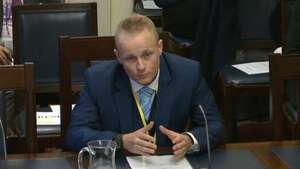
Political blogger Jamie Bryson, above, won’t be attending the Public Accounts Committee tomorrow, as originally planned.

Nama will be appearing before the committee tomorrow at 10am.

Mr Bryson told the Northern Ireland Assembly’s Finance Committee on September 23 that Northern Ireland First Minister Peter Robinson [and four businessmen] were set to receive a ‘success’ fee following the sale of Nama’s NI portfolio.

Meanwhile, Mr Bryson’s written submission to the Northern Ireland committee can be read here

Previously: Nothing To See Here

‘Cerberus Told Me I Was Going To Get Sorted’

The Eagle Has Landed

UPDATE: