
Tag Archives: tax

Bono

Gaybo

On RTÉ’s The Meaning of Life With Gay Byrne last night, Bono spoke to host Gay Byrne about God and his tax arrangements

Essentially, U2 is a business and he’s a tough guy.

And, you know, GET OVER IT.

Gay Byrne: “If I don’t ask you this, I’ll be criticised and if I do ask you this I’ll be criticised but since you’ve touched on the subject now. The subject of U2’s taxation arrangements, whereby people are expressing their wonder at what they call your hypocrisy, not my word, their word, hypocrisy of haranguing us all and asking us to pay for more international aid, at the same time as you shift your company overseas in order to save taxation.”

Bono: “Yeah, but it’s [unintelligible] of Irish people to be critical of this is because the shock horror moment here is U2 behaving like a business. (Fake shock facial and gasp expression). And I mean our, we live in a small rock in the North Atlantic and we would be under water were it not for very clever people working in Government and in the Revenue who made tax competitiveness a central part of Irish economic life.

It is the reason we have companies like, you know, Google and Facebook and, indeed, I helped bring those companies to Ireland. So it’s more than churlish for Irish people to say well we don’t want an Irish company involved in that stuff that we do want everyone else. I mean we do pay a lot of, I want to say, we pay a lot of tax and…but we are, you know, tax sensible. But, as every business is. And why is it because I’m involved in these…some people think as idealistic things but I think as pragmatic things, why can’t U2 be tough in business? This thing of the warm, fuzzy feeling, you know we want you know this…I’d like people to get over that. Because that’s not who I am. I am tough and I may have, you know, I may sing from a very private and intimate place and I make art. But I’m tough-minded and I’m intellectually rigorous, I hope. And, I think U2’s tax business is our own business and I think it’s not just to the letter of the law, it is to the spirit of the law.”

Byrne: “In that context do you think you’re removed from the everyday lives of people in Ireland, especially today?”

Bono: “That must be true.”

Watch here (from 27.40)

Apple-France-in-visit-in-Cork

Apple’s Cork HQ during a visit by French Apple staff in 1980.


A former company executive and Irish officials told Reuters the almost tax-free status dates all the way back to Apple’s arrival in County Cork 32 years ago.

“There were tax concessions for us to go there,” said Del Yocam, who was Vice President of manufacturing at Apple in the early 1980s. “It was a big concession.”

In fact, the deal was about as good as a company can get.

“We had a tax holiday for the first 10 years in Ireland. We paid no taxes to the Irish government,” one former finance executive, who asked not to be named, said.

Apple wasn’t an exception, although it was among the last to enjoy such favorable treatment. From 1956 to 1980, Ireland attracted foreign companies by offering a zero rate of tax, according to the Irish government’s website. Eligible companies arriving in 1980 were given holidays until 1990.

“Any multinational attracted into Ireland that was focusing on the export market paid zero percent corporation tax,” said Barry O’Leary, CEO of IDA Ireland, which is charged with attracting investment into Ireland.

Apple said it pays all the tax due in every country where it operates. It declined to comment on the tax treatment it received in the 1980s.

As part of Ireland’s accession to the European Economic Community, precursor to the European Union, in 1973, it was forced to stop offering tax holidays to exporters.

From 1981, companies arriving in Ireland had to pay tax, albeit at a low 10 percent rate, providing they qualified for manufacturing status.

Apple’s investment was a major coup for Ireland. At the time, the country was struggling with high and rising unemployment, double-digit inflation and a brain drain of the young and educated through emigration.

“We were the first technology company to establish a manufacturing operation in Ireland,” recalled John Sculley, Apple’s CEO from 1983 to 1993. He said government subsidies had also played a role in deciding to set up a base in Ireland.

Apple told the subcommittee it could not answer questions about why it chose Ireland as a base since it had lost the paperwork from the period.

The operation in Cork built the company’s Apple II computer and would later build disc drives, ‘Mac’ computers and others.


Apple enjoyed Irish tax holiday from the start (Reuters)

Previously: A Long Way From £2 Apple

PIc; Apple

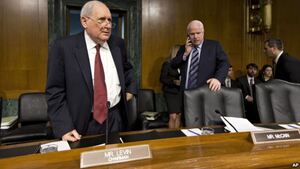
51DD7090-2791-444E-9239-AB49514F7691_w640_r1_s_cx0_cy10_cw0Members of the US Senate’s Permanent Committee on Investigation including chairman Senator Carl Levin (left) and Sen John McCain.

UPDATE:


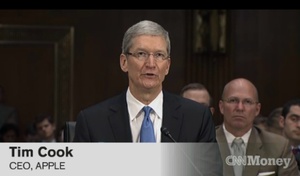
cookThe investigation by the committee into Apple’s tax affairs has thrown up some glaring contradictions.

Tim Cook Apple CEO (above) has confirmed it has negotiated a special corporate tax rate of less than 2%.

But the Department of Finance says:“We do not have a special extra low corporation tax rate for multinational companies. Ireland’s tax system is statute based so there is no possibility of individual special tax rate deals for companies.”

The report suggests the Irish government is taxing profits made by Apple and other companies at rates below the 12.5% standard.

But the Department of Finance says: “All companies in Ireland pay the standard 12.5% rate on their trading profits arising in Ireland and reports of lower effective tax rates appear to arrive at their figures by running together the profits earned by group companies in Ireland and in other jurisdictions and incorrectly suggesting that Irish tax does or should apply to both,”

Hmm.

Ireland Defends Corporate Tax System (4Traders)

Apple grilled about tax haven (CNN)

Earlier: Meanwhile, In Cork (Via Elsewhere)

Applex

But one comes away from the document feeling that there is much more that could be said about what Apple is up to in Cork.

Take, for example, this Catch 22, offered baldly as a statement of fact:

“AOI is incorporated in Ireland and based in Cork; thus, under US law, it is not tax resident in the US. AOI is also not tax resident in Ireland because it does not meet the fact-specific residency requirements of Irish law.”


Meet AOI, Apple’s mysterious Irish subsidiary (Fortune)

Dublin rejects Apple tax avoidance claims, (Jamie Smyth, Financial Times)

Previously: Anything Good Behind The FT Paywall?

Nothing To See Here

Pic: T-Shock

Google3

“Meanwhile, Ireland, already an attractive destination for multinational companies, is making it even easier for them to avoid taxes.”

“Last year, for example, Irish revenue authorities agreed to let Google make billions of dollars in royalty payments directly to a Bermuda subsidiary, helping to cut the company’s tax bill by at least $2 billion a year, according to U.S. and overseas securities filings. Previously, Google had routed those payments through a shell company in the Netherlands to avoid a 20 percent Irish withholding tax on payments destined for island havens. According to a person with knowledge of the arrangement, Ireland agreed to accept an additional tax well below 20 percent in exchange for the favorable treatment.“

Jesse Drucker on Bloomberg.

Europe Eases Corporate Tax Dodge as Worker Burdens Rise (Bloomberg) 

Previously: Anything Good Behind The FT Paywall? 

How Google’s Double Irish Tax Scheme Works

Mark Stedman/Photocall Ireland

revmapWell, the Revenue’s property values website went live yesterday.

It will allow homeowners to calculate how much they will have to pay in property tax.

This year property owners are being asked to pay for just half a year, from July 1st. However this effectively means whatever is paid this year, will double in 2014.

Joy.

Homeowners to calculate value on property tax site (Tim OBrien, Irish Times)

Time to lower those expectations…

Middle-income families would lose €640 a year for each child if the Government decided to tax child benefit at current income tax rates, figures provided by the Department of Finance have disclosed.

The cut for families paying income tax at the higher rate of 41 per cent would be five times higher than the cut of €120 in yearly benefit per child announced in last month’s budget, if that measure were proceeded with by the Government.

It works out at a €55 cut in the monthly benefit for each child and would mean a family with three children would lose almost €2,000 in annual income to the household, or €166 a month.

Well, that’s a kick in the Pampers right there.

Taxing child benefit may cost families €640 a year (Harry McGee, Irish Times)

(SaskoLazarov/Photocall Ireland)

French tax officials investigating links between Google’s French arm and its European head office in Dublin seized files during police raids at four Paris addresses linked to the company.

Google, which declares its European profits in Ireland, insists that all its advertising in the region is handled by staff based in Dublin and that Google France’s work is limited to “marketing assistance and service support”.

The arrangement means that while Google generated between €1.25 and €1.4 billion in revenue in France last year, according to estimates, it paid just over €5 million in corporate tax to the French exchequer.

Awkward.

Google files seized in Paris police raids (Ruadhán Mac Cormaic, Irish Times)

(Mark Stedman/Photocall Ireland)