







MORE to folly.



MORE to folly.

This evening.
A nation bloke holds its his breath.
Eddie Gardner writes:
Enjoying the Northern Ireland game in Hogan’s [South Great George’s Street]…

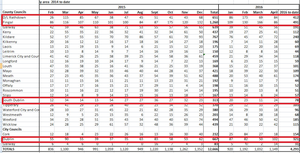
Table of new house completions released by the Department of Housing, Planning and Local Government this afternoon
What’s the news today?
The Department of Housing, Planning and Local Government (which used to be called the Department of the Environment) has published housing completion and commencement statistics for the month of April 2016.
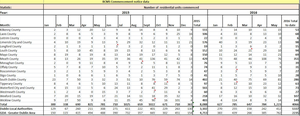
In addition, it has published commencement statistics only for the month of May 2016.
In the month of April 2016, 1,149 residences were completed nationwide, of which 296 are in Dublin. Completions are measured by reference to first connection to the ESB.
In the month of April 2016, commencement notices for 784 residences nationwide were filed, of which 242 are in Dublin.
In the month of May 2016, commencement notice for 1,223 residences nationwide were filed, of which 412 are in Dublin.
When you want to start building a residence, you need to notify the Building Control Authority in your local council 14-28 days before you actually start building, and building needs to commence within 28 days of providing the notification.
It takes 3-6 months typically to build a residence, so commencement statistics give a forward-looking indication of future housing supply.
How many new residences do we need a year?
There are different views. In 2014, the ESRI estimated we need 25,000 new residences a year up to 2030. Government departments have adopted this research by the ESRI’s David Duffy, and it represents the official position.
However
(1) if annual housing need isn’t met in any year, then the shortfall will be passed on to the following year and in 2014, we completed just 11,016 residences and, in 2015, we completed 12,666 units.
If you accept the ESRI analysis, then in 2016, we started with a 27,000 deficit from the previous two years before consideration of the 25,000 units we need for new demand in 2016.
and
(2) there are other views as to how many units we need annually. Based on the assumption that Irish households are shrinking by 0.04 a year (there were 2.68 people in the average Irish household in Census 2011, but the number has been declining by an average of around 0.04 a year over the past two decades, as we near the European norm of around 2.4 people per household), we need around 17,000 units a year for fragmenting households.
We also need units to replace obsolete stock. The ESRI estimate obsolete replacement need at 5,000 units a year (that’s included in their 25,000 analysis). Other sources suggest international obsolescence rates are 0.5%, which would equate to 10,000 units a year in Ireland, which had, according to Census 2011, 2m residential units.
And, based on April 2015 population estimates compared with April 2014 (the latest available), and assuming 2.52 people per household, the annual housing need is closer to 50,000 units, of which 23,000 would be in Dublin.
NAMA, for instance has told an Oireachtas committee that over 20,000 units a year are needed in Dublin alone.
So, what do today’s published figures mean for the housing crisis?
With 25,000 units needed a year, according to the official position, equivalent to 2,087 a month, and with just 1,149 completed, it means the housing crisis has gotten worse to the tune of 938 in the month of April 2016.
With 10,000 units needed in Dublin, according to the official position, equivalent to 866 a month and with just 296 completed, it means the housing crisis in Dublin has gotten worse to the tune of 570 in the month of April 2016.
The housing crisis got crisisier in the month of April 2016.
Do today’s figures give any guidance about the future?
Yes, the commencement statistics should point to completions in 3-6 months time.
Alas, assuming the average commencement-to-completion duration is 6 months, the commencements indicate that in 2016, just 8,514 residences will be completed in the first 11 months of 2016, or which 3,193 will be in Dublin.
If the housing crisis is getting worse, what does that mean?
More people won’t be able to live in suitable accommodation in their preferred location and a greater proportion of household income will be spent on rent or house purchase.
The number in emergency accommodation (hotels, hostels, B&Bs) will increase. There were 6,100 in such accommodation at the end of April 2016, of which 2,100 were children.
The numbers sleeping rough on the street, in parks or in cars will increase.
The hidden homeless sofa surfing or staying in unsuitable or cramped accommodation will increase.
The 130,000 households on the waiting list for social housing will have to wait longer. Last Monday night, Vincent Browne estimated that these households equate to around 500,000 people.
Rents inflation (presently running at 9% per annum, and 20% per 24-month period) will continue to outstrip general inflation (presently 0.0%) and wage increases (presently 1.1%) and that will lead to lower disposable household income for renters.
From November 2016, there will be substantial number of tenancies each month which are subjected to a 24-month rent review and the trend in rent inflation suggests reviews will be in the 20-25% range, that is, a €1,500 monthly rent will be increased by €300-375.
Basic supply and demand principles will keep house price inflation elevated above general inflation.
Were it not for the mortgage rules, residential inflation would probably be 10-15% per annum, but even with mortgage rules, residential inflation is 7% for the 12 months to April 2016.
There will be lower disposable income for house buyers.
Thanks Nama Wine Lake

Tom Tuite tweetz:
Comedian David McSavage has been convicted and fined for not paying TV licence arrears after slating RTE’s output.
Yikes.
David McSavage convicted and fined over TV licence arrears (Tom Tuite, Irish Independent)
Previously: RTÉ Needs To Stop Embarrassing Us

Sky, Horse and Death – debut album released last week
What you may need to know…
01. Sky, Horse and Death is an outfit for Altered Hours guitarist Kevin Terry and collaborators’ sonic investigations into the paranormal.
02. Debut album Music for Karla Turner is a tribute to the late academic, author and (alleged) abductee.
03. Streaming above is the album in its entirety, available now online via KantCope records.
04. Cassettes also available, as with all KantCope releases, from their Bandcamp and instore at PLUGD Records.
Verdict: Intense stuff to say the least, but another reason to pay attention to Cork music’s fertile and wildly imaginative outer reaches at present.

John Gallen writes:
Spotted this on Feckbook, Alan Partridge and Nigel Farage striking the same pose, on a boat, on the Thames yesterday :)
Yesterday: Rat Joins Sinking Ship


From top: Michael Taft; William Campbell
He knows stuff.
Journalist William Campbell meets soft spoken economic number cruncher Michael Taft in the latest episode of Here’s How., William’s excellent, in fairness, Irish current affairs podcast.
William writes:
Broadsheet regular Michael Taft wants the government to promote Irish-owned industry. He says it’s not to be like De Valera’s Economic War in the 1930s, but is it possible in an open economy in the high-tech age?
Listen here

https://www.youtube.com/watch?v=mZliTt1GsKo
Hungarian sports reporter Mohay Bence attempts a live segment following the Ireland Sweden match on Monday.
Enter Green Army recon team.

Thank Me Later.
By 21-year-old Kilkenny hip hop artist Sam Guilfoyle, or SG guillotine.
