


Spanish video artist Jorge Luengo Ruiz compares scenes from Pulp Fiction and Breaking Bad to show the extent to which Vince Gilligan’s drugs, crime ‘n’ ultraviolence saga was inspired by Quentin Tarantino’s.



Spanish video artist Jorge Luengo Ruiz compares scenes from Pulp Fiction and Breaking Bad to show the extent to which Vince Gilligan’s drugs, crime ‘n’ ultraviolence saga was inspired by Quentin Tarantino’s.


A clock by London based designers Studio Ayaskan based on the design of a Japanese Zen garden: in this case, raked in the am, smooth in the pm.


From, top: the MyKrd runner-up designs, Tom Bourke’s defiant, tri-coloured winning design and Tom with oversized cheque for ten big ones yesterday
Rory Gleeson writes:
I’m over in Toronto with half the country and thought you might like an emigrant success story. My girlfriend works for an App start-up called MyKrd that launched a global logo design contest. I posted the contest on a Facebook group for Irish in Toronto, and it was won yesterday by Irishman Tom Bourke (I believe he also designed a Le Cool Dublin cover back in the day). Anyway, yesterday he was handed a giant cheque for 10,000 Canuckian Dollars. It’s tough getting going abroad by it can be done!
Fair ply, in frness.
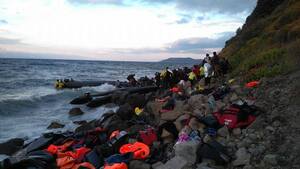
A dispatch from an Irish volunteer helping with the refugee crisis in Eftalou (above) on the island of Lesbos, Greece.
Bewildered Student writes:
I arrived in Eftalou on Lesbos island, Greece last Saturday week. Located around 70km north west of the island’s main city Mytilene, the village is home to a picturesque pebbled beach, overlooking the Aegean Sea and the Turkish coastline.
I went for a walk heading eastwards along the twisty, hilly, cliff-edge dirt road cut into mountainous terrain that stretches for 17km from Eftalou to the pretty village of Skala Sykaminia.
Reaching the top of the dusty hill at the edge of Eftalou, the the view unfolded to show a breathtaking seascape framed by a necklace-like chain of discarded neon orange life-jackets snaking along the Greek coastline.
I met an elderly Greek man, who was also looking out at the sea that looked as flat as glass under the scorching sun.
‘No boats today,’ he said referring to the daily arrival of almost 7,000 refugees.
But, within hours, they came.
Several days later, the weather changed and it rained solidly for almost three days. The dirt road from Eftalou to Skala Sykaminia – where volunteers drive all day watching out for boats -crumbled from the heavy rainfall and the only way I can describe the situation is utter chaos.
The well-intentioned people who are helping them off the boats, giving them clothes, food, water, and medical attention – before sending them on their way to Camp Moira, where every refugee has to register – are volunteers.
Save for the nurses, doctors and one small team of four Spanish lifeguards, the volunteers are very young and inexperienced.
The effort that’s playing out along this 17km of coastline is super-human but it’s fragmented, splintered, ill-conceived and, because of this, dangerous for both the refugees and the volunteers themselves.
I have rowed in with a Norwegian volunteer group, Dråpen i Havet (A Drop In The Ocean) and, in just a week, I have seen exhausted volunteers weep as they process what they have witnessed, what they have heard and come to terms with what they cannot do.
People are dying in the water; boats are disappearing from sight; refugees who make it to the shores of Lesbos tell of children falling out of the boats; some refugees who are tasked with driving the boat, but who can see how dangerous the journey is, tell of guns being held to their heads when they wish to turn back to Turkey; some tell volunteers that they injected their children with heroin so that they don’t wail throughout the boat trip and risk being tossed over the side of the boat; they tell of passing destroyed boats and seeing people drowning.
The volunteers are everything from dancers to bankers, they do the best they can and use common sense but they still don’t know what they’re doing – all on maybe three to four hours’ sleep.
The refugees come off the boats freezing cold, drenched, tired and scared. Children and babies often have to sleep on the street, in the rain, with no blankets or cover. Some haven’t eaten for days. The shocking lack of logistical expertise means that even when the volunteers have water, food and blankets they literally don’t know how to distribute these essentials because they’re afraid of a mob forming.
A poorly constructed camp with the UN logo emblazoned on its cabins and tent in Skala Sykaminia is run solely by volunteers. I have been there several nights until the early hours of the morning and there are no UN staff here.
There is no significant support from any major organisation that could, first of all, care for the people who land along this 17km stretch correctly and, second of all, co-ordinate and create an efficient manner to help these people reach Mytilene.
Pic: Dråpen i Havet

https://www.youtube.com/watch?v=MrOhYUYbmTk
*swerve*
Martin writes:
Caught this on my way to work on Friday morning just beside the Convention Centre [north quays, Dublin]. Up there with some of the most dangerous driving I’ve ever seen That junction gets a lot of crazy behavior as the lights on the right only stay green for a short period and the junction is always blocked with traffic to the left. Same place I caught this: (which you previously shared)


‘sup?
Annie West writes:
This little guy appeared in the Enchanted Bit of the new BenBulben walk on Saturday morning. Checked to make sure I wasn’t hallucinating as a crowd gathered and yes he’s definitely there. Called Sligo County Council and Coillte and they don’t know anything about it. After a bit of consultation we’ve decided to call him Dave. Also I think I saw him move.
SHROOMS SHROOMS SHROOMS SHROOMS

http://www.youtube.com/watch?v=_1SmJUBT5q0
What you may need to know:
1. After a break of 14 years, Chris Carter brings Mulder (David Duchovny) and Scully (Gillian Anderson) back together for a short run miniseries.
2. These six episodes will combine wider X-Files mythology with old school monster-of-the-week stuff.
3. And will presumably address why the Earth wasn’t colonised back in 2012.
4. There is absolutely no truth to the rumour that “Cigarette-Smoking Man” is now a vaper.
5. With TFI Friday back on the box and more Twin Peaks in the works, the 90s revival is definitely on. B*witched are probably putting a new album together as we speak.
6. Broadsheet prognosis: Just don’t mention that second movie.
Release Date: January 24, 2016 (Fox).
(Mark blogs about film, TV and other stuff at WhyBother.ie)

From left: Socialist Party TD Paul Murphy, People Before Profit Dublin City Councillor Brid Smyth and Sinn Féin TD Pearse Doherty at a Right2Water press conference in August.
Sinn Féin will announce this week that it has signed up to a number of broad policy principles drafted by those behind the anti-water charges movement and ask its supporters to transfer to others who support the initiative.
Party sources say supporters will be asked to continue their preferences for other parties and Independents who have signed up to the Right2Change policy principles. One source also said Sinn Féin signing up to this approach will create a “new dynamic” for the election.
The Right2Change group already includes the People Before Profit and Socialist Party-Anti Austerity Alliance.
FIGHT!
Sinn Féin to agree pact with left-wing parties and Independents (irish Times)
(RollingNews)


From top: Passos Coelho of the right-wing PSD; António Costa, leader of the opposition Socialist party and supporters; Dr Julien Mercille
What is the truth behind the alleged coup in post-election Portugal?
Dr Julien Mercille writes:
This weekend, there was a lot of talk on social media about an alleged coup in Portugal. For example, on twitter, #PortugalCoup was very popular.
However, the truth is that there has been no coup in Portugal, not even a constitutional crisis. But this could change, of course.
How did the whole controversy arise? (Interesting discussions may be found here , here and here.
On October 4th, legislative elections were held for the Portuguese parliament, which has a total of 230 seats.
There are two main electoral groups: left wing and right wing. The two main right-wing parties won 107 seats together, while the three main left-wing parties won 122 seats.
However, the one party that won the most seats on its own is the right-wing party PSD, which got 89. It is led by a man called Passos Coelho.
What was unexpected in the election is that the centre-left Socialist Party (PS), which can be compared to Ireland’s Labour Party, did not do as well as expected. On the other hand, the “radical left” parties Bloco de Esquerda (“Bloco”) and Communist Party did very well.
Bloco is interesting to watch because it is the Portuguese equivalent of Syriza in Greece and Podemos in Spain. It is one of those new left-wing parties that got electoral traction in Europe during the economic crisis of which we are slowly emerging.
The last player in the thriller is the President of Portugal, Mr. Cavaco Silva. He was elected in 2006 (there are separate presidential elections in Portugal) and he happens to be a member of the right-wing PSD party that got the most votes in the legislative elections. He’s a big political figure in Portugal who has been around for a long time. You can compare him to Margaret Thatcher in his politics and significance, so pretty right wing.
The normal procedure is that following a legislative election, the President offers the leader of the party that got the most seats the opportunity to form a government. So the President gave that chance to the leader of the PSD, Passos Coelho.
And there’s the rub. Passos Coelho cannot muster a majority in parliament. Indeed, the right-wing parties (PSD and CDS) only have, together, 107 seats. That falls short of the majority needed of 116 seats.
However, together, the left parties (Socialist Party, Bloco, and the Communists) have 122 seats and thus have a majority. Therefore, they could vote down any piece of legislation introduced by a right-wing government.
And here one can see where the accusation that the President conducted a coup comes from. He asked the leaders of the right-wing parties to form a government even though it is the left-wing parties that have the most seats.
However, the fact is that this accusation is wrong. The President just followed tradition: it is always the leader of the party that has the most seats in parliament that gets asked first to form a government. The President, therefore, did nothing wrong or illegitimate in this respect.
But this is not all what fuelled the “coup” story. In his speech, the President made some revealing remarks that were truly extraordinary and deemed very inappropriate, even by some members of the right-wing parties.
What he said is basically that he would not allow in government leftist parties, like Bloco and the Communists, that oppose Europe’s regime of austerity and NATO.
The President effectively conveyed that he cared more about what financial institutions and the European establishment think of the Portuguese elections than what Portuguese people want. Indeed, he declared:
“After having completed a demanding programme of financial aid, which implied heavy sacrifices for the Portuguese, it is my duty, within the scope of my constitutional remit, to do everything possible to avoid that wrong signals are transmitted to the financial institutions, investors and markets, placing in question the Country’s external trust and credibility which, with great effort, we have been gaining”
In short, he doesn’t want parties that challenge the Eurozone and NATO to be in government:
“The observance of the commitments assumed within the framework of the Euro Zone is decisive, is totally crucial for the financing of our economy and, consequently, for economic growth and job creation”.
The parties that the President does not want in government are Bloco and the Communists because they have called for:
“the repeal of the Lisbon Treaty, of the Budgetary Treaty, of the Banking Union and of the Pact of Stability and Growth, as well as the dismantlement of the Economic and Monetary Union and Portugal’s exit from the Euro, and, still further, the dismemberment of NATO, of which Portugal is a founder member”
This is very explicit, and it infuriated many throughout Europe. It has been suggested that it meant that the European Union, or the troika, had concocted a coup towards Portugal, by forcing out parties that oppose European austerity.
But as stated above, so far, there hasn’t been any coup because everything has proceeded normally (except for the President’s incendiary words). Even the left parties agree with this. For example, a leader of Bloco, Catarina Martins, said that the President’s speech was unacceptable not for the decision to give the right-wingers the first shot at forming a government, but for the comments he made against left parties.
But the soap opera is not over, far from it.
What will most likely happen next is this.
Within a few days, the right-wing government will lose the parliament’s confidence, because it doesn’t have a majority.
Then the question will be: what will the President do? Normally, he should give the opportunity to the left parties to form a government, which ostensibly, they would be able to do, because they have a majority of the seats.
But what happens if the President remains stubborn and simply does not want to let the left parties Bloco and the Communists enter government? Then, we’ll have a real constitutional crisis, and depending on how things go, something that one could characterise as a coup by the President.
Sparing you the legal details, an additional problem is that, according to Portuguese law, there cannot be new elections before nine months from now, so governance in the country until then would be unstable and uncertain, to say the least.
If, on the other hand, the President yielded and allowed all left parties to form a government, then, we would have a majority government of the left.
But even then, problems could arise between the Socialist Party, which is centre-left, and Bloco/Communists, which are “radical left”. Would those two groups be able to agree on enough common policies to maintain a government, or would they fail to reach consensus to the point that their government would fall?
To follow the developments, watch this space.
Julien Mercille is a lecturer at UCD. His book Deepening Neoliberalism, Austerity, and Crisis: Europe’s Treasure Ireland is out now. Follow Julien on Twitter: @JulienMercille
