








Author Archives: Admin

Last night.
On TV3’s Tonight with Vincent Browne.
The panelists were: Michelle Murphy, from Social Justice Ireland; policy analyst Dr Rory Hearne; media lawyer Andrea Martin, and political correspondent at The Irish Times Harry McGee.
In the latter half of the show, they discussed the Disclosures Tribunal, following on from Judge Peter Charleton making his opening statement yesterday morning.
The tribunal will investigate allegations of a smear campaign against Sgt Maurice McCabe.
Specifically, Mr Browne raised the subject of journalists and their sources.
Vincent Browne: “There is another issue that arises and it is that a woman made, allegedly made allegations of misconduct against Maurice McCabe which she subsequently withdrew*. And which the DPP found, it couldn’t possibly prosecute on the basis of those allegations. But the name of that person was disclosed to at least two journalists who went off and got exclusives in interviews with this woman. Now that would seem to me that there’s something really insidious involved in that. And who disclosed it? And the journalists then going and interviewing those people. What do you think about that, Harry?”
Harry McGee: “Well, I don’t know if, I mean, what evidence is there that the name was disclosed to journalists?”
Browne: “Well, how else would journalists know otherwise?”
McGee: “Well, I don’t know, you’d have to ask the journalists.”
Browne: “I know but can you think how the journalists would know otherwise?”
McGee: “I can think of many ways in which journalists might know otherwise.”
Browne: “Tell us.”
McGee: “Well, they might have been told my some other people, they might have…”
Browne: “By who? Who’d know?”
McGee: “Well, I don’t know, Vincent.”
Browne: “But who’d know? A priest? A nun? A social worker? A counsellor?…”
McGee: “Well, who do you say? Who would you suggest told the journalist?”
Browne: “I would think that the likelihood is that it was the gardai, members of An Garda Siochana.”
McGee: “I just, I don’t know. I, I…”
Browne: “These are crime journalists that were…”
McGee: “But listen I wasn’t [inaudible] to that particular story, Vincent, you’re asking me to give…”
Browne: “Social workers wouldn’t have much truck with crime journalists…”
McGee: “You’re asking me to answer a question for which I have no, I have no direct knowledge.”
Browne: “Assuming, assuming that it was revealed by gardai – or that the journalists were tipped off by members of An Garda Siochana – this would be pretty insidious, wouldn’t it?”
McGee: “If they were tipped off about the…the identity of…?”
Browne: “Given the name of the person who originally made the complaint.”
McGee: “But there’s no evidence to suggest that at this particular juncture, Vincent, other than supposition. And I, I have no direct influence…”
Browne: “What do you mean there’s no evidence for it? The fact of the matter is: a woman made a claim of abuse. Subsequently, that woman’s name was released to journalists, crime journalists and they went and interviewed that person.”
McGee: “But, you, there is no direct evidence that the identity of the woman was released by gardai. They might have come to identify that woman and find out where that woman was and contact that woman from a separate source. To illicit that information. I think that you should ask…”
Browne: “But is it likely that, is it likely that, given that it was the crime journalists that were given that information – not journalists that are involved in social issues or political journalists or whatever – it’s crime journalists. Isn’t it likely that they got it from the gardai?”
McGee: “Well, there’s a possibility…”
Browne: “But anyway…”
Talk over each other
McGee: “I just can’t…”
Browne: “If that’s so, do you think that’s another dimension of insidiousness with the garda in this whole thing?”
McGee: “Well, I mean, if that were so, yes it would be. But there’s no direct evidence to suggest that, Vincent.”
Browne: “Ok, in your view, in your view, can journalists validly claim confidentiality with regard to their sources, in respect of texts they may have received, or emails, or whatever, they may have received, concerning phone calls, relating to false information concerning Maurice McCabe?”
McGee: “Well, I think that, what the judge was doing today was he was making a distinction between legal professional privilege where he said that the privilege lay with the client and that of informant privilege where it lay with the informer, as opposed to the recipient of that, which is the journalist in this case. And that’s an important distinction, that he’s making. So, I think that, from what I, he said he [Judge Peter Charleton] hasn’t reached a conclusive decision in relation to this and he’s going to receive submissions on it. But he is making the case that if the informer were to waive his or her privilege, than the privilege wouldn’t attach to the journalist who received it. Now, but, for that to work, the journalist would have to reveal who their source was and the journalist, no journalist, in my experience would reveal who the source was. The second…”
Browne: “But, on what basis?…where information was received, that was entirely false, designed to do terrible damage to a person’s reputation, all in the aim of discrediting that person, in the context of…”
McGee: “But in your own, you said that it was, in your opinion, that journalists actually believed the information that was conveyed to them. So, in this case, I think that the test will be a subjective test because if it were an objective test, if the journalist believed that what was being said to them was a calumny, detraction, was a lie – that would be ludicrous and the journalist would be in dereliction of their duties as journalists. So I think that journalists, who received that information, believed that information to be true…”
Browne: “And they should not disclose and, in your view, they should not disclose the source?”
McGee: “Well, yes, if, I think journalists are quite entitled not to disclose their source.”
Browne: “On what basis do you think that?”
McGee: “On the basis that they gave an undertaking to their source that they wouldn’t compromise that source. They believed that information that was being given to them at the time…”
Browne: “And if it then emerges that that source told them lies, and malicious lies, should the journalist still be bound by the the confidentiality arrangement?”
McGee: “Well, that would be post-hoc and so..”
Browne: “Well, we now know it was lies…”
McGee: “I think that might change the circumstances somewhat, if the informer were to waive their privilege. But the difficulty is that the journalist would then be required to reveal their source.”
Browne: “Yeah.”
McGee: “That would present a difficulty for journalists.”
Later
Andrea Martin: “[If she was a journalist] What I would do is I think that I would disclose my source. If ordered to by the court to do so, if there was no greater good going to be had by staying silent on it. But I think many, many journalists would not agree with that. And it’s a personal decision…”
Michelle Murphy: “I think if you are aware that, or if you become aware that what you have been used as a conduit to spread lies then, I think the journalist, in order to protect their integrity, might do so. If they felt that they were being used by a particular individual….in this exact situation, I think they should. But then there’s other areas where you need whistleblowers, in for example, the HSE…”
Rory Hearne: “I think in this case, yeah, they should. I think that the level of maliciousness, the extent and depth of, you know, it’s just shocking to see the corruption and the way people are treated. Our institutions are, you know, used. People who are supposed to be there to protect us are actually, you know, like the guards, are doing things like this to other guards. Tusla has appeared to be used, it’s just disgusting if you ask me. And I think if you were a journalist, and you realise that these people had done this, you know, used you, to denigrate their colleague, then I think I would say, ‘I’m going to tell who that person is’.”
*Broadsheet understands that what’s been reported thus far has been that the girl made an allegation against Sgt Maurice McCabe in 2006, it was investigated, a file was sent to the DPP – with the recommendation that there was no grounds for a prosecution – and the DPP directed that no prosecution should be taken, with the observation that it was doubtful the allegations should constitute a crime at all.
Watch back in full here

Swiss animator Frederic Seigel’s short, inspired by the obsessive compulsive eccentricities of himself and his family. To wit:
On his way to work, Ruben is haunted by obsessive-compulsive thoughts; is the front door locked? Is the stove really turned off? As Ruben’s creative mind is invaded by increasingly absurd scenarios, reality and imagination begin to merge…


This morning
Glass Dublin writes:
Dream car from the ’70s – near Dublin markets. BMW 2002 (from the Baader Meinhof Wagen era) 2002 Brightens my day… #pradameinhof chic.
Cosy
at

Yikes!
Bags the side nearest the door, etc.
Saint Vincent Street South, The Five Roads, Dublin 8 (daft.ie)
(Thanks Davey)

A Cork festival, with Cork bands, at the Cork Opera House, for all the people. April 28th-30th.
Writes Edel Curtin:
Right Here, Right Now is a brand new music festival presented by Cork Opera House and Coughlans Live Promotions from April 28th – 30th, celebrating the vibrant, eclectic music scene in Cork City. Featuring over 20 different artists, the festival is a unique snapshot of a time and place through the lens of the city’s artists.
This festival brings together some of the finest acts and musicians in the bustling music community around Cork, from brash bands, to balladeers, from sweet soul, to rock and roll, with a full concert orchestra thrown in for good measure! One of the highlights of the weekend sees Jack O Rourke and band perform his critically acclaimed debut album Dreamcatcher with the Cork Opera House Concert Orchestra, directed by John O Brien and featuring special guests Strung and Anna Mitchell.
Full line-up, including Broadsheet featurees Shookrah and The Shaker Hymn, as well as tickets, available here.

Post-Punk Podge – Limerick agitprop
What you may need to know…
01. A very tall man clothed in padded envelopes and The Fall T-shirts, known to turn up at Naive Ted gigs to commandeer the house mic, has begun filing his own material for release.
02. Ted’s label, The Unscene, possibly out of some sort of intimidation or duress, has relented to his ideas, and a collaborative E.P. between the two is due this year.
03. Streaming above is debut single Post-Punk Election Party, released last May with the aid of his house band, the Technohippies. Possibly still relevant given the recent tumult in the Dáil?
04. He’s posting videos of himself in training for the next Community Skratch Games, in Galway over the upcoming Easter Weekend.
Thoughts: A riot for punx, noise types and the Irish political spectatorship alike. Worth the listen for the opening verse’s imagery alone!

Last night.
Keelin Shanley on RTÉ’s Crimecall.
Busted.
Thanks Niall Smith
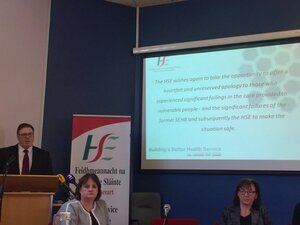
HSE officials holding a press conference in Kilkenny this morning
This morning.
Following the seven-year efforts of social worker whistleblowers, the HSE is publishing two reports into serious failures at a foster home in Waterford.
A press conference on the matter is currently under way in Kilkenny.
The reports, the Conal Devine and the Resilience Ireland reports, were commissioned by the HSE and both looked at the services provided by this particular foster family – who had looked after 47 children intermittingly over a 20-year period, up to 2013.
One of these children was Grace, a non-verbal, intellectually disabled woman who is now in her 40s and who lived with the family for 20 years, until 2009.
Grace lived in the home for almost 13 years after the local health board decided to stop placing children at the home.
The 148-page Conal Devine report was completed in 2012, while the 92-page Resilience Ireland report was finished in 2015. Copies of both reports were issued to service users and families of service users yesterday and some journalists have had sight of them.
In this morning’s Irish Examiner, Daniel McConnell and Fiachra Ó Cionnaith report:
The 2012 Conal Devine Report and the Resilience Ireland Report into the foster abuse scandal reveal Grace suffered significant physical injuries before being removed from the home in 2009. The two reports are due to be published today.
The injuries include black eyes, bruises to limbs, and carpet burns on her back, while she also suffered horrendous neglect in terms of her physical condition.
The Devine Report details how an original 1996 decision to remove Grace from the home, amid allegations of sexual abuse, was overturned following representations to the then health minister Michael Noonan.
It shows that a seperate allegation of “sexual molestation” against a second child in 1995 was not properly investigated because of the absence of a formal complaint to gardaí.
Meanwhile…
Last night, on RTÉ’s Claire Byrne Live…

One of the social workers who blew the whistle on the Waterford home spoke to Claire Byrne last night.
Her identity was protected during the interview (above).
While speaking with Ms Byrne, the woman told how, after raising concerns with the HSE, the Department of Health, the Department of Children and Youth Affairs and the gardaí, she felt she had to go to the Public Accounts Committee – to highlight the wastage of taxpayers’ money – in an effort to get answers.
The move resembled that of Garda whistleblowers Sgt Maurice McCabe and former Garda John Wilson, who also approached the Public Accounts Committee – to highlight the loss of money for the State – when they were trying to highlight the quashing of penalty points.
From last night’s interview:
Claire Byrne: “Grace is currently a client of yours and, before we begin, it’s important for me to ask: is she in a safe place now?”
Social worker: “She is.”
Byrne: “Allegations of sexual abuse, physical abuse and neglect. When did the extent of the allegations, regarding the foster care facility become known to you?”
Social worker: “It really started in 2009 that my colleague and I began to become aware of some concerns that we were, I suppose, unaware of, up to that point. But, really, over the last seven to eight years, we’ve become aware of more and more, a litany of failures I suppose to address these concerns, more concerns about different types of abuse, the number of people involved. And right up to today with the publication of these reports, it’s the first time that we’ve become fully aware of what was known to the health board and the HSE at various times.”
Byrne: “And it’s estimated that 40 individuals would have passed through this care home?”
Social worker: “Yes, what we know from today’s reports is that, in total, there were 47 children and vulnerable adults with disabilities, some of them for long-term placement, some of them for short-term respite care breaks.”
Byrne: “Now, when Grace was living at the home, the local authorities became aware of serious allegations by a previous resident and steps were taken, at that time, to remove the resident still living there, but Grace went on to live in that home for a further 13 years. Isn’t that the case?”
Social worker: “That’s correct.”
Byrne: “Now, seven years ago, you began a process of uncovering why Grace had remained in that care home, despite the complaints that had been made and the concerns that had been raised. You blew the whistle on what you believed had happened. To whom and which organisations did you speak to?”
Social worker: “We made a protected disclosure to the Department of Health, in the first instance, we then went to the Office of Protected Disclosures, within the HSE. At various times, I’ve been to the Office of Ombudsman, the Department of Children and Youth Affairs, several different departments within the HSE itself, right up to the very top echelons of the HSE. I’ve been to An Garda Siochana, we’ve had numerous inquiries, reviews and investigations out of those processes and, still, I suppose, in 2014, late 2014, I was in a position where I still didn’t know what had happened. I still had no answers… I hadn’t achieved anything other than endless inquiries, reviews, significant amount of taxpayers’ money – over half a million on inquiries at this stage, plus I would say, an equal amount on legal fees and management consultant fees. And so I decided to investigate the procurement processes in relation to those and that gave me, I suppose, a circuitous route to the Public Accounts Committee. And I was quite fortunate there that, upon meeting John McGuinness, and explaining to him my concerns around wastage of taxpayers’ money on unpublished reports, you know, answers we weren’t getting, learning that wasn’t happening, that we weren’t protecting vulnerable adults or learning from these failures. And John McGuinness, very quickly, took on board that there were more substantive issues, really than procurement. And it really is because of the work of the Public Accounts Committee that we are where we are today – waiting on a proposed Commission of Investigation.”
Byrne: “And where we are today, the HSE-commissioned reports, two of them will be published tomorrow [Tuesday]. Now there was one that was published back in 2012, that was the Conal Devine report. Another report was completed in 2015 by Resilience Ireland but neither report was published, as we know. They will be published tomorrow [Tuesday]. You have seen them, what do you make of the findings?”
Social worker: “While I was prepared for the lack of answers, we still don’t really know what happened. There seems to be, by and large, a failure to establish the facts, a failure to establish why certain things went wrong. We know that it went wrong, we just don’t know why yet. What I really wasn’t prepared for is the litany of failures. The word ‘failure’ it just seems to appear over and over again. Reading those reports today and seeing 47 individuals who were put at risk, there’s no other way around it. Their lives, these are people’s lives, they’re not just cases. They were put at risk. And I wasn’t prepared for how stark the reports would be in outlining 30 years of repeated failures. We know that the terms of reference for the Conal Devine report and the Resilience Ireland report were far too narrow to ever investigate what happened fully.”
Byrne: “Well, the Government has committed now to a Commission of Investigation into this foster home scandal and the minister in charge, Minister Finian McGrath will publish those terms of reference shortly. But what you’re saying is, the end result here, the one that you would hope for, is accountability in these cases?”
Social worker: “That has to happen. I think, at this stage, that, if the taxpayer sits back and doesn’t demand accountability on this, if they say, ‘well, I’m happy to pay for repeated inquiries and reviews and reports for a system that never holds anybody accountable’ – the same system, without any change, can’t affect different results in the future. That’s my concern. That, really, how can that system protect people if failures and a duty of care to the most vulnerable in our society – if we let that system become a risk to the very people it’s there to protect, how can that system ever protect vulnerable people?”
Byrne: “All of this, and given what you’ve just said. It must be hugely concerning for the families with those people with intellectual disabilities who are relying on the State to provide care facilities for them. I mean can we be sure that this isn’t happening now? Are the checks and balances in place now, do you believe?”
Social worker: “Oh I don’t think so. I think if I believed that, I wouldn’t be sitting here tonight, for a start. I wouldn’t have spent the last seven years, intend to spend the next couple of years working towards the Commission of Investigation’s findings to affect that kind of change. But, at the moment, I don’t think the system can adequately protect people. I think what we’ve seen, even around policy direction, what we have is people leaving foster care with an intellectual disability and there is no system for them to go into. They’re discharged from the care of Tusla. The HSE has a duty of care to them but doesn’t actually have a system of monitoring, vetting, oversight, training of the placements where they stay, if they’re in family-based placements. What we need is that for every child with a disability leaving foster care, if we learn anything from this, we need now for those placements to be regulated, for them to have oversight, to ensure that their needs are being met, to ensure if there are concerns, that action is taken and that there is a structure in place and that there is a system of regulation in place.”
Byrne: “Finally, we’ve heard an awful lot about whistleblowers and how they’re treated in this country. How was your experience, as a whistleblower?”
Social worker: “It’s been appalling. You know, it’s been a very difficult seven years and I think that, all through that, I was very lucky because I work for a very small agency that, when I came to that agency in 2009 – I was only a newly qualified social worker – this was actually the first case I ever had in disability social work. And, when I started raising those concerns, I had the support of the management team within the organisation I work, I had the support of the board of directors and the voluntary agency I work for. And that allowed me to go to all of the various departments I went to. To go to the Office of the Ombudsman, to go to the Public Accounts Committee. At no stage, did anybody – I suppose despite the impact that that had on a small agency – at no stage did anybody attempt to discourage me from that within the organisation.”
“The difficulties I faced within the HSE were significant and my concern is that for any other social worker now, who might be out there, who might know of another Grace today, that’s not a system that would entice anybody to make a protected disclosure, to blow the whistle on it.”
Byrne: “Thank you very much for your time.”
Watch back in full here
Previously: Grace, Monageer And Noonan
Top pic: Gavan Reilly
Refutation
at
Garda Commissioner Noirin O’Sullivan
Nóirín O’Sullivan claims she has repeatedly refuted the allegations made against her. She has done nothing of the sort. To refute something means to prove it to be untrue. The word she should have used is reject; but sure, refute sounds fancier and who knows what it means anyway? Except that if refute becomes just another synonym for reject, we will have no word to describe actual refutations.
Yours, etc,
Jonivar Skullerad,
Sandymount, Dublin 4
Rollingnews