Author Archives: Bodger

This afternoon.

Kildare Street, Dublin 2.

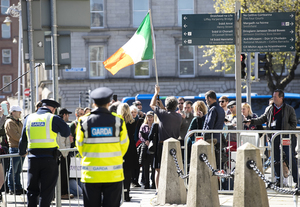
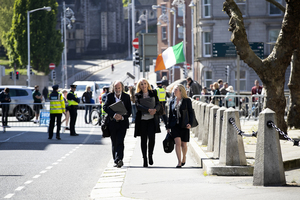
Fianna Fáil leader Micheá. Martin and Green Party Leader Eamon Ryan are greeted at Leinster House by Debenhams workers picketing outside the Dáil after they lost their jobs last Thursday when the retailer applied to be liquidated.

Previously: Regarding Henry Street

Leon Farrell/RollingNews

They’ll need to be at least twice that size.

Rob Loughlin writes:

Get creative and make yourself some models of vehicles from the Dublin Fire Brigade and National Ambulance Service. You can print [at link below] at home, cut out, and create!

Instructions here

Just ‘dropped’.

Full Colour: An Irish Street Art Story.

From Harry Moylan, who writes:

it includes interviews with Dublin’s Maser, Subset (top) and a load of big names from Belfast’s modern scene, as well as taking a look at the old political murals too for historical context.

Full Colour (Instagram)

Chair of Bar Council of Ireland Micheál P O’Higgins SC

This afternoon

Further to a report in The Irish Times this morning about the Bar Council of Ireland suggesting to the Courts Service that non-jury courts be used to try “ordinary crimes”…

The chair of the Bar Council of Ireland, which represents around 2,200 barristers, Micheál P O’Higgins SC spoke to Seán O’Rourke on RTÉ earlier about the report.

He said jury trials present a problem in terms of social distancing rules which are likely to remain for some time.

Mr O’Higgins added:

“The Bar Council [of Ireland] is looking at ideas as to how best to get the normal court system back up and running when the Government eases the current restrictions. And what we’ve done is we’ve sent, we’ll call it, an overused term perhaps, but a road map of sorts, or a list of suggestions, and proposals to the Court Service and we’re aware from their very [inaudible] response that they’re, it’s being actively considered by the Courts Service and we’re hoping at Government level.”

Mr O’Rourke said that the mention of “non-jury courts” prompts one to consider the word “Constitution” because people have the right to be tried by a jury.

Mr O’Higgins replied:

“That’s absolutely right and that is why, as it happens, any consideration of diluting or abolishing jury trials does not in fact feature. I’m looking at it here, does not in fact feature in the proposal that we’ve put in.”

Returning to The Irish Times report about “ordinary crimes” being tried in non-jury courts, Mr O’Higgins said:

“It’s an academic query: the suggestion whether the DPP’s power to certify that the ordinary courts are inadequate which is something that’s currently there and we know is used in gangland contexts or the context of paramilitary crimes [this step of certification occurs before cases are sent for trial in the non-jury Special Criminal Court].

“Whether that could be, quote unquote, imaginatively interpreted so as to incorporate a right to put other matters in the Special, I think there would be, I’m speaking personally, but I imagine it would be the view of many practitioners there would be constitutional implications to that.”

“One could readily imagine that if there was to be an attempt to force, unwilling litigants, under duress…”

Asked if some defendants, in certain cases, might feel they would more likely get a “not guilty finding” from a non-jury court, Mr O’Higgins said:

“Perhaps. It’s a troublesome one. I think that certainly, it would be something that a barrister would have to advise a client on and we would certainly have major concerns if there was to be any attempt to foist such a matter on unwilling litigants because, after all, as you’ve pointed out in the opening, the right to a jury trial is embodied in the Constitution, it’s there and it’s there for good reason.”

Asked how much “of this is driven” by a drop in barristers’ income, Mr O’Higgins said:

“The reality is that for, you know, barristers earn their income from court trials proceeding. If they’re not proceeding the tap is somewhat turned off. Now in our case it’s a bit of an unusual model in that there’s a tunnel of time or a period of time during, the period of when one gets paid for a case and the doing of the case. The carrying out of your professional obligations.

“So some barristers will continued to get fees in from cases done a year ago or two years ago. Particularly younger members, I’d be particularly concerned about who are reliant upon what’s known as the split-fee arrangement in the District Court where one gets not enormous sums now but in the region of €65 for [inaudible] trial or €25 for a remand which are important matters involving custody.

“If they’re stopping, even that level of income is not available to the younger barristers.”

Mr O’Higgins also told Mr O’Rourke that he’s aware of some barristers who’ve applied for the State’s Covid-19 unemployment payments.

Bar Council looking into idea of ordinary crimes being tried in non-jury courts (Irish Times)

PA/Twitter

Former Fine Gael Taoiseach John Bruton with former Fianna Fail Taoiseach Bertie Ahern and former Fianna Fail Taoiseach Brian Cowenat a Brexit conference in Dublin in 2018

This morning.

Right to Know CLG and Department of Public Expenditure and Reform (Right To Know)

Rollingnews

Meanwhile…

Yesterday.

Good times.

Rollingnews

This morning.

Four Courts, Dublin 1

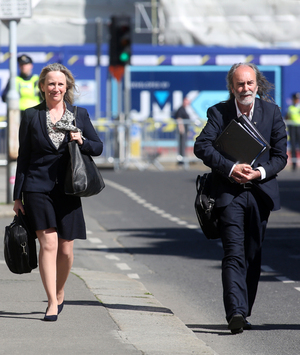
John Waters and Gemma O’Doherty arriving at the Four Courts for the second day the High Court action challenging the State over the introduction of Covid-19 restrictions.

The pair have launched a legal challenge against the State over its decision to implement ‘unconstitutional’ emergency measures in response to the Covid-19 pandemic.

More as we get.

Rollingnews

Update:

A Garda checkpoint on the N11 heading south out of Dublin last Saturday

This morning

Via The Irish Examiner:

Gardaí have invoked [covid emergency] regulations on 139 occasions, including arrests and cases where personal details have been taken for consultation with the DPP on the decision to issue charges, while pre-existing enforcement powers were also used in relation to 1,172 incidents since April 8.

These include drugs and weapons seizures, drink driving offences and public order incidents.

…From Apr 8 to May 2, there were 52 incidents of spitting and/or coughing against gardaí. Last week, this figure was reported as 31, indicating that another 21 incidents happened over the weekend.

Anti-spit guards, the controversial but legal ‘hoods’ which can be placed over assailants to protect gardaí from being coughed or spat at, have been used 28 times since Apr 8…

Man breached Covid-19 restrictions three times in one day; Regulations invoked 139 times (Kevin O’Neill, The Irish Examiner)

Yesterday: Meanwhile, At The Four Courts

Rollingnews

Professor Neil Ferguson and Antonia Staats

Last night.

The scientist whose advice prompted UK prime Minister Boris Johnson to lock down Britain resigned from his Government advisory position as it was revealed he broke social distancing rules to meet his married lover.

This morning, UK Security Minister James Brokenshire has called Prof Neil Ferguson’s resignation a “matter of regret” but an “appropriate course” of action.

Speaking on BBC Radio 4’s Today programme, he said:

“I’m obviously saddened to hear this development and the actions Professor Ferguson has taken but, ultimately, I think it is the right course of action.

I think Professor Ferguson has taken an appropriate course given the issues of ensuring there is clarity of message on upholding the rules and requirements on social distancing and just why that matters so much in terms of protecting our NHS and saving lives.

It is a matter of regret but that guidance is unequivocal, it is there to protect all of us.”

Minister says Neil Ferguson right to step down (The Guardian)

Exclusive: Government scientist Neil Ferguson resigns after breaking lockdown rules to meet his married lover (Daily Telegraph)

Getty/AP

Number of death notices posted on RIP.ie in April 2020; tweets from Gerard McCarthy and Pádraig MacCarron

Yesterday.

Gerard McCarthy, of Maynooth University and Pádraig MacCarron, of University of Limerick published their research after they looked at the number of death notices posted per county on RIP.ie in April 2020.

Mr MacCarron spoke to RTÉ’s Morning Ireland earlier and told how they found that there were more death notices for Dublin, Kildare, Laois, Meath, Louth, Cavan and Monaghan than any month over the past ten years in those counties.

In comparison, Kilkenny‘s death notices were about the same as April 2019.

Speaking about the accuracy of the figures, he said that the number of death notices posted on RIP.ie match up with figures from the Central Statistics Office death and mortality data.

Asked if the increase in death notices in certain counties can be “put down purely to Covid”, Mr MacCarron told Morning Ireland:

“Yeah, it seems to be. The mean number of deaths in April for the last ten years is about 2,500. And the official numbers give about 1,200 people died [of Covid] in April. So if you add those together, there’s only 60 extra deaths. And our death notices posted on RIP.ie compared to the average plus the number of deaths from Covid.

“And in fact if you add up the number of deaths from Covid to last year’s number of death notices, that would be about 100 higher than it is now. So it seems like the official numbers are quite representative and that’s the main cause of this excess.”

Listen back in full here

Meanwhile…

Meanwhile, on RTÉ’s Brainstorm, they write:

Nationally, the number of death notices posted on RIP.ie in April 2020 for the whole of Ireland are the highest on record, but comparable with January 2018 and 2017 when there was a bad flu season.

Typically deaths peak in Ireland in the winter are associated with respiratory diseases, including the seasonal flu. The number of death notices posted typically decreases going into April, whereas there is a spike associated with the coronavirus in 2020.

Comparing the magnitude of this spike to the seasonal peak in winter of other years, it could be argued as comparable to the numbers of death notices posted in previous years (January 2018 was the previous maximum).

There is increasingly heated debate about whether the unprecedented measures implemented to combat the spread of Covid-19 are necessary to maintain, if excess mortality is comparable to that of the seasonal flu.

However, this picture of the national situation, where Ireland could be on track to keeping mortality to that of a bad flu season, belies a more complex geography of the pandemic in Ireland.

…Looking in more detail at the map, it is the border counties of Monaghan and Cavan that are worst affected where the increase in postings in April 2020 relative to the average number of postings was 150% and 120% respectively.

What death notices tell us about the coronavirus across Ireland (RTÉ Brainstorm)

This afternoon.

Leinster House, Dublin 2

Green Party leader Eamon Ryan with Senator Pippa Hackett (top left) and Senator Pauline O’Reilly (top right) tells the press that he will begin formal talks with Fianna Fáil and Fine Gael on government formation on Thursday.

Green Party leader hoping to conclude govt talks by end of month (RTÉ)

Leon Farrell/RollingNews