A short by Grant Colton that delves into the strangeness that is human anatomy.
God, we’re weird though.



A short by Grant Colton that delves into the strangeness that is human anatomy.
God, we’re weird though.

Question: what could possibly shoot out a neutron star like a cannonball? Answer: a supernova. But you knew that. To wit:
About 10,000 years ago, the supernova that created the nebular remnant CTB 1 not only destroyed a massive star but blasted its newly formed neutron star core — a pulsar — out into the Milky Way Galaxy. The pulsar, spinning 8.7 times a second, was discovered using downloadable software Einstein@Home searching through data taken by NASA’s orbiting Fermi Gamma-Ray Observatory. Traveling over 1,000 kilometers per second, the pulsar PSR J0002+6216 (J0002 for short) has already left the supernova remnant CTB 1, and is even fast enough to leave our Galaxy. Pictured, the trail of the pulsar is visible extending to the lower left of the supernova remnant. The featured image is a combination of radio images from the VLA and DRAO radio observatories, as well as data archived from NASA’s orbiting IRAS infrared observatory. It is well known that supernovas can act as cannons, and even that pulsars can act as cannonballs — what is not known is how supernovas do it.
(Image: F. Schinzel et al. (NRAO, NSF), Canadian Galactic Plane Survey (DRAO), NASA (IRAS); Composition: Jayanne English (U. Manitoba)

Charming Tibetan Buddhist monk Yongey Mingyur Rinpoche explains how to chill that cranial primate out.
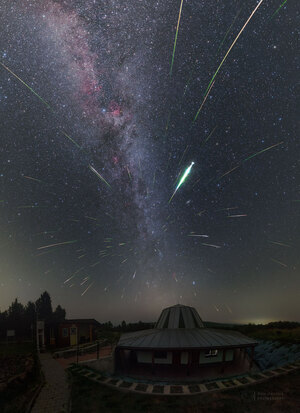
Did you catch the annual Perseid meteor shower last night? Of course you did. But it didn’t look like this. Because this (with a little technical adjustment) is what it looked like last year over Slovakia. To wit:
The featured composite image was taken during last year’s Perseids from the Poloniny Dark Sky Park in Slovakia. The unusual building in the foreground is a planetarium on the grounds of Kolonica Observatory. Although the comet dust particles travel parallel to each other, the resulting shower meteors clearly seem to radiate from a single point on the sky in the eponymous constellation Perseus. The radiant effect is due to perspective, as the parallel tracks appear to converge at a distance, like train tracks.
(Image: Petr Horálek)


Behold: the Riva Cinquanta Metri – a 50 meter long steel and Aluminium alloy super yacht from Officina Italiana Design – the company founded by Riva designer Mauro Micheli.
As you’d expect, it’s somewhat luxurious, with a main-deck master suite private lounge, four staterooms and a sky deck with hot tub, bar, and lounge areas. There’s room for 12 guests and nine crew and the boat has a range of 3,000 nautical miles at a cruising speed of 12 knots.
Yours for if you have to ask you can’t afford it.


German educational design studio Kurzgesagt explore a conflict old as time that shows no sign of ending. To wit:
Every day billions of soldiers fight a merciless war on thousands of fronts, that has been going on for over one hundred million years. The world war of the ants.
Previously: Bombs Inside Us


Two years ago, Lego builder The Brick Wall created a fully functioning Lego Technic hay baler.
This year he upgraded his design to produce neatly squared-off bales and also built a wagon to stack and transport them.
In fairness.

Behold: a rather extraordinary image of the star cluster of Messier 16, aka NGC 6611, aka ‘The Eagle Nebula’, surrounded by natal clouds of dust and glowing gas. To wit:
This beautifully detailed image of the region adopts the colourful Hubble palette and includes cosmic sculptures made famous in Hubble Space Telescope close-ups of the star-forming complex. Described as ‘elephant trunks’ or ‘Pillars of Creation’, dense, dusty columns rising near the centre are light years in length but are gravitationally contracting to form stars. Energetic radiation from the cluster stars erodes material near the tips, eventually exposing the embedded new stars. Extending from the ridge of bright emission left of centre is another dusty star-forming column known as the Fairy of Eagle Nebula. M16 lies about 7,000 light-years away, an easy target for binoculars or small telescopes in a nebula rich part of the sky toward the split constellation Serpens Cauda (‘the tail of the snake’).
(Image: Ignacio Diaz Bobillo)