


Part one of an episodic CG short – like an elaborate video game cut scene – with impressive character design created on Unreal Engine by animator Han Yang.



Part one of an episodic CG short – like an elaborate video game cut scene – with impressive character design created on Unreal Engine by animator Han Yang.

Marnie and Patrick Laird (aka Brooklyn Duo) perform another poignant instrumental cover – this time a very passable cello and piano version of Coldplay’s ‘Yellow’.
Previously: Mad Pair
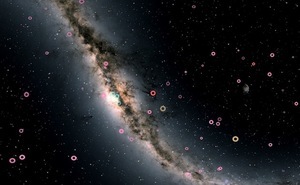
Exoplanets are planets known to exist outside our solar system. The first one was detected in 1992 and this video – using data from NASA’s Exoplanet Archive – visualises the chronology – in sound and light – of those we’ve clocked since. To wit:
The entire night sky is first shown compressed with the central band of our Milky Way Galaxy making a giant U. Exoplanets detected by slight jiggles in their parents-star’s colors (radial velocity) appear in pink, while those detected by slight dips in their parent star’s brightness (transit) are shown in purple. Further, those exoplanets imaged directly appear in orange, while those detected by gravitationally magnifying the light of a background star (microlensing) are shown in green. The faster a planet orbits its parent star, the higher the accompanying tone played. The retired Kepler satellite has discovered about half of these first 4000 exoplanets in just one region of the sky, while the new TESS mission is on track to find even more, all over the sky, orbiting the brightest nearby stars. Finding exoplanets not only helps humanity to better understand the potential prevalence of life elsewhere in the universe, but also how our Earth and Solar System were formed.
(Video: SYSTEM Sounds (M. Russo, A. Santaguida); Data: NASA Exoplanet Archive)

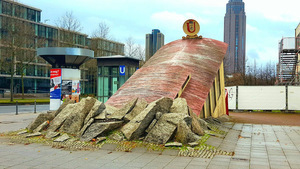
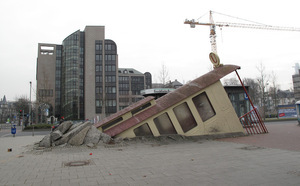

The entrance to Bockenheimer Warte U-bahn station in Frankfurt, designed by architect Zbigniew Peter Pininski and apparently inspired by the surrealist paintings of René Magritte.


Behold: the De Tomaso P72 Coupe – a 60th anniversary offering from the Italian marque paying curvaceous homage to the short-lived De Tomaso P70 of the mid 1960s.
Only 72 of these carbon fibre-bodied, quilted leather-lined presumed track monsters (on account of as-yet unspecified power plants) will be made.
Yours for just over three quarters of a million euro.


It’s very difficult to tell what’s going on at the centre of our galaxy, what with interstellar dust blocking the view of conventional telescopes. In other bands of light however, such as radio, it’s a pretty lively place. To wit:
The featured picture shows the inaugural image of the MeerKAT array of 64 radio dishes just completed in South Africa. Spanning four times the angular size of the Moon (2 degrees), the image is impressively vast, deep, and detailed. Many known sources are shown in clear detail, including many with a prefix of Sgr, since the Galactic Center is in the direction of the constellation Sagittarius. In our Galaxy’s Center lies Sgr A, found here just to the right of the image center, which houses the Milky Way’s central supermassive black hole. Other sources in the image are not as well understood, including the Arc, just to the left of Sgr A, and numerous filamentary threads. Goals for MeerKAT include searching for radio emission from neutral hydrogen emitted in a much younger universe and brief but distant radio flashes.
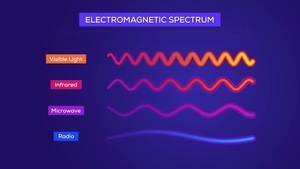

Another fascinating science animation from German educational design studio Kurzgesagt. In this case, the electromagnetic radiation that surrounds us and whether it’s as dangerous as some think.
Previously: Is Meat Bad For You?
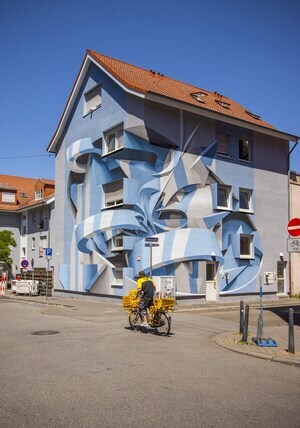


The morphing, dissolving, trompe l’oeil murals of Italian artist Peeta.
More of his M.C. Escher-esque abstract shenanigans here.
