


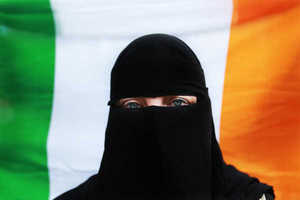

From top: Zainab Heaney from Ireland during a protest over France’s ban on women wearing the Islamic Niqad, Hijab, Abaya and Burqa; Dr Julien Mercille
Anti-extremism statements and pledges are not the way to go. They are against freedom of speech and implemented in a biased fashion against specific groups but not others.
Dr Julien Mercille writes:
In the wake of the terrorist attacks on Brussels, Muslims are often asked the question, “Do you reject the acts of terrorism committed in Europe?”
However, Muslims shouldn’t have to apologise every time a Muslim does something wrong.
To repeat the obvious: an act of terrorism committed by a Muslim has nothing to do with the 1.7 billion Muslims in the world. Terrorism is almost always a political act, not a religious act.
Sure, religion may or may not be used to wrap terrorist acts into some kind of ideological garment, but the roots are political.
In any case, it’s easy to see the double standards at play when we ask Muslims “to apologise for terrorism”.
For example, when it was revealed that the Irish Catholic Church had been involved in the mass abuse of Irish children, did we drag every Irish person in front of the cameras to ask them, “As a Catholic, do you unequivocally reject those actions?”
Or imagine that in Africa or Asia, a news presenter had asked a Christian, “As a Christian, do you dissociate yourself from the abuses committed by the Irish Catholic Church?”
And since terrorism is very often committed by men, why not ask every man on the planet, “As a man, do you reject in all your manliness those acts of terrorism?”
And why not require that customs officials of all countries ask Irish travellers, “As an Irish person, do you reject all acts of violence ever committed by the IRA and all its splinter groups?”
Of course, that would be laughable and demeaning and we would never think about doing this.
Yet, for Muslims, it seems to be different.
Two dangerous developments in Belgium and in Ireland are related to this.
Belgium just announced a plan to make all non-European visitors to sign a pledge to accept “European values” if they stay longer than three months in the country. If they don’t sign the pledge they won’t be allowed in Belgium.
This is because the Belgian government said that many people are coming “from countries with other values”. “If they want to build a life here in Europe [we have] no problem with that but they have to sign this statement that they accept our values”. Among other things, the statement will include a pledge to prevent and report any attempts to commit “acts of terrorism”.
In Ireland, leaders of the Irish Muslim community introduced an “anti-Extremism Declaration” that should be signed by any foreign Muslim speakers who come here to give speeches. It was even suggested that the Irish government should incorporate the signing of this declaration as part of the visa application process to visit Ireland.
Such policies are very misguided. They are against freedom of speech and will only serve as another tool for excluding immigrants and whoever governments don’t want to see in their countries. They will reinforce the demonization of immigrants and Muslims.
Just consider the Belgian proposal and see how absurd it is.
If the Belgians are worried about expelling violent extremists, the first thing they should do is to expel NATO—the military alliance of Western governments that has its headquarters in Belgium.
NATO has unleashed so much destruction in Afghanistan and Libya, let alone the destruction caused by the military forces of its individual member states, notably the US. If this doesn’t qualify as violent extremism, nothing does. Remember that perhaps one million people died in the Iraq War.
Next in line, they should expel all politicians who have supported those military adventures, and that includes a lot of European politicians. And while at it, why not expel anybody who votes for the political parties of those politicians.
Then, if the worry is to protect values of tolerance, why not expel members of far-right groups, including the National Front in France, UKIP, Pegida, etc.?
And why not expel members of the clergy who oppose gay rights, abortion, etc.?
In short, it is clear that none of this makes any sense whatsoever.
Therefore, anti-extremism statements and pledges are not the way to go. They are against freedom of speech; they are implemented in a biased fashion against specific groups but not others; and even if they were implemented objectively, they would be absurd..
The way to fight extremism is by enabling more freedom of speech and more democracy. Those who are scared of that are usually those who seek to prevent others from speaking.
Julien Mercille specialises in US foreign policy and terrorism and is a lecturer at University College Dublin. Follow him on Twitter: @JulienMercille
Yesterday: Declare And Present Danger
Rollingnews and IMPIC