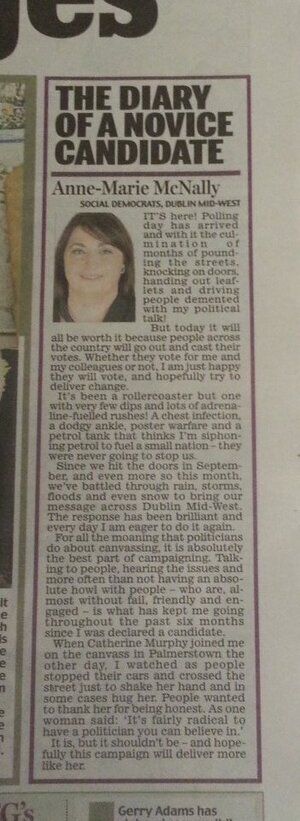



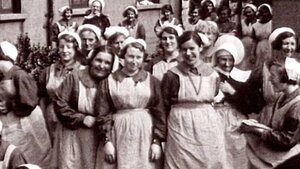
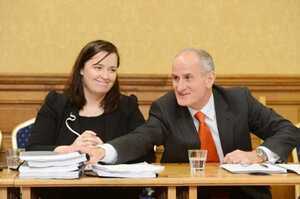

From top: A Magdalene Laundry in the 1950s; Nuala Ní Mhuircheartaigh (Department of Foreign Affairs), adviser to Martin McAleese in his role investigating State involvement with the Magdalene Laundries; Enda kenny during the leaders’ debate on Tuesday night
Also known as Opus Dei.
On Tuesday night, towards the end of the Prime Time Leaders’ Debate on RTÉ, presenter Miriam O’Callaghan asked the leaders what decision they regretted the most in their public life – political or otherwise.
When it came to Taoiseach Enda Kenny, the Fine Gael leader said:
“Well I regret a number but I would say that, maybe, to have been able to do things earlier but then that didn’t come my way. Like, that’s why I was happy to speak out about the sexual abuse in Cloyne, that’s why I was happy to do, to be moved by the tears of the Magdalene women, that’s why I was happy to deal with the people in Priory Hall, and that’s why I think it was important to be able to join the, join with the many hundreds of thousands who were able to provide freedom and relief for so many people in the marriage equality referendum. I had regrets about not being able to do things about those earlier but, when its come my way, we’ve been happy to work with others in delivering on that responsibility.”
Further to this.
Oireachtas Retort has dedicated their Election Day post to the survivors of the Magdalene laundries and symphysiotomy with pieces written by Claire McGettrick, of Justice For Magdalenes, and Marie O’Connor, of Survivors of Symphysiotomy.
Oireachtas Retort writes:
“You will find no clearer example of how brute uncaring force, casually demeaning people over decades is hardwired into the DNA of this state.
The cold indignity visited upon these women is multi-layered. The complicity and indifference that fuelled these crimes is not confined to the past but persists in the decisions we make in the ballot box today.”
In the post, Ms McGettrick reminds readers that, as the UN found the McAleese Report’s investigation to be neither prompt, independent nor thorough, it called for the Irish government to set up an independent inquiry.
But the government rejected the UN’s claim stating that because McAleese didn’t find evidence to “support allegations of systematic torture or ill treatment of a criminal nature in these institutions”, there would be no independent inquiry.
Further to this, Ms McGettrick writes:
“Are we to believe that the Taoiseach’s tearful apology [on February 19, 2013] was as a result of a ‘road to Damascus’ moment, or was it a political decision, designed to make the Magdalene problem go away? The experiences of survivors in contact with our organisation since the apology would suggest that unfortunately, it was the latter.”
“In June 2013, Mr Justice Quirke published The Magdalen Commission Report and while the financial element of the ex gratia scheme fell far short of what survivors deserve, we nonetheless welcomed it, in recognition of the other recommended benefits and services, particularly the establishment of a Dedicated Unit and the provision of an enhanced medical card which would provide access to ‘the full range of services currently enjoyed’ by HAA Card holders. We were pleased when the government announced that it would accept all of Judge Quirke’s recommendations.”
“...It is now three years since the apology, and the trust of Magdalene survivors has been seriously undermined, as the government has tried to cut corner after corner on its implementation of the ex gratia scheme. Survivors are still awaiting the establishment of a Dedicated Unit, a measure that should have been put in place immediately and not after the women have had to navigate the Ex Gratia Scheme alone. Some survivors have difficulty in proving lengths of stay because of the religious orders’ poor record keeping, yet incredibly, the government affords greater weight to the religious orders’ contentions than survivor testimony.”
“The healthcare provisions as outlined in the RWRCI Guide do not provide Magdalene survivors with the same range of drugs and services made available to HAA cardholders.”
“…Earlier this week a vulnerable Magdalene survivor phoned to say she had spent 17 hours on a drip in a chair in a crowded A&E. This same woman shed tears of happiness in the Dáil on the night of the apology. She phoned me the next day, concerned about the Taoiseach – ‘the poor man was very upset’ she said. Three years later however, she feels completely hoodwinked.”
“She read Appendix G of Judge Quirke’s report and signed away her right to sue the State based on the legitimate expectation that she would receive a comprehensive healthcare suite. She certainly expected better than 17 hours in A&E.”
Election Day 2016 (Oireachtas Retort)
Previously: Three Years Ago Today
The Magdalene Report: A Conclusion
Watch the debate in full here