
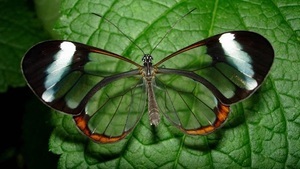


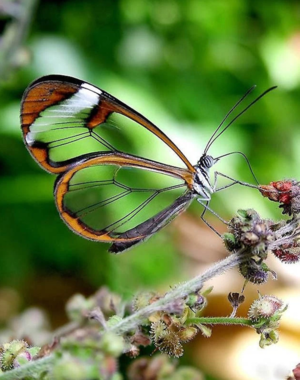
The Glasswinged butterfly (Greta oto) gets its name from the fact that the tissue between the veins of its wings lacks the coloured scales of other butterflies.
Its Spanish name is ‘espejitos’ (little mirrors).
Mmf.



The Glasswinged butterfly (Greta oto) gets its name from the fact that the tissue between the veins of its wings lacks the coloured scales of other butterflies.
Its Spanish name is ‘espejitos’ (little mirrors).
Mmf.


The sounds of the Amazon rainforest rendered as visuals by digital artist Andy Thomas. To wit:
I see sounds as moving shapes and colours in my imagination. Bringing these to life is the challenging part. There are many countless hours drawing sketches and testing particle effects. Some of the results are more refined and closely match my imagination than others.
Previously: Eye Candy: Synthetic Nature

Of this delightful baby octopus, Flickr user caretta156 sez:
I found this little guy inside of a scallop in Baja.

The shot of a lifetime, taken during yesterday’s solar eclipse by American photographer Kirsten Jorgensen.

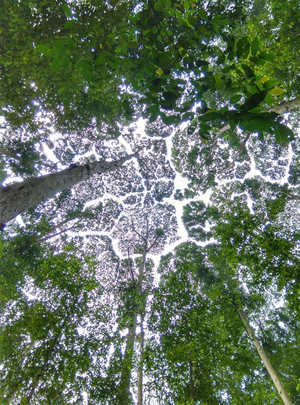


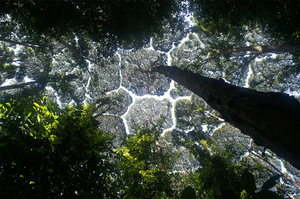

No, not digitally retouched photos but, rather, the all-natural phenomenon of Crown Shyness where the uppermost branches of certain tree species avoid each other in the forest canopy.
First discovered in the 1920s, the exact cause is unclear: whether the result of trees rubbing against one another or an active process by which the available light needed for photosynthesis is ‘shared’.
Either way, isn’t nature wonderful?
https://twitter.com/WorldAndScience/status/885710538424156160
Philliidae – when it comes to mimicking leaves, nobody does it better.
(H/T: John Gallen)
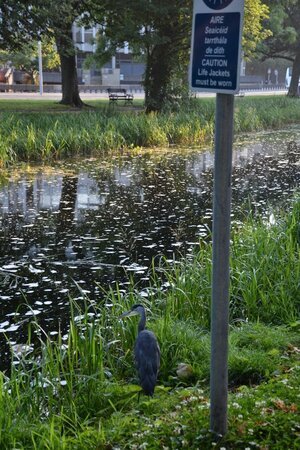
Earlier today by the Grand Canal, Dublin.
Carole tweetz:
‘Life jacket? I’m just tryin to catch my breakfast.’

A lamp designed by Leslie Nooteboom that projects animated patches of light on walls – mimicking the appearance of what the Japanese call komorebi (patches of sunlight reflected off water or filtering though leaves).
The idea is to add soothing ambience to high rise spaces usually denied such simple pleasures.
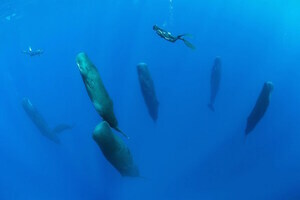
Photographer Franco Banfi‘s shot of a pod of sperm whales at rest, hanging together motionless and vertical in the water.
The whales do this for about 6-24 minutes at a time, exhibiting signs of REM (dream) sleep, an activity that accounts for 7% of their life.
The phenomenon was accidentally discovered by a team of UK and Japanese researchers in 2008.
