
The Phoenix magazine’s 2019 annual.
On all good shelves now.



It’s official, #DublinTownChristmas is here and we’ve brand new lights to welcome you to #GraftonQuarter! 💚🎄🎅🎊 #Christmas pic.twitter.com/8cbefzPjFC
— The Grafton Quarter (@GraftonQuarter) November 12, 2019
Last night.
Grafton Street, Dublin 2.
Oh, we’re back.
Meanwhile…
What gobshite decided to call Grafton Street “Grafton Quarter”? #GraftonStreet #GraftonQuarter
— The Bad Beard Dude (@TheBadBeardDude) November 12, 2019
Grafton Quarter me hole
— Gav O))) (@Birneybau) November 12, 2019
“Grafton quarter” get a grip…this is NOT New Orleans…its fucking Grafton street you utter idiots #DublinTown #DublinTownChristmas
— Fionn (@Fionn_Eire) November 13, 2019
I see that Grafton Quarter rebrand is going well.
Seriously lads, the amount of anger being expressed here.
There are many *many* things worth getting angry and upset about today.
That? Meh.
— Rick O’Shea (@rickoshea) November 13, 2019
Oh.
FIGHT!


Independent TD Noel Grealish; remittance figures, from the Central Statistics Office, provided to Mr Grealish last month
This morning.
On Morning Ireland, RTÉ journalist Rachel English asked Minister for Finance Paschal Donohoe about Galway West Independent TD Noel Grealish’s comments about remittances sent out of Ireland.
Yesterday, during Leaders’ Questions, Mr Grealish said:
“I bring to the Taoiseach’s attention the amount of money being transferred out of Ireland in personal remittances. Over the past eight years alone over €10 billion has left the country by way of personal transfers. That is a staggering amount of money.
The top five countries to which money was transferred in the past eight year include €843 million to Lithuania and €1 billion to France. The top three countries were: €1.54 billion to Poland, €2.7 billion to the United Kingdom and €3.54 billion to Nigeria.
These figures have been published by the World Bank which defines “personal remittances” as the sum of personal transfers and the compensation of employees.
It includes all current transfers in cash or in kind between resident and non-resident individuals independent of the source of income of the sender.”
“…Taoiseach, €3.4 billion transferred to one non-EU country is astronomical. Have Revenue or the Department of Finance any way of tracking this money or where it is coming from?
“Are mechanisms in place to ensure the money that leaves this country in personal remittances has been fully accounted for within the Irish revenue and tax system and is not the proceeds of crime or fraud?”
However, Mr Grealish was provided with significantly lower figures by Fine Gael TD Sean Kyne last month (see table above).
Further to this…
Mr Donohoe told Ms English this morning:
“The figures provided to me today by the Central Statistics Office are some way short of this. It is difficult to accurately estimate this but it can be modelled and the Central Statistics Office indicates that, across many years, that figure has been around €17million per year.”
The minister went on to say that, given the disparity between Mr Grealish’s figures and those of the CSO, it’s important for Mr Grealish to “make clear exactly where these figures are coming from” and “why he’s singling out particular country outside the European Union”.
Ms English and Mr Donohoe also had this exchange…
Rachel English: “It seems that the figure you quoted this figure of an average of €17million a year going to Nigeria and that contrasts, it should be said, with in 2017, €342million going back to Poland, €92million to Lithuania, €43million to India, €50million to Latvia, it seems that these figures were provided to Noel Grealish. Why do you think then that he used the other figure yesterday?”
Paschal Donohoe: “It’s up to him to clarify his intentions and up to him to clarify his use of figures. I’m very happy to clarify my view on these issues here which is that there has been much change in our economy, much change in our society as a result from people from elsewhere in Europe and outside of Europe coming to our country.
“It’s the kind of experience that Ireland visited to many other countries at other points in our history. We should have a degree of generosity and focus on the facts when we are debating this.”
In September, Mr Grealish referred to asylum seekers as “economic migrants from Africa who are coming here to sponge off us”.
H/T: Gavan Reilly.

Last night.
Irish Embassy, London
Deirdre Ní Choistín writes:
The 2019 Best Documentary Award at the Irish Film Festival London was presented last night to ‘Cumar – A Galway Rhapsody’ a film by Acadamh na hOllscolaíochta Gaeilge, NUI Galway’s Aodh Ó Coileáin (top).
Cumar – A Galway Rhapsody’ examines the influence of Galway city and Connemara on seven artists of varied fields.
In turn the lens focuses on the impact of these artists’ work on the place where they live. The artists featured in the film include: musician/composer Máirtín O’Connor, poet/playwright Rita Ann Higgins, novelist Mike McCormack, Noeline Kavanagh, artistic director of Macnas, singer song-writer, Róisín Seoighe, visual artist, Pádraic Reaney and comedian, Tommy Tiernan.
The film is scored by Galway composer Jake Morgan while Galway Street Club make a guest appearance with their own brand of music.
The film will screen at Regent Street Cinema as part of the Irish Film Festival London on Sunday at 7.30pm. The screening will be proceeded by a drinks reception celebrating Galway 2020, European Capital of Culture.
In fairness.

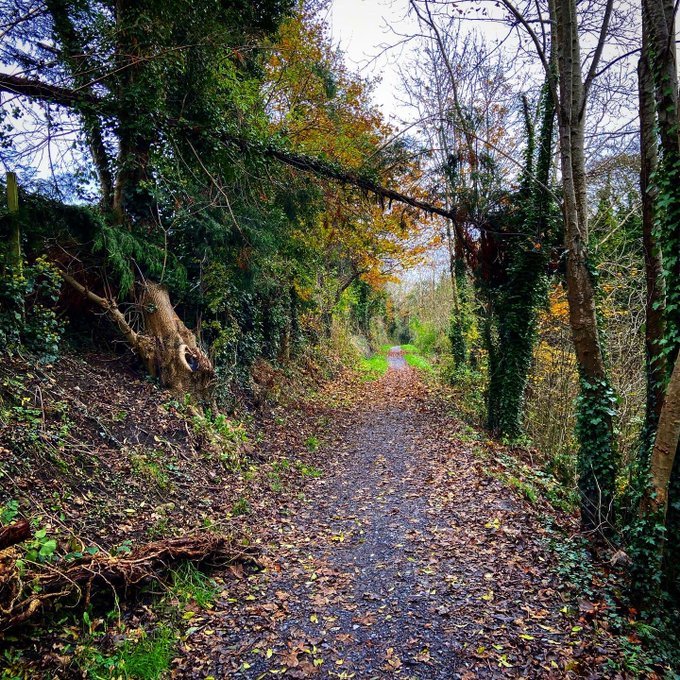

Colum Cronin tweets:
Some photos from Sunday’s walk along the @royalgreenway. The variety and vibrancy of autumn colours was stunning. Ireland is gorgeous.
In fairness.


 Letter written by Fine Gael councillor Emer Higgins to residents on Friday, April 4, 2014; front page article about the letter in the Lucan Gazette; Ms Higgins with fellow Fine Gael politicians Kenneth Egan, left, and Frances Fitzgerald, right
On April 4, 2014, Fine Gael councillor Emer Higgins wrote to residents to say she was “delighted” to announce that ten purpose built houses in Ballymakelly were not going to be bought by the council for a Traveller Accommodation Scheme.
It’s since resurfaced as she prepares for the by-election in Dublin Mid-West on November 29.
Last night.
In a statement to the Irish Examiner, Ms Higgins said:
“Straight up, this was about the council moving forward with new plans in an estate which hadn’t even met the conditions of the first scheme.
“In 2014, when the country was littered with unfinished ghost estates and negative equity, distressed mortgages and repossessions were a big fear in my area.
“My language was insensitive and did upset people and I apologised for that at the time.”
Previously: Emer’s Delight
Pic: Lucan Life


A discharge from the Ringsend wastewater treatment plant into Dublin Bay in February; the Environmental Protection Agency’s Urban Waste Water Treatment in 2018 report
A report by the Environmental Protection Agency into water water treatment in Ireland last year has found that raw sewage from the equivalent of 77,000 people in 36 towns and villages across Ireland is released into the environment every day.
It’s also found that Irish Water is “taking too long” to finish the “improvements necessary to protect the environment”.
It adds: “Delays mean 13 areas will continue releasing raw sewage after 2021.”
In relation to the Ringsend Waste Water Treatment Plant, the report notes:
Ringsend waste water treatment plant opened in 2003 with a capacity to cater for a population of 1.64 million.
It now serves an average population equivalent to 1.9 million, which can increase up to 2.3 million during busy periods.
The plant fails to meet EPA and European Union treatment standards because it is overloaded and is not large enough to consistently treat the waste water it receives to the required standards.
Waste water released from the overloaded plant into the Lower Liffey Estuary will continue to breach the treatment standards until the plant is upgraded to provide additional treatment capacity.
…The quality of the treated waste water will improve as the upgrade works proceed but is not expected to start meeting the required standards until the end of 2022 at the earliest.
The report can be read in full here

Berlin’s politicians are fine-tuning a redevelopment plan for a 3.2-acre site around Checkpoint Charlie (above) that includes a cold war museum and apartments
It’s been thirty years since the fall
Of Berlin’s great dividing wall
But its once mighty gate
Is in a sorry state
If you go there it’s bound to appal.
John Moynes
Getty