
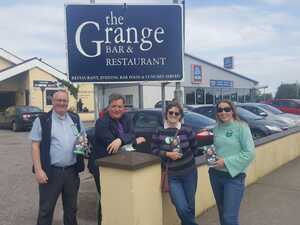
Top: Local Election candidate Dan Boyle (second left) canvassing in Douglas, Cork this week with Green Party colleagues.

Tomorrow is a day I’ve been working towards for the past six months. It is my fifteenth election.

While I’m experiencing the usual feelings of uncertainity, married with a somewhat obsessive need to do more, this is an election campaign that seems different.

Reactions on the doors have been more friendly. Angry responses have been fewer, and more about disillusionment with politics in general.

I’ve known what it is like to win. I’ve known what it’s like to lose, when I hoped I could win. For the most part I have contested elections as part of a wider and longer process.

I have tried to show that the values and ideas I hold, values and ideas I hold with others, could have a better application; a better way of doing things; achieving better results.

I have chosen to do so from a less traditional, less prominent place.

Politics has been a huge part of my life, but it has not been my life itself. It has dominated, affected me too personally too often, but there are more important aspects of my life involving my family, in particular, that I hold more dearly.

As precarious as politics can be, there are easier ways to navigate its often choppy waters. Who we choose to associate with, how we choose to act and what we choose to say, are the main detriments of political ‘success’.

Conventional wisdom is that you should choose to associate with those who have, or are near power. Once associated you should keep your head down. Do nothing that will rock the boat. Say or do nothing that hinders career prospects.

Not my choices, because of which my political journey has been more rollercoaster-like than it otherwise might have been.

I don’t regret any of it, even if there many things I wish I had approached differently.

What sustains me with these interests? What encourages to keep going?

Watching my colleague Saoirse McHugh perform so brilliantly in an European Elections television debate onTuesday night, has helped crystalise those questions for me.

I also have a daughter named Saoirse. They are both around the same age, half that of my own. I am reassured that the path I have followed will be travelled by others, certainly more assuredly.

I have seen myself as a pragmatist in politics. I have been involved in compromise in attempts to achieve incremental change. These are important political tools but they are, and should remain, secondary tools.

Passion should be the prime motivator in politics. Saoirse McHugh is showing that in spades. Her performance has bolstered my confidence and has hardened my resolve.

At a time when the very idea of a future for our planet is being compromised, never has this passion been so needed.

An increase in public concern surrounding our climate emergency may see more Green representatives being elected.

Hopefully so. However, even if raised expectations cannot be met, the Greens as a political party will have benefited enormously from this election campaign.

The performance of Saoirse McHugh is helping the party renew its soul. Collectively we will face future challenges more convinced we are pursuing the right approach. Our confidence re-established that we can succeed.

I’m more than happy to stand behind a new generation of torchbearers. Their energy giving more of us renewed energy. Their passion helping us to remember the commitment that sometimes we have misplaced.

I am honoured to continue to be a part of this process. I would be privileged to serve in whatever way the public decides.

Dan Boyle is a former Green Party TD and Senator and is standing in the Local Elections for the party in Cork tomorrow. His column appears here every Thursday. Follow Dan on Twitter: @sendboyle

Top pic via Dan

Wednesday: ‘Go On Dancing With The Stars If You Want The Attention’

Minister for Finance Paschal Donohoe at the Harvard Kennedy School and Irish Tax Institute’s Global Tax Policy Conference at Dublin Castle

Serious reservations have been expressed by Minister for Finance Paschal Donohoe over a move amongst some OECD members to advocate a minimum effective corporate tax rate.

Speaking at that Irish Tax Institute Global Tax conference, Mr Donohoe noted that the proposal for a minimum rate, which could range between 15 and 18 per cent, was problematic.

Paschal Donohoe concerned over OECD move to minimum corporate tax rate (Peter Hamilton, The Irish Times)

Leah Farrell/Rollingnews

Hugh O’Connell tweetz:

An ad in this week’s Mayo News featuring Michael Ring literally delivering bags of cash to Mayo

Previously: ‘I’m The Minister Of The Department And I Make The Decisions’


Dublin Rental Investigator tweetz:

Do you want to share a ‘twin cot’ for €370pm. This looks like a bed-share. Only available for 4 months which prevents tenancy rights. It’s a two bed apartment with 5+ tenants.

Seapark Apartments, Mount Prospect Avenue, Clontar, Dollymount, Dublin 3 (Daft.ie)

UPDATE:

Meanwhile…

Uncanny.

Previously: The Doors

Um.

Conor McCarthy tweetz:

Homeless numbers increasing everyday and Fine Gael candidates banging on about Tamagotchi, Fruit Salad and the Spice Girls. What a country.

In fairness.

From top: Voting in the General Election of 2016 at St Joseph’s NS in Cabra, Dublin; Bryan Wall

One of the issues worth expanding on with tomorrow’s elections is the idea of tactical voting. The simple fact is that Fianna Fáil and Fine Gael are cut from the same cloth. Civil War politics aside, at this stage their policies are one and the same.

The confidence and supply agreement all but confirms that they are essentially different wings of the same party: The business party. For both of them free markets take precedence over the average person.

Public spending on housing, health, and public transportation is anathema to both. And let’s not dare mention any kind of regulation when it comes to finance or housing.

Despite this, both parties will do quite well in the elections. Which of the two comes out on top will make no real difference. That leaves us with the rest of the parties and independents.

This ranges from Solidarity – People Before Profit to Renua, to everything and everyone in between. So the question is: If you want to ensure the most possible damage to Fianna Fáil/Fine Gael pact, and stop an incipient far right, how should you vote?

My own approach is to vote tactically.

My constituency in West Cork is in the heartland of establishment politics. But there is also a rise of far-right conspiratorial types who hate anyone non-Irish as much as they love talking about the dangers of chemtrails.

The combination of these two factors means I have a relatively easy decision to make. Vote against the establishment and at the same time ensure that the far right get nothing.

One aspect of tactical voting is figuring out who the establishment is. In my opinion that includes the Green Party and Labour. Both did untold damage to the country and the most vulnerable while in power. They might suggest that they are of the left but they simply aren’t. They have no political compass other than the quest for power once again.

Who does that leave?

To mention my own constituency again, that means voting for parties I have disagreements with, such as Solidarity – People Before Profit. This, along with voting for genuine outsiders who are of the people, — and don’t yearn for an all-white Ireland — ensures that the transfers will make a difference.

The outsiders running as independents in my own constituency understand the problems that we face and do legitimately want to do something about it. We don’t have a duty to vote but we do have a duty to fight hatred and inequality. And right now this means voting for people who believe in the same things.

Figuring out where Sinn Féin fit into this is, personally, tough. It makes the right sounds but so did Labour and the Greens. And like them, Sinn Féin has shown a willingness to cooperate with the establishment it so often criticises. The same can be said for the Social Democrats.

But it boils down to who do you hate more? Would you prefer a mix of Fianna Fáil and Fine Gael alongside members of the far right on your local councils and in Europe, or would Sinn Féin be a better alternative? For me the answer is self-evident.

In Dublin we have the appearance of Frances Fitzgerald on the ballot. Anyone remotely familiar with Maurice McCabe will know about her role in the scandal. The same calculus as above applies.

Do you want to reward dishonesty and at the same time allow a far-right victory? If not, then vote for candidates who understand racism, inequality, and injustice and will fight against them.

They might not change anything in the long-term, but it will terrify the establishment and its defenders. And it will undermine the political aspirations of the far right.

When it comes down to it, we’re in a situation where business as usual is creating more and more havoc. I don’t mean that people should go and vote for whoever claims to be against this arrangement. Many claim to want change and that they want to end corruption. In reality they’re far-right ideologues salivating at the chance of attaining power.

No matter what you think about voting and its effectiveness – and my own cynicism of it is well documented – there is a real chance to at the very least temporarily block the far right’s rise.

Along the way it might scare the establishment to witness a left-wing surge in the elections. Voting tactically will achieve this.

Bryan Wall is an independent journalist based in Cork. This is an election special. Bryan’s regular column appears here every Monday. Read more of Bryan’s work here and follow on Twitter:  @Bryan_Wall

Rollingnews

Yesterday.

Croke Park, Dublin.

Shot, in fairness.

Yesterday: They Are Amöng Us

Broadsheet.ie