
Larry Gogan receives a standing ovation on his last day on @RTE2fm #LarryGoganFM via @RTE_Ents @rtenews @SineadCrowley pic.twitter.com/PBnXwX7zGX
— RTÉ (@rte) January 31, 2019
This afternoon.
In fairness.
Previously: Gogan For Gold



Larry Gogan receives a standing ovation on his last day on @RTE2fm #LarryGoganFM via @RTE_Ents @rtenews @SineadCrowley pic.twitter.com/PBnXwX7zGX
— RTÉ (@rte) January 31, 2019
This afternoon.
In fairness.
Previously: Gogan For Gold


Behold: the Gemballa GTR 8XX Evo-R Biturbo Coupe – an elaborately streamlined, super-tuned 911 from authorised Porsche-tweakers, Gemballa.
This 818bhp, 3.8 litre flat six will accelerate to 100km/h in a hypercar-bothering 2.38 seconds, reaching 200km/h just over five seconds later.
Price yet to be announced.
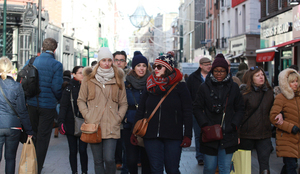

From top: Christmas shoppers on Grafton Street; Michael Taft
Colin Murphy has a provocative column in The Sunday Business Post (January 27 – behind paywall) about measuring our economy and national well-being.
The traditional measure is GDP. The traditional yardstick is the higher the GDP per capita, the more prosperous the society. Maybe.
Even the originator of GDP, Simon Kuznets, had his doubts about that, as Colin points out:
‘Kuznet argued that spending that did not further the welfare of society – such as on armaments – should not be included but he was overruled. And he consistently warned against the over-interpretation of the data. National income and GDP were not measures of economic welfare, he stressed: to understand welfare you would need to know not merely what income amounted to but how it was distributed. ‘
And now the illegal narcotics trade and prostitution are included in GDP. How does that fit in with ‘economic welfare’?
A number of economists, sociologists, statisticians and activists have tried to come up with an alternative set of data to reveal a more effective picture of a nation’s well-being but the range is so extensive, the interactions complex and the permutations voluminous.
Surprisingly, there is no consensus on how to do this.
The OECD has devised an interesting Better Life Index comprising housing, income, employment, community, education, environment, civic engagement, health, life satisfaction, safety, and work-life balance.
But there are other indexes that have over a hundred measurements and it is difficult to come up with a single number that can compete with GDP.
For instance, someone in country A may have a higher income than someone in country B. But people in country B pay less on rent and receive free healthcare – benefiting from lower costs and security. Though income-poorer they may be better off than people in country A.
Another problem is that wellbeing can be a subjective matter. It’s not just about how objectively we compare, it’s how we feel about our situation.
In this spirit of exploring the different indicators I’d like to draw attention to three particular measurements that don’t get much airing.
These are not conclusive tests or even the best indicators. But they do tell us something about people’s wellbeing.
Inability to Make Ends Meet
This is a subjective measurement contained in the EU Survey of Living Conditions that asks people how well they can make ends meet – that is, meet every day expenses. There are five responses: ‘with great difficulty’, ‘difficulty’, ‘some difficulty’, ‘fairly easily’ and ‘easily’.
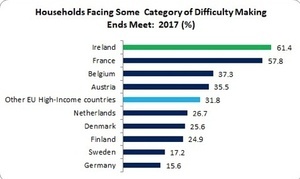
Combining ‘great difficulty’, ‘difficulty’, and ‘some difficulty’ we find Ireland at the top of the EU high-income league. 61 percent expressed some type of difficulty in making ends meet – compared to a 32 percent average among other EU high-income countries.
Irish households are nearly twice as likely to experience difficulty making ends meet and nearly four times the German rate. [It is worth noting the high French levels – could this be a contributing factor to the emergence of the gilet jaune protests?]
There is a difference, though, between ‘some’ difficulty and ‘great’ difficulty. How does Ireland fare in the specific difficulty categories?

Ireland leads the most difficult categories – more than twice the ‘great difficulty’ average. With ‘some difficulty’ Ireland ranks second behind France.
The only bright spot in these depressing numbers is that difficulty experiences are falling from even higher rates that were generated during the recession / austerity period.
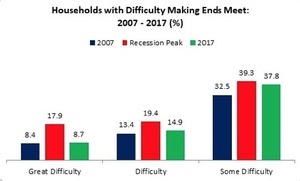
Households experiencing ‘great ‘difficulty have halved since the peak in 2012/13 and are back to 2007 levels. Those experiencing difficulty has also fallen since the 2013 high and is nearly back to pre-crash levels. However, those experiencing ‘some’ difficulty are still close to the recession high and still significantly above pre-crash levels.
It should also be noted that had we returned to pre-crash levels (54.3) we would still be well above the EU high-income country average.
Unable to Meet Unexpected Expenses
The EU Survey on Living Conditions also asks households their ability to meet unexpected expenses. This differs from making ends meet as it refers to meeting a substantial cost such as replacing a broken cooker, boiler, fridge or car; or some other expense of equal value that is unexpected (a hole in the roof is another example). Again, Ireland fares poorly.

We are the league leaders – four out of ten households are unable to meet unexpected expenses. This is considerably above the average of other EU high-income countries and more than twice the rate of Sweden that has the lowest level.
At least we are improving. A decade ago – in 2007 – the rate was 39.1 percent and rose to a recession / austerity high of 56.4 percent in 2012. However, even if we were to return to pre-crash levels we would still well above the average.
Living Standards: Actual Individual Consumption
Actual Individual Consumption (AIC) is used by the EU as a proxy for living standards. It combines consumer spending per capita and Government spending on goods and services for households (this includes services that the Government offers free or at below market-rates). It is adjusted for inflation and the purchasing power standard (PPS).

Ireland is at the bottom – far behind the average but also far behind the next lowest country, France. Ireland would have to increase AIC (real consumer spending and Government services) by 23 percent to reach the average.
In fact, so poor do we rate in this measurement that we are behind Italy and not that much higher than Spain or Lithuania.
And we are still quite a bit away from the pre-crash level. In 2007, Irish AIC was 21,600 PPS. This fell to a recession low of 18,800 PPS in 2010. In 2017 this this has risen to 20,500 PPS but we still have a ways to get back to where we started a decade ago.
The one drawback with this measurement is that we shouldn’t assume that high consumer or social spending equates to well-being. Consumer spending may be poorly distributed (i.e. more spending by a small group at the top) and social spending may be inefficient.
There is some co-relation with this graph and inability to make ends meet: France and Ireland are low in the AIC table and high in the making ends meet table. Germany is reverse. But for other countries there are slightly contrasting stories.
* * *
What do we do about this? We can make reasonable assumptions about why people are finding it hard to make ends meet: lack of income and low-pay, high rents, medical bills, cost of raising children, mortgage arrears, etc.
However, we can make a more forensic analysis. Quite simply, we should ask people why they are finding it hard to make ends meet and what they need to make their situation better.
The CSO could be provided the resources to conduct this in-depth survey (and the resources would be miniscule). The results should give rise to a national debate, for clearly a significant proportion of households suffer inability to make ends meet and to meet unexpected expenses.
That doesn’t mean we have to wait for such results. We should start addressing the housing crisis in and of its own right. We should start giving employees greater collective rights in the workplace to increase enterprise efficiency and combat low-pay. We should go much, much further to combat precarious work.
However, rather than just assuming what people need, we ask the people themselves. This is the first step in getting people socially and economically engaged. It’s when people start determining the policy responses that substantial progress can be made.
In short: well-being is a political issue.
Michael Taft is a researcher for SIPTU and author of the political economy blog, Notes on the Front. His column appears here every Thursday.

Galway hurler Davy Glennon
On The Late Late Show.
Sarah Whiteacre writes:
Ahead of his new four-part series, Dermot Bannon’s Incredible Homes, Dermot will join host Ryan Tubridy to compare and contrast how people live in different cities around the globe
The Late Late will celebrate the best of new Irish Enterprise with some of the inventions and products set to make a mark in the coming year.
After seeing her husband Niall Quinn receive an honorary degree some years ago, Gillian Quinn was inspired to return to college and joins Ryan to chat about how she’s proved that it’s never too late to get an education.
We’ll be joined by Conor Sketches to chat about his rise to success, and how his impressions helped to secure a gig with a major US TV network.
For years, Galway hurler Davy Glennon hid a chronic gambling addiction from his friends, family and employers before a life of lies caught up with him. The All Ireland winner joins Ryan…
There’s also music from tenor Alfie Bow.
The Late Late Show on RTÉ One tomorrow at 9.35pm
Pic: Connacht Tribune


Kilkenny Town Hall entrance (top) and how it will look under new proposals
In Kilkenny.
A petition has been launched opposing a glazed enclosure on the classical arcade of Kilkenny Town Hall, known as the Tholsel and built in 1761.
And to reject the removal by Kilkenny County Council “of the beautiful ceremonial staircase from the body of the building”.
Padraig O’Ceallaigh writes:
This Disneyfication of Kilkenny has to stop. The Tholsel or Town Hall in Kilkenny city is a public building and a protected structure, classified as ‘a substantial edifice of national significance, forming an imposing centre piece in High Street’.
We, the people of Kilkenny, love it.
We love its public Arcade that welcomes musicians, artists, craftspeople, jugglers, carol singers and the Crib at Christmas, art exhibitions in the summer and meetings, remembrances, public gatherings and community fundraising events all year round.
This is Kilkenny’s public space, our Agora. We don’t want it enclosed, reduced in size, or glassed in for use as a ticket office, or anything else.
We’re also proud of the ceremonial staircase within the building. We don’t want to lose this either. It’s part of who we are, part of the Tholsel that we love. Leave it alone.
Sign here
Top pic by Andy Sheridan

Splutter!
Barry writes:
Interesting choice of picture for this artist on this week’s Ticketmaster mailout…
Boobies.


Patricia King gives rough figures of what could be lost to state in Revenue in construction as result of bogus self-employment – €240 million a year in PRSI and tax. Neither Department of Social Protection or Revenue gives any indication of caring much.
— Paul Murphy (@paulmurphy_TD) January 31, 2019
This morning.
At a meeting of the Joint Oireachtas Committee on Employment Affairs and Social Protection.
General Secretary of the Irish Congress of Trade Unions Patricia King (top) and the general secretary of the National Union of Journalists Seamus Dooley (above) addressed the matter of bogus self-employment.
Meanwhile…
The Irish Times reports:
Talks with State broadcaster RTÉ in relation to the employment status of more than 100 of its contractors have been “tortuous and extremely difficult”, the National Union of Journalists has said.
Séamus Dooley, the union’s general secretary, was giving evidence to the joint Oireachtas committee on employment affairs and social protection in relation to “bogus self employment” on Thursday.
Bogus self-employment occurs when workers who should be classified as employees are marked as self-employed, which can lead to benefits for employers who otherwise would have to pay PRSI and sick pay.
RTÉ last year agreed to review the employment status of 106 contractors after an independent report by law firm Eversheds Sutherland found that they have “attributes akin to employment”.
Mr Dooley said he would be meeting with senior management at RTÉ on Friday in relation to the matter. He described the period since the review by Eversheds Sutherland as “tortuous and extremely difficult”.
“I have spent more time in Montrose than any human being should be required to do,” he said, before criticising the culture of media “personalities” that are treated differently to other staff.
NUJ critical of ‘tortuous’ talks with RTÉ on contractors (Colin Gleeson, The Irish Times)
Previously: ‘I Don’t Want To Make Employers The Bad Guy’
Meanwhile…
Today at the employment Committee @irishcongress renewed its call for the enactment of new laws, like those contained in the @labour Bill which passed Second Stage last year to #EndBogusSelfEmployment. The govt’s softly-softly approach is allowing dodgy employers off the hook pic.twitter.com/nIw3TgSgzV
— Ged Nash (@geraldnash) January 31, 2019

Construction work on the National Children’s Hospital earlier this month
The final cost of the new national children’s hospital could exceed €2 billion, the Public Accounts Committee has heard.
Labour’s health spokesperson Alan Kelly said it is “mind boggling” that up to September last year, the cost of the project was expected to be €983m and four months later it cannot be guaranteed that it will come in under €2bn.
The overall cost of the project has now risen to a total of €1.733bn.
PAC told final cost of children’s hospital could be over €2bn (RTÉ)


Since 2016, self taught artist Carl Lavia and photographer Lorna Le Bredonchel have been documenting the ongoing creation of Carl’s large scale ink drawings of all 69 cities in the United Kingdom.
Whatever that is.
Above (from top): Birmingham, Dundee, Edinburgh, Lavia and Le Bredonchel, Manchester (x2), Perth (x3).
