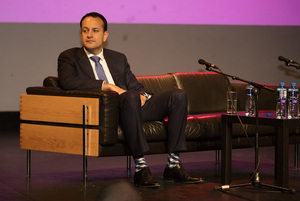

From top: Image obsessed Taoiseach Leo Varadkar; Bryan Wall
Recent news that the public relations bill for the Taoiseach’s office amounted to €1,794,678 in 17 months should come as no surprise.
Leo Varadkar has been insistent on portraying an image of a dapper, cosmopolitan, and jocular leader; an antidote to the weariness of Irish political life and the wider world.
His choice of socks and attendance at gigs paints him as a young leader who is at one with the people. The demos can rest assured that their rulers understand them. This is obvious given the fact that they share the same sock-wearing habits and attend the same gigs.
It also means that they can rest assured in the knowledge that given the above, their rulers will do their utmost to protect and uphold the interests of their clients, the citizens.
Any economic cutbacks, reductions in funding for housing, homeless services, or the increasing privatisation of the health service, only come to pass regretfully. After all, he cares.
It costs money to care, though. Specifically, it costs money to popularise the image of someone who cares; of someone who fraternises with the masses, understands them, and therefore would do them no harm.
We often forget that the original term for public relations was the word propaganda.
One of the most informative pieces of work on the term was by Edward Bernays, the nephew of Sigmund Freud. Bernays wanted to take the theories and ideas of his uncle and apply them to mass industrial society.
His reasoning for this was that it was normal for the wider population to be controlled. In fact, they needed to be controlled. Otherwise anarchy would reign.
He opens his book, Propaganda, by writing
“The conscious and intelligent manipulation of the organized habits and opinions of the masses is an important element in democratic society.” Those who “manipulate” society form “an invisible government”.
For Bernays, the members of this “invisible government” are needed – in fact a requirement – for “the orderly functioning of our group life.” In return for order, the masses have had to cede power to their betters in government, invisible or otherwise.
This is not an ideal system, he adds. Much more preferable would be a system in which there were “committees of wise men who would choose” for us everything in society, from our leaders to our clothing.
Alas, this is apparently not the case. Therefore, “society has consented to permit free competition to be organized by leadership and propaganda.”
Bernays was of course writing about America in the early-twentieth-century but his word are worth reading and understanding nearly one hundred years later.
Public relations, or more accurately, propaganda, has become a mainstay of every society. With the advent of social psychology and technological innovation it has become far more insidious than Bernays could have ever predicted.
Communications obtained by Ken Foxe under Freedom of Information (FOI) legislation demonstrate how far the government will go to obfuscate and misdirect the public and journalists by utilising the power of public relations advisors.
Governments have relinquished power to formidable public relations firms upon whom they have become totally reliant. The Irish government is no different in this regard.
In a truly democratic society there would be no need for propaganda and the public relations industry. The terms would be misnomers. In a true democracy there is no need to hide information from people, no need to alter their perceptions of reality, and no need to engineer their needs and wants.
But we do not live in a democratic society. We live in a society in which governments implement cutbacks and introduce privatisation initiatives of public goods and services. Things that are of inherent value to the wider population — such as healthcare, water services, and public transportation — are willingly hived off to unaccountable private tyrannies.
This is then sold back to us as an optimisation of services, an increase in competition in the market, or some other such string of public relations buzzwords which have become all too common over the last thirty years.
Public relations taints and undermines any attempts to achieve a genuinely democratic society. Lies become truths and heroes villains.
When Justice Peter Charleton published his report last month regarding the allegations of Maurice McCabe, he took note of the increasing manifestation of public relations among officialdom.
He wrote that:
“It seems that our public life is now to be dominated by spin and that plain speaking is elided in favour of meaningless public relations speak.”
This, he wrote, “is a hideous development”. Such methods “adds to the sense of public distrust in the key institutions of the State.”
The communications revealed by Ken Foxe, along with the comments by Justice Charleton have gone some way to lifting the veil that covers many official pronouncements. If this engenders a “sense of public distrust”, as Justice Charleton fears, then all the better. Liars ought to fear the truth.
Nonetheless, public relations still manages to be an effective tool in the arsenal of the powerful.
As I wrote about previously, the headlines about the supposed “vindication” of former Minister for Justice Frances Fitzgerald, along with former Garda Commissioner Nóirín O’Sullivan, were an attempt to whitewash and rehabilitate their characters in the eyes of the public. This was public relations on a mass scale via the mainstream media.
That neither were vindicated was irrelevant. A certain image had to be portrayed and certain parts of the media in Ireland were willing to play along. On the other hand, this comes as no surprise given what we know about the media’s role in propping up the housing bubble.
It is also no surprise given the controversy that erupted earlier this year when it was discovered that Leo Varadkar’s Strategic Communications Unit (SCU) paid for advertisements for the government’s Project Ireland: 2040 plan, that were depicted as articles, in dozens of newspapers. When one glances at them they look and read as articles written by journalists.
Regardless of whether or not the Project Ireland scheme has any essential value, the government’s pushing of these advertisements, and the willing acceptance of them and portrayal of them as articles by journalists, is a fundamental betrayal.
Alternative or non-mainstream media play a role in combating this propagandising of society, hence the contempt it is held in by certain parts of the mainstream. Even so, we still have to deal with Bernays and the legacy of his descendants in public relations.
One example of just how effective this invisible government was and continues to be is the fact that the term propaganda was replaced by the phrase public relations and that this history has been elided.
As Bernays wrote:
“Modern propaganda is a consistent, enduring effort to create or shape events to influence the relations of the public”
. Our own government are consequently, by any calculation, experts in this field.
Bryan Wall is an independent journalist based in Cork. His column appears here every Monday. Read more of his work here and follow Bryan on twitter: @Bryan_Wall
Rollingnews