
From top: Dublin Sanctuary Runners; Graham Clifford giving post-race peptalk in Corkagh Park last Saturday; Naima Chaudhry, Hicham, Siobhan Moran and Padraic Moran 

Dublin Sanctuary Runners write:

A solidarity-inspired initiative which brought together 200 runners, spanning 40 different nationalities for last June’s Cork City Marathon, has now been launched in Dublin.

The Dublin Sanctuary Runners have been participating in the Corkagh Park 5km parkrun in Clondalkin each Saturday for the last six weeks but on Saturday, November 24th, the group was officially launched in the capital.

There are two Direct Provision centres in Dublin, the Clondalkin Towers centre with 231 residents and the Hatch Hall centre in Dublin 2 with 220 residents (figures correct as of July 29th).

“After the success of the marathon in Cork we decided it was important to set up similar groups across the country. We’ve been overwhelmed by the outpouring of support from those in Dublin and already have 80 Irish runners signed up to run with us here when they can,” explained Graham Clifford, writer, broadcaster and founder of the Sanctuary Runners movement.

On Saturday in Corkagh Park a group of 40 Sanctuary Runners, including many from the Clondalkin Towers centre, ran and walked together in solidarity.

The group also aim to enable people in the Hatch Hall Direct Provision to participate and will be taking part in various parkruns across Dublin in the months to come. They will also reach out to former residents of Direct Provision centres now living in Dublin.

“The Sanctuary Runners aim to break down the barriers which exist between those in the Direct Provision system and those outside the gates. To allow Irish people show solidarity, friendship, kindness and respect to those awaiting a decision on their immigration status. Also, it promotes activities that benefit both mental and physical health and for people in Direct Provision that’s vital.

“The collaboration with the parkruns network has been wonderful. We are non-political and focussed on humanitarianism and showing fellow human beings the same dignity and support as we would hope to be shown were we ever in the same situation in another country,” added Clifford.

The Sanctuary Runners have also launched local running groups in Cork and Limerick with plans to expand to Galway, Waterford, Kerry, Longford and Laois in the coming months. Nationally they have over 400 members already.

Supporters, who have also helped with training sessions, include athletes Lizzie Lee, Rob Heffernan, Derval O’Rourke, Sonia O’Sullivan and Gillian O’Sullivan as well as Kerry GAA legend Tomás Ó’Sé and Limerick All-Ireland winner Kevin Downes.

“While it will be beyond most Sanctuary Runners to take on the full Dublin City Marathon next year we hope to enter teams in upcoming races in, and around, Dublin. Bit-by-bit we hope to increase our group’s visibility, and everyone is welcome to join us and wear one of our iconic blue tops in solidarity,” said Clifford.

The Sanctuary Runners is not a charity and those who join are not asked to pay any membership – nor will they ever be asked to fundraise a single cent.

Funded by sponsorship from Cork City Council, Limerick Healthy Cities and a number of corporate donations the Sanctuary Runners focus on solidarity rather than charity.

“Running is a wonderful leveller. When you’re out pounding the roads race, religion, nationality, gender and legal status are irrelevant. Our team motivate each other, support each other and look out for each other. We show solidarity to each other not pity. And laughter flows through everything we do. We can’t wait to welcome more people to the Dublin Sanctuary Runners now that we’ve launched,” said Graham Clifford.

To find out more about the Sanctuary Runners or to join us visit: SanctuaryRunners.ie or email Anna Pringle, the Coordinator of the Dublin Sanctuary Runners at SanctuaryRunnersDublin@gmail.com

Sanctuary Runners


From top: Wages have barely exceeded inflation over the last 10 years; Michael Taft

Tom Healy, Director of the Nevin Economic and Research Institute, put up the graph (below) on Twitter with the comment:

‘Average Weekly earnings flat in real terms since 2009. Yet, non-labour incomes rising significantly.’

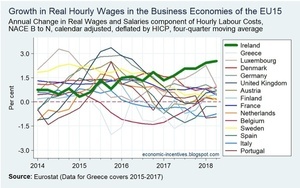
Seamus Coffey, Chair of the Irish Fiscal Advisory Council, responded with a graph of his own (below) commenting:

‘Current trends are surely more informative? Ireland has had the fastest real wage growth in the EU15 for nearly 18 months.’

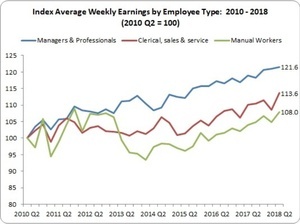
I threw in my two cents. I tweeted a graph (below) of the CSO’s average weekly earnings for three employee types: managers & professionals; clerical, sales and service workers; and manual workers (production, transport, craft and other manual). My comment:

‘But we have to look at who’s benefiting. Weekly earnings increases are taken up by the higher income groups with white and blue-collar workers trailing.’

Managers and professionals have experienced a 22 percent increase in weekly earnings over the last eight years; white and blue-collar workers received a 14 and 8 percent increase respectively.

With inflation running at nearly 6 percent over this eight-year period, most of the gains for manual workers have been wiped out with white-collar workers seeing nearly half of their gains eaten away. Managers and professionals are still well ahead of the game.

And ahead of everyone else.

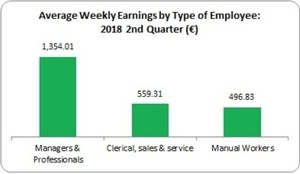
Unsurprisingly, the group that received the highest increases is the highest income group. Managers and professionals earn more than twice as much as other employees.

What does all this tell us? First, it’s good that people swap graphs on social media rather than insults. Second, data tells you what it tells you. It is the framing and interpretation that fuels the debates.

For instance, Tom Healy is right to point out that wages have barely exceeded inflation over the last 10 years. Seamus Coffey is right to show that in the recent past (18 months) wages are starting to rise, faster than other EU-15 countries (though if you go back a few years the story changes).

I hope that I have shown that the gains over the last eight years (that’s as far back as that CSO dataset goes) have gone to the highest income groups.

Of course, all the data in these graphs beg questions. And the answers can slightly alter the conclusion. For instance, when looking at the data for types of employee, we should remember that the numbers could change – not because of actual pay increases or working hours increase – but because the composition of the group has changed.

However, the main point I would draw from all three graphs – growth in real wages, relationship to other countries and the distribution of those earnings – is that we’re heading into greater inequality if we rely on ‘market forces’.

We need a wage market that is negotiated between employers and employees. Such negotiation has a tendency to favour low and average income earners whereas market forces tend to favour higher income groups who have stronger bargaining leverage.

In short, we need a negotiated economy.

Michael Taft is a researcher for SIPTU and author of the political economy blog, Notes on the Front.

Rollingnews

Fast track apartments announced by Minister for Housing Eoghan Murphy (above) may not be built until 2020

This morning the newspapers say
There’s going to be a delay
Before we build flats
Though I’m certain that’s
Something we’ll get round to, someday

John Moynes

Rollingnews

Give the joy of the capital this Christmas.

Mark at Jam Art Print writes:

Just thought your readers might like a few of our Dublin themed pieces by Irish based artists and designers.

From top: Layered Paper Dublin Lightbox by Alljoy; Meet Me Under Clerys’ Clock – print by Maxi and Dancing Mary of O’Connell Street – signed print by Fuchsia Macaree…

Jam Art Prints

Irish-made stocking fillers to broadsheet@broadsheet.ie marked ‘Irish-Made Stocking Fillers’. No fee.

This afternoon.

School of Physical Sciences, Dublin City University.

Ronan writes:

This poster has been sitting on the wall in @DCUPhysics for long enough it’s got the correct manager again. Or someone around here’s invented a time machine and not told us…

Previously: He’s Coming Home

This afternoon.

Government buildings, Dublin 2

Taoiseach Leo Varadkar meets the Grand Secretary of the Orange Lodge, Reverend Mervyn Gibson. Rev Gibson led a delegation of Orange Lodge members from the southern border counties to discuss “matters of interest to their members including education, infrastructure and culture”.

Name that painting, anyone?

Eamonn Farrell/RollingNews

Broadsheet.ie