

An experimental graduation short by Royal; College Of Art student Alex Bernas: a personal narrative about the parent child relationship pitched midway between abstract and mainstream animation.



An experimental graduation short by Royal; College Of Art student Alex Bernas: a personal narrative about the parent child relationship pitched midway between abstract and mainstream animation.


National Ploughing tweetz:
The event arena will be open for an extra day on Friday. Wristbands from today (Wednesday) will be valid both Thursday and Friday. See you on site.
Earlier: Ploughing Off
Meanwhile…


This afternoon.
Ploughing ‘revellers’ slowly make their way out of the site in Screggan, Tullamore, Co Offaly, after it was cancelled earlier today due to Storm Ali.
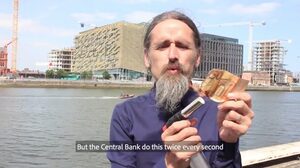
Imagine someone going around burning your money. You’d be annoyed wouldn’t you? Well it’s happening. Watch this. #Promnotes #NotOurDebt #BallyheaSaysKnow pic.twitter.com/iOuVNDjRft
— Luke ‘Ming’ Flanagan (@lukeming) September 19, 2018
MEP Luke ‘Ming’ Flanagan, along with his parliamentary assistant Diarmuid O’Flynn – who appeared before the Joint Committee on Finance, Public Expenditure and Reform, and Taoiseach in June – reminds people of the Anglo Irish Bank promissory note deal.
In June, Mr O’Flynn, of the newly titled Ballyhea Says Know group, told the committee that Ireland’s Central Bank took out of circulation €500million in 2014; €2billion in 2015, €3billion in 2016; €4billion in 2017; and, as of June this year, €1billion.
Mr Flanagan, in the clip above, calls on members of the public to ask their local TDs, regardless of party, to stop this practice.
Previously: There’s A Touch Of That About It


From top: Taoiseach Leo Varadkar (left) and US President Donald Trump in the White House Washington last March; Ciaran Tierney
It has been amazing to hear so many people in Ireland express regret that President Trump has postponed (or cancelled) his Irish visit this coming November.
They were so fired up that many said they were looking forward to joining a political protest for the first time.
Irish protesters had to reach out to their counterparts in the UK, who turned out in their thousands to make the President feel so unwelcome when he visited London back in July.
Sorry, they said, we won’t need to ship the giant orange “baby blimp” to Ireland after all!
People in Dublin were really looking forward to the sight of a giant baby Donald in a nappy floating across the skyline.
And a hugely successful crowdfunding campaign had already covered the cost of bringing over the six metre high blimp within days of being set up.
Everyone, it seemed, wanted to be part of mass protests against the US President. The sense of anti-climax was palpable as soon as the White House announced that he had postponed his travel plans.
The leaders of two opposition parties, Labour and the Greens, had come together to announce plans for a joint rally for “democracy, decency, and international solidarity” in Dublin.
As though such concepts, so alien to Mr Trump, were plentiful across the political spectrum here in Ireland.
Labour Party leader Brendan Howlin went as far as to say that President Trump was “no friend of democracy or human rights”.
Mr Howlin said it was important to stand up to Trump on issues such as climate change, the treatment of migrant and asylum-seekers, spending on arms, and the slashing of aid budgets.
In Galway, the local anti-racism group wanted hundreds of people to gather to spell out the words “Feck off Trump” (with a little Irish humour, from the ‘Father Ted’ TV series) on a beach.
In much different times, President John Fitzgerald Kennedy addressed 50,000 people in Eyre Square and the city authorities renamed it as Kennedy Park in his honour.
We are unlikely to see a ‘Trump Park’ in Galway any time in this millennium.
So many people are disappointed that the street protests are off. They wanted to convey a firm message that Trump’s policies have no place in a modern, prosperous, outward-looking Ireland.
They want to reject the anti-immigrant rhetoric on an island where emigration provided the only refuge for the afflicted through much of the 19th and 20th centuries.
The street protests are off . . . as though there was nothing to protest about closer to home.
The economy might be in recovery, but the recovery does not seem to have reached so many Irish people who are struggling to keep a roof over their heads.
Last week, masked thugs – protected by masked Gardai – used heavy-handed tactics to evict homelessness campaigners from an empty building in Dublin.
The sight of masked policemen with no identification on their uniforms caused consternation at a time when there are almost 10,000 people living in emergency accommodation across Ireland.
And now our Minister for Justice says he would support moves to criminalise the photographing of Gardai as they carry out their duties.
Such a move would be an attack on press freedom and should lead to questions as to what the Gardai have to hide.
Would that mean banning photos of public events such as GAA games or the annual Macnas Parade?
The last time I checked such measures were only being considered in states such as Israel, where an oppressive occupation force has a vested interest in covering up its crimes in the West Bank.
Given recent Irish history, we don’t have to cross the Atlantic in search of police forces who abuse their power. In fact the filming of protests has helped to prevent injustice from occurring.
So, instead of worrying about Trump, perhaps we should be looking at how power is being abused much closer to home.
Last month, a photo of homeless children sleeping in a Garda Station went viral. The youngsters had to sleep on hard chairs in the police station because there was nowhere else for them to go.
The distraught mother who took that photo could soon be guilty of a crime.
Last week, a photo of a sick and distressed 92-year old woman sitting on a chair in a public hospital Emergency Department went viral.
Gladys Cummins posted the photo on Facebook out of frustration and despair. Her mother did not even have a trolley, as she spent 25 hours sitting on that chair.
Two months ago, I saw a 93-year old family member spent 48 hours on a trolley in the ED Department in Galway. The unacceptable has become acceptable and lengthy waiting lists in our public hospitals have become the new norm.
In a supposedly “socialised” health service – compared to the US at any rate – the old and the weak are being forced to spend days lying in corridors in overcrowded facilities.
But Irish people are not taking to the streets to protest about our health crisis.
In June, Irish people became outraged by the images of child migrants on the US-Mexico border crying in distress after being separated from their families. They were outraged by Trump.
Yet few of them have much awareness of the hardships endured by those who spend up to seven or eight years in Ireland’s own Direct Provision system.
About 5,000 asylum-seekers are detained at 31 accommodation centres without permission to work, or even to cook for their children. Among them are 2,000 children, growing up in highly inappropriate shared spaces with adults from a variety of countries.
Direct Provision centres have been described as the Magdalene Laundries and Mother and Baby Homes of our times. Some even see them as a “time bomb” for future problems to come.
We have British politicians steamrolling headlong towards Brexit, with little or no awareness that their dangerous language is threatening the peace process which transformed life in Northern Ireland over the past 20 years.
We have the families of victims of loyalist collusion who are shocked that a former member of the Royal Ulster Constabulary is now at the helm of the Irish Gardai.
They believe he has questions to ask about their long search for justice for atrocities such as the Miami Showband Massacre and the Dublin and Monaghan bombings.
We rant against Trump for his sexism, at a time when Irish society has been convulsed by a cervical smear test scandal in which the Irish Government treated Irish women appallingly this year.
A lot of Irish people are disappointed that they won’t get a chance to protest against President Trump, but let’s not pretend that we don’t have some pressing problems much closer to home.
Call Off The Blimp (Ciaran Tierney)
Top pic: MerrionStreet

@broadsheet_ie #tuambabies Not to be missed. Peter’s Story. A Tuam Home Survivor TG4 9.20 pm Wednesday 19th https://t.co/6Yp1rJIC0p
— Kevin Higgins (@Boglawyer) September 19, 2018
Finné.
A new documentary series on TG4 featuring tonight: Tuam Mother and Baby home survivor Peter Mulryan at 9.30pm.
Previously: Peter Mulryan on Broadsheet
Meanwhile…

A date for your diary.
Don’t forget.
Previously: A Day To Remember


From top: Frederick Street removal: Mick Wallace; Joan Collins; Claire Daly and Minister for Justice Charlie Flanagan in the Dáil today.
This afternoon.
In the Dáil.
Further to the eviction of housing activists from a vacant property at North Frederick Street last week…
Independents 4 Change TD Mick Wallace asked the Minister for Justice Charlie Flanagan who authorised members of An Garda Síochána – who wore fire retardant hoods – to attend the eviction.
Joan Collins, also an Independents 4 Change TD, asked Mr Flanagan on what basis were the gardai asked to attend.
Ms Collins referred to the mater as “very, very sinister”.
Independents 4 Change TD Clare Daly then said:
“I think we have to be very conscious that this incident has set back public confidence in An Garda Síochána considerably. That’s actually my starting point on this issue.
We have, at the backdrop, an unprecedented housing crisis. Where people are homeless, families are homeless. And that the Garda organisation, whose motto is supposed to be ‘to protect and serve’, rallies around to carry out an eviction – resonates really badly with the Irish public and you can call it politically with a small ‘p’.
It was lunacy whoever made the call.
“And, like Deputy Wallace, I don’t believe it was the Commissioner [Drew Harris].”
“The minister says the gardai were only upholding the law. Well my neighbour’s house was broken into and they called the guards and they didn’t’ see one for love nor money. That’s their job, as well.
“They chose to take sides in this incident. There was no signal that they were going to be public order problems of the scale that merited masks and balaclavas and all this type of carry-on and palaver which was really intimidatory.
“And it does deserve an investigation. It particularly deserves and investigation, given that concrete evidence has been produced that shows that the security firm were breaching the law and yet the perception was that the gardai were there to protect them and not actually the public.”
Mr Flanagan, in his response, said:
“I would reiterate again, that the gardai present faced a most difficult task, managing protest, in enforcing the law. There was a matter of abuse, including racial abuse, online threats and intimidation, came to light at the weekend.
“Such threats are utterly unacceptable, rightly being investigated. Gardai work on our behalf. They need support from the public, not intimidation, not abuse. As I’ve said Commissioner Harris has made a statement in relation to the protest. I understand he’s requested a report from Assistant Commissioner DMR, to see what lessons can be learned from the event.
“I can assure the house my department continues to work closely with all stakeholders including An Garda Síochána, to further enhance the safety of the public at such events, while safeguarding the fundamental right of people to protest.
“Of course if people have concerns about the way the garda behave, which I’ve just heard, if people have those concerns, in relation to this or, indeed, any other matter, there are established procedures for pursuing such matters. Deputies are aware of the role of the Garda Síochána Ombudsman Commission [GSOC] in this regard…”
Previously: What’s Going On Here?


From top The Hill of Faughart, Dundalk, County Louth; Dundalk trio L-arry
Corridor – a multi arts project focusing on the political, social and cultural consequences of borders – is back for a second year.
Marcel Kreuger (him off the telly!) writes:
Following the first series of events in 2017, we are delighted to announce the Corridor 2018 bringing together artists from all over Ireland and Europe.
Our first event in 2018, the corridor no. 4, will be `L’arry on the Hill’.
Local up-and-coming music trio L-arry will perform a special acoustic set at the Hill of Faughart, Dundalk, County Louth – on the border between the Republic and Northern Ireland on September 21, to coincide with Culture Night.
This will be followed by the official launch of the first the corridor publication, with new contributions from some of last year’s artists (among them Evelyn Conlon, Garett Carr and Paul Scraton), at Roe River Books in Dundalk in October.
Previouslty The Border At The Crossroads

Trinity College Dublin
The University Times reports:
[Trinity] College is investigating offensive comments made in a class last week by a new intellectual property law lecturer, Brendan Guildea.
…Speaking to The University Times, Guildea said: “I’m reserving my reply.”
…A Muslim student, who was wearing a headscarf, was asked to name a book Guildea was holding. When they failed to identify the book, Guildea suggested that someone Irish might know the answer. The student was born in Dublin.
Guildea also asked that student whether anyone had ever interfered with their bags before travelling.
College to Investigate Comments Made by Law Lecturer (University Times)
Thanks Jim

