

King Dumb writes:
If 15 years of putting facts on cigarette packs is not getting through to everyone, isn’t it time we tried religion?
Fight!
*wheeze*



King Dumb writes:
If 15 years of putting facts on cigarette packs is not getting through to everyone, isn’t it time we tried religion?
Fight!
*wheeze*

Repeal.
A trailer for a short film by Karl Callan, approved by the Abortion Rights Campaign, that will have a preview screening at the IFI, Temple Bar, Dublin 2 on Saturday, March 31 at 11am and will be released to social media on April 6.
Emma Fagan writes:
The narratives within the film are all based on real life testimonies from people who have been directly affected by the 8th amendment.
Karl’s goal is to shine a light on what is happening every day in Ireland as a result of the current law .It is his hope that those who are currently undecided may feel inclined to vote Yes after seeing the film…


From top: Minister for Housing Eoghan Murphy and Taoiseach and Fine Gael leader Leo Varadkar at the launch of social housing units last November; Michael Taft
The National Homeless and Housing Coalition is holding a demonstration on Saturday, April 7 over the housing crisis. It has the support of dozens of organisations spanning civil society groups, trade unions and political parties.
To highlight the urgency of this issue and the importance of the march, I have expanded on some ‘quick facts’ published in Home Truths – a special newspaper being distributed nationally in advance of the march by supporters of the coalition.
1. Homelessness Rising

Homelessness has seen a steady rise since 2015, more than doubling. The last year saw an increase of over 1,900; this compares to an annual average increase of about 1,650 in the previous two years. Of the 9,100 homeless, nearly 3,300 are children.
These numbers only refer to people in emergency accommodation. The Housing Agency’s Summary of Social Housing Assessments 2017 shows nearly 20,500 households living with family or friends. And this doesn’t include people in the same circumstance but not on the housing list.
2. People on the Social Housing Waiting List
There are over 85,800 households on the social housing waiting list – nearly 200,000 adults and children. That’s a bad enough. But a look at some of the sub-categories illustrates the dismal realities of this fact:
Nearly 40 percent have been waiting for five years or more
Over 7,000 have a household member with a disability or exceptional medical condition
Nearly 18,800 are actually in employment
And there are 6,600 aged 60 years and over
3. Upward Pressure on Homelessness
Over 72,000 households are in residential mortgage arrears. Over two-thirds have been in arrears for 90 days or more. In addition, over 20 percent of employees are officially categorised as ‘low-paid’, while 13 percent at work live in deprived conditions. Evictions and inability to afford rent are now driving forces behind homelessness.
4. The Rise and Rise of Rents
According to Daft.ie, rents have increased by over 60 percent in the last five years. During this same period inflation rose by less than 1 percent. Rents are increasing by over 10 percent a year. Wages are only increasing by 2.5 percent. Every year, rents are moving further out of reach of low and average income groups.
Given that these are Daft.ie figures, they are asking rents. But this shows that new apartments coming on to the market are not going to make a contribution to reducing the level of rents or increasing the stock of affordable rental accommodation. And market analysts are projecting a 20 percent rise over the next two years. Excessive rent increases will be with us for a while.
5. Dublin Rents far Exceed Other EU Capitals
When compared to other EU capitals, Dublin is at the top of the rent league (only London is more expensive than Dublin). If you were renting in the city centres of Berlin, Amsterdam, Vienna or Brussels, you’d be paying €8,400 less per year to your landlord.

This shows the difference between managing market rents and, in the case of Ireland, not managing them.
(Note: the above data is taken from Numbeo, a user-generated site. This is not as accurate as a properly produced statistical survey. However, the National Competitiveness Council has started using this site, stating that ‘the scope and depth of the data gives this approach some merit’.)
6. Subsidies to the Private Rental Sector
In the last 12 years, the state has handed over €6.4 billion to private landlords and the private rental sector. Under current targets, the Government will be spending nearly a €1 billion a year by 2022. Question: is it more financially and socially efficient for the state to build and rent housing through a public agency (local authorities, public company, etc.), or to rent housing from the private sector?
7. Rising House Prices
The average new house price nationally is €330,000. In Dublin it is nearly €420,000.

House prices have yet to return to the stratospheric pre-crash levels. However, since house prices troughed in late 2012 / early 2013 (the above graph includes both new and second-hand), national prices have risen 69 percent in five years while Dublin prices rose by 76 percent. In the last year, prices have risen by 12 percent.
There are several contributors to prices: availability and price of land (and impact of land hoarding); availability and cost of credit; wages and incomes; desirability and viability of alternative housing tenures – in particular, rental accommodation.Supply of housing is only one factor in price and, at times, not the main or relevant factor as Mel Reynolds and Dr. Lorcan Sirr have pointed out.
8. Home Ownership Increasingly Out of Reach
In Dublin, a couple buying their first home will have to pay, on average, a deposit of over €40,000 and have a combined income of over €100,000. Currently, the average wage for workers is €38,000. For average-income employees, it is difficult to see how they can afford to buy a house in Dublin.
9. High Cost of Credit
It has been well-established that Irish mortgage interest rates are higher than in other EU countries. So, in addition to increasingly high house prices, were average income earners able to get to the purchase stage, they would find themselves paying high monthly mortgage costs.
Let’s do a stylised comparison with other EU countries – a €275,000 mortgage for 20 years at fixed rates.
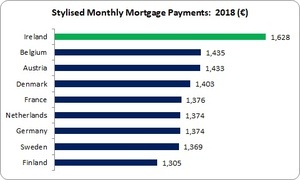
Like rents, Irish monthly mortgage payments are higher than in other countries. There will be differences depending on length of mortgage and the mix of variable and fixed rates, but this stylised comparison is likely to hold across the range of option – especially as Irish interest rates are 3.7 percent while in many of the other countries they are below 2 percent.
We are still paying for the banking crisis.
10. Land Costs and Developers’ Margins Driving High Property Costs
There’s a housing cooperative in Ballymun – the Ó Cualann Cohousing Alliance – which is building houses for sale at prices that can come in well below (30 percent or more) market rates. How can they do this? First, the land is provided at heavily subsidised prices from the Dublin City Council – so land costs are reduced.
Secondly, they don’t have a developers’ margin (though the private companies that build the houses do so at profit). That’s the difference.
The Journal.ie’s Fact Check came up with a similar finding when asking whether it would be cheaper for the state to build houses.
What is driving high property prices?
The cost of land (which is being inflated given land-hoarding and the lack of market management) and developers’ profits.
The cost of land and developers’ margins can account for a third of the price of a home in Dublin.
Those are just a few reasons to march on April 7. But actually, there are hundreds of thousands of reasons to march – the vast number of people in housing need. These are the stake-holders in this march. Indeed, they are the only stakeholders.
I will be marching with them on April 7. Hopefully, you will too.
Michael Taft is a researcher for SIPTU and author of the political economy blog, Notes on the Front. His column appears here every Tuesday
The ‘Housing is a Human Right’ march will be held on Saturday, April 7th at 1pm assembling at 1pm at the Garden of Remembrance, Parnell Square, Dublin 1.

UK Brexit secretary David Davis with sick bucket on the The Andrew Marr Show on BBC 1
Does Davis’s diet include
Some dangerously unwashed sea food
Or did he hit the bar
Before talking to Marr
And end up a little too stewed?
John Moynes
Pic: BBC

The Tanaiste Simon Coveney is shifting his position on abortion. He’s indicated he will support a law to allow terminations up to 12 weeks, if it’s coupled with strict medical guidelines. @jerrybuttimer speaks to #DrivetimeRTE
— Drivetime RTE (@drivetimerte) March 26, 2018
The full text of @simoncoveney‘s piece is available online now “This is not an easy issue, many of us have seen our views evolve as the facts and cruel inadequacy of our current laws are exposed.” #together4yes https://t.co/fcz9m34wfI
— Together for Yes (@Together4yes) March 26, 2018
Judith Goldberger writes:
I’d hate to be behind Simon Coveney in a queue in Starbucks. Or a polling booth…
Coveney to seek clause to limit future abortion law changes (Irish Times)


Piers Scott tweetz:
…things you’re not allowed to do in St Stephen’s Green.The fine for using a gramophone is a whopping £5


MORE to folly



From top: Denis O’Brien; Social Democrat-co-leader Catherine Murphy outside the High Court in 2015; Anne Marie McNally
Anne Marie McNally writes:
Last Tuesday night [March 20] RTÉ One;s Prime Time aired a segment about the curious case of Denis O’Brien and the PR firm Red Flag.
This long-running saga between determined adversaries has captured the minds of…well very few actually.
Primarily because it is a convoluted tale of unusual events and powerful men (in the main) and telling the story is not always an easy web to untangle in a way that makes it accessible to those with limited knowledge of the various backgrounds or history of the main protagonists.
If you watched the Prime Time piece you’ll have seen yours truly here being interviewed as part of the package.
Not because of any involvement in the legal battle between Red Flag CEO Karl Brophy and Denis O’Brien, but because I happened to be one of the key researchers on the Siteserv transaction and wider IBRC issues that Deputy Catherine Murphy first began raising back in 2014 – long before it came to national prominence or indeed was of interest to anyone outside the office of Catherine Murphy.
The research began to pay dividends when after six months of asking Parliamentary Questions and submitting FOI requests, the Department of Finance released internal documents to us under FOI which showed that they had raised significant concerns about how the management of IBRC had handled the Siteserv transaction as well as a number of other large transactions.
These revelations shot the issue into the limelight and suddenly the months and months of methodical research, and Catherine’s tenacity, began to pay off.
The question which formed the base of all the research was always, at its most basic, did the taxpayer get the best deal possible from a bank that had already cost them billions of euros?
If it could be proven that the best deal had been achieved then great, but if not, that deserved scrutiny. For us, it really was and continues to be, as simple as that.
But suddenly we found ourselves in a world of intrigue and curious events. Many of these events went publicly unremarked upon by us as we felt there was an element of a distraction about them and we made decisions about whether or not they these curious incidences were worth making a song and dance about.
We generally decided they weren’t.
Now, almost three years later and with some of the incredible elements of this saga now out in the open I find myself looking back and almost pinching myself at some of the experiences both Catherine and I encountered as the Siteserv issue rumbled through the Spring and Summer of 2015.
The Prime Time piece focused in on the curious case of Mark Hollingsworth – a journalist of some significant professional standing – and his unusual role in the saga. Upon first being contacted by him in July 2015 I ran a rudimentary background check and found he’d written extensively for major publications and was recognised as an investigative reporter, including on some high profile cases such as the Madeline McCann case.
He’d also written several books on corruption and Russian oligarchies. I spoke to journalist friends who vouched for his credentials. Basically, his bio stood up. Yet once I agreed to speak to him – over the phone initially, my Spidey senses immediately tingled. I refused to answer his questions (although he preferred incorrect statements of fact that he wanted me to confirm rather than asking actual questions).
Two months later when he arrived at a scheduled meeting in Leinster House with Catherine and I, he had done nothing to indicate my initial sense had been wrong and everything to confirm I was right.
When I described on Prime Time the type of clothing he showed up to the meeting in, it wasn’t because I’m fashion conscious. It was because it stood out to both of us as being highly unusual given the warm weather of the time and it appeared designed to conceal something.
The way he insisted on positioning himself in the room further cemented this belief and within minutes of commencing the meeting,
Catherine’s Spidey senses had also kicked in and she decided to cut the meeting short. It wasn’t long before he’d raised the Spidey senses of other journalists he met on his trip to Dublin and it soon became apparent there was, for all intents and purposes, a spy in our midst!
Things went from weird to weirder in the next instalment of my involvement in just one small part of this gripping international mystery.
Following our interactions with Hollingsworth, Catherine and I were advised (by people who know about these kind of things) to send a formal request for any files held on either of us from a number of secret intelligence agencies based in the UK – some of whom had MI5 connections and other such reputations which up until that point I had assumed was only true of movies with Daniel Craig in them.
It seemed things couldn’t get more surreal until the day that I, apparently randomly, hailed a taxi outside the Four Courts only to be greeted by a drive, who once I was in and started my journey, described himself to me as a former Mossad agent who was here to give me some ‘friendly advice’.
When he got agitated that I wasn’t taking him seriously enough, I began to realise this wasn’t a random taxi driver.
There I was, in a taxi, while a man with dark wraparound glasses gave me a ‘friendly’ warning that I was ‘likely’ under surveillance and that my phone, car and home were ‘probably’ bugged.
When he offered to use his former Mossad connections or his claim that he previously held a senior ranking position in Mr O’Brien’s personal security detail in Papau New Guinea to help sweep my car, home and devices, I politely declined.
When he proffered the names of other intelligence officers of various military backgrounds operating in the city who had myself and Catherine in their midst, I took note of them.
When he told me about the men purporting to be Sky Agents who had called to my home to install bugging devices, or how a simple exercise could ensure every key tap of my phone was traced, I snapped a picture of his licence and calmly asked him to unlock the doors and let me out.
We parted with a final warning from him that I would regret not taking him seriously.
I made a judgement call that the move had been designed to intimidate me and so I chose to ignore it and not make a song and dance about it. I did however speak to people in our security services that were able to confirm his identity and his background and the same for the individuals he had named – his claims stood up – this was no ordinary Taxi driver.
It was a frightening experience. However, we yet again decided not to make a fuss about it and apart from taking advice regarding precautions, I continued on with my work as normal – albeit using a few different phones!
In the months after I had these experiences I had a newspaper outlet scan my phone to check for bugging devices, I spoke to Roy Greenslade in The Guardian and we joked about how ludicrous this whole thing was as if we were old mates. The New York Times were in touch and Alex Thompson in Channel 4 took to calling me to keep up with developments. The Washington Post even popped a call onto me late one night.
It was a surreal experience that seemed like it couldn’t get any weirder and then Peter Murtagh blew that out of the water with an expose in the Irish Times last year that told the tale of a mystery USB, a trail across the globe that Jason Bourne would be proud of and of course, the now infamous Mark Hollingsworth.
So if last Tuesday’s Prime Time seemed slightly confusing to you, rest assured it is only the tip of a very large and hidden iceberg which still has plenty of story left to tell.
Anne Marie McNally is Social Democrats Political Director and General Election candidate for Dublin Mid-West.
Rollignnews
Meanwhile…
I hailed a taxi randomly on the street on the very first day of the Red Flag case in October 2015.
Same guy. Same sinister warnings. Mentioned people by name.
I’ve never been in a taxi before where the driver knew who I was as soon as I got in.
— Karl Brophy (@KarlBrophy) March 26, 2018
There you go now.

