


A 1956 Mercedes Benz 190SL roadster – 62 years old with just 65,000 miles on the clock.
Restored to Concours condition and yours for a mere €121,000.



A 1956 Mercedes Benz 190SL roadster – 62 years old with just 65,000 miles on the clock.
Restored to Concours condition and yours for a mere €121,000.

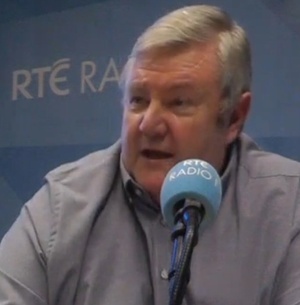
From top: Sherlock Holmes and Dr Watson in ‘The Adventure of the Copper Beeches’; Derek Mooney
Though Sherlock Holmes is a fictional character… almost as fictional as the Strategic Communication Unit’s Taoiseach Leo, but let’s not go there this week… his creator used Holmes to bring the skill of calm, logical reasoning to a wider audience.
Conan Doyle crafted intricately complex scenarios and then allowed his hero the time required to think and analyse the situation logically. He called it Holmes’s iron rule:
“When you have eliminated all which is impossible, then whatever remains, however improbable, must be the truth.”
If only someone inside the British government could just stop and think, applying Holmes iron rule to the current Brexit conundrum, particularly as it relates to the border running across our island.
So, this week I want to apply the Holmes iron rule to how Brexit affects the Irish/Irish border and show why the U.K. is: 1). on the wrong course and 2) ignoring a far less painful option.
Option One: Ireland rejoins the UK. OK, I am leading-off with an absolute non-starter, yet there are, bizarrely, those on the other island who think one way to avoid a hard border is for us to see the error of our ways and return meekly to the current United Kingdom of Great Britain and parts of Northern Ireland.
These people are wondrously ignorant of modern Irish history, but then again there are former Northern Ireland Secretaries of State who are happy to tear up the Good Friday Agreement to save their imagined Brexit. So, for the avoidance of doubt, let me borrow some words from the late Mrs Thatcher that they can understand: this option is out, out, out.
Option Two: Irexit. This one is just as ludicrous as Option One, but with the dubious bobus of having some Irish advocates. You may have seen them a few weeks back, moistening the seats of the RDS as they listened to Nigel Farage and the only stopped clock never to be right even once a day: Anthony Coughlan, amongst others.
The harsh reality for these folks is that there is no backing for Irexit. The latest Eurobarometer poll, published just over a week ago, reported that 66% of us believe Ireland is better off inside the EU and that our attachment to the EU is at its highest level in 15 years.
Why would we give up our attractiveness as a base for foreign direct investment looking to access the European market?
Outside the EU the only major market access we could offer would be to the UK market – but why invest in Ireland to gain UK market access when you can invest in the UK directly and cut your cross-channel transport costs? Oh, now I see why Farage is pushing the idea, though why he would have Irish backers is still a mystery.
Option Three: UK quits the Customs Union and Single Market: If the UK is outside both the Customs Union and the Single Market then the border that separates the six north-eastern counties from the rest of this island will become an external frontier between the EU and a third country, the UK.
That is a fact. Don’t take my word for it, read what Dr Katy Hayward and Dr David Phinnemore of Queen’s University, Belfast have said:
Let us be under no illusion: with the UK outside the single market and a custom union, there will be an unavoidable increase in border controls.
The people who backed the Good Friday Agreement in 1998 – North and South –voted to replace the “border” that divided us with a cross border approach that brought communities together.
That Good Friday Agreement is more than just a hard-won political agreement, it is an international treaty between two sovereign governments.
The cross border approach it enshrined is incompatible with the sort of border and customs arrangements which Mr May mentioned last week, a reheat of paras 46 – 54 in the UK’s August 2017 NI position paper. It was a non-runner then and as Fintan O’Toole reminds us today, it’s a dud now.
Option Four: A Canada/USA style border: This option arose just yesterday when Mrs May was asked for an example of a border between two countries that were not in a customs union. She replied:
“There are many examples of different arrangements for customs around the rest of the world and indeed we are looking at those, including for example the border between the United States and Canada”
This on the day that President Trump was announcing tariffs on steel and aluminium imports from other countries, including Canada. Eh, no thanks.
Having crossed that border twice, a few years back, in a car from Seattle to Vancouver, queuing in traffic for about five hours not including the time spent out of the car at the huge customs post filling in forms, I can vouch that this one is a non-runner.
Option Five: No Brexit. I added this one as a counter balance to the previous four Irish centric, impossible options. The British people have voted to leave the EU and there is no hard data to suggest that the result of a rerun referendum would dramatically reverse that decision.
And before anyone points out that we have re-run EU referenda here, let me remind them that those first round turnouts were low, not a factor in the Brexit vote as I outlined here before.
The elimination of Option Five brings us to the one and only remaining option, no matter how improbable it may seem now. That is for the UK to leave the institutions of the EU, to quit the EU Council, Commission, Parliament etc., but to remain in the Customs Union and Single Market.
This, effectively, would see the UK return to the old EEC era – the common market. It is the solution that my friend, and former UK Europe Minister, Dr Dennis MacShane has been advocating from the moment of the Brexit vote. As Anna Soubry and Chuka Umunna have said, there is a cross party majority in the House of Commons to back staying in both.
It also has the added cachet of according with the outlook of the already mentioned Mrs Thatcher, a fact lost on the likes of Jacob Rees-Mogg who forget that Mrs T was a big supporter of the Single Market.
After almost two years of chasing Brexit fantasies the Brexiteers need to face up to the logic of their own position and stop pursuing the impossible.
They also need to start coming up with real, possible alternatives, so let me end by offering the bare bones of a proposal for Mrs May and the DUP.
Though I am a firm believer in a United Ireland and a strong advocate for more all island approaches, I can understand why Mrs May and the DUP baulked when they saw the the EU’s draft legal agreement proposing a backstop “common regulatory area”.
I don’t accept their objections to the draft text which, after all only turns in legalese what the EU27 and UK already agreed last December, but I can still understand how they might feel that it undermines the “constitutional integrity” of the United Kingdom.
So, I suggest that they look to Hong Kong for some inspiration. If it is possible to have one country, two systems, then it is not also possible to have two different economic regimes in one country?
Rather than moaning at Barnier, London should be looking to actively exercise its “constitutional integrity” and itself make Northern Ireland a “special economic zone” within the UK.
Make it a “special economic zone” which is linked via the “common regulatory area” to Ireland and hence to the EU.
A “special economic zone” which secures the important trade flows from Northern Ireland to Ireland (and vice versa): Northern Ireland to Great Britain and, of course, Northern Ireland to the EU.
This leaves the Irish/Irish border frictionless and invisible, as it is now, with the UK operating its own e-checks at crossing points to Great Britain, but not imposing tariffs on goods incoming from Northern Ireland.
It is not nearly as effective and workable a solution as remaining in the Customs union and Single Market, but no matter how improbable it may seem, it is a lot less impossible than options one to five above and it is entirely within their own hands.
Elementary, huh?
Derek Mooney is a communications and public affairs consultant. He previously served as a Ministerial Adviser to the Fianna Fáil-led government 2004 – 2010. His column appears here every Tuesday morning. Follow Derek on Twitter: @dsmooney
Illustration: Sidney Paget


06/03/2018. Dublin Traffic Collision. (Information from Garda Twitter account). Pictured damage following a collision involving a bus and a mini bus at the junction of Shaw Street and Townsend Street this morning. Photo: Sam Boal/Rollingnews.ie
This morning.
Shaw Street/Townsend Street, Dublin 2
Three people were injured this morning in a collision between a Dublin Bus and a van.
The bus driver and two people in the van were taken to hospital with minor injuries.
There were no passengers on the bus at the time of the collision.
Three injured after Dublin Bus and van crash in city centre (RTÉ)
Update:

Dublin City Council workers assess the damage.
*sucks teeth*

‘It’s Over‘.
Words and Music by Cathal Feeney.
Performed by The Leeside Trio: Nikki Griffin, Ciaran Ahern and Johnny Houlihan.
From the short film Level 2 (2017), starring Elynia Betts and Peter Melrose (top) and written and directed by Cathal.
In fairness.

This morning.
National Museum, Dublin 2.
Orla writes:
There is no escape….More ‘strategically’ placed Project Ireland propaganda paid for by you and me….
Four complaints to ASAI over Project 2040 adverts (RTÉ)
Previously”

Welsh voice actor Scheiffer Bates showcases 85 of his best impressions, most of them pretty damn good, in fairness.
NSFW: language.
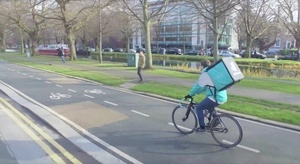

From top; cycle courier in Dublin; Michael Taft
Precarious working is rising, pervading a number sectors: hospitality, retail, construction, financial, education (including childcare) and health. A major difficulty, though, is that there is no official or agreed definition.
There is no one set of measurements that captures precariousness.
We sometimes use short-hand data such as under-employment –people working part-time but looking for more hours or a full-time job. Or those on uncertain working hour contracts. These are aspects of precarious working but do not tell the full story.
To overcome this, the EU Commission’s Precarious Employment in Europe uses the concept of ‘at-risk of precariousness’. They first identify the risks:
Low-pay and in-work poverty
Lack of certainty over hours worked
Lack of access to social security / insurance benefits such as unemployment or illness benefit
Lack of employment rights such as holiday pay
Lack of right to collective bargaining
Lack of career progression, career development, in-work training
Stress and negative health impacts
This list covers a number of precarious situations based on income, workplace rights, social security, career and health-related issues. The EU Commission then ranks various employment contracts by their potential risk.

Standard open-ended contracts – whether full-time or part-time – are not without risk of precariousness but they are at the lower end. The highest at-risk contracts are, unsurprisingly, temporary agency work, posted work, zero-hour contracts and black market work.
All work that is ‘atypical’ (that is, not full-time standard contracts) is subject to levels of unacceptable risk. And atypical work is growing.
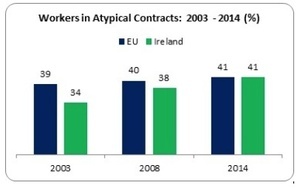
Four in every 10 workers are in medium to high risk categories. Of course, this doesn’t mean that all ‘atypical’ workers are at risk. High-income, professional self-employed and many fixed-term contract workers would not be subject to risk. Nonetheless, if we are to find precariousness, we’ll find it in atypical work.
Obviously no single measurement can encompass all this and provide a bottom line number. We can, though, measure some aspects of precariousness.
Part-Time Involuntary employment: Those who are involuntarily employed part-time (when they would rather be employed full-time or with more hours) stood at 23.7 percent of all part-time workers in 2009. This rose to over 40 percent by 2012 as would be expected during a recession. Since then it has fallen back 31.5 percent but still remains above pre-crash levels.
Temporary Agency Workers: A small category, it has increased during the recession and afterwards. In 2009 only 0.7 percent of workers were employed in this category. By 2016 this has nearly doubled to 1.3 percent with a continuous upward trend.
Temporary or Fixed-Term Contracts: In 2009, 8.8 percent of employees were on fixed-term contracts. This rose to over 10 percent during the recession but has fallen back to 8.2 percent.
These measurements show a mixed-bag. And some high-risk categories are not measurable such as bogus self-employment.
ESRI’s Elish Kelly and Alan Barrett, writing in the Economic and Social Review, studied the trend in atypical contracts and expressed concern at the:
‘ . . . apparent persistence of the increased likelihood of atypical work in the recovery, albeit to a weakening degree. Before drawing any strong conclusions, we should note that the timeframe we are using is short and so we certainly cannot conclude that Ireland is in a new phase where atypical work is more likely. Nevertheless, the results raise the possibility that economic recovery will not, of itself, lead to more full-time and permanent jobs.’
Whether we will fall back to pre-crash norms or enter into a new phase of increasing atypical contracts is still not settled.
If measuring precariousness is difficult, resolving it is even more so and not amenable to a magic bullet.
The problems faced by low-hour contract workers are different from temporary agency workers are different from bogus self-employed.
Each situation requires specific tools and, as the Irish Human Rights and Equality Commission shows, the resolution can be quite complex with potential for perverse consequences (in this case, the Government’s legislation on ‘if-and-when’ contracts and banded hours).
A Floor of Social Rights
So how can we establish a framework that can tackle precariousness while acknowledging the complexity of the different solutions?
A EU Commission study came up with a provocative proposal: a Social Rights Floor. This would take all the social rights currently enjoyed by those on open-ended contracts and assess the degree to which those rights are applicable to those on atypical contracts.
This would include many of the risks outlined above by the EU Commission (social security, workplace rights, etc.).The fight against precariousness shouldn’t be reduced to legislation over employment contracts.
There are two other key ingredients:
Sectoral collective bargaining: each sector has particular issues which could be addressed by employers and employees collectively to ensure the remedy is robust and universally applicable. This not intended to replace a legislative floor but the fact is that banded hours negotiated collectively in the retail sector are more secure than what the Government is proposing. And if one were to look at the legislative protection for atypical workers in Denmark, you might think it quite weak. However, precariousness is tackled through sectoral collective bargaining and the result is much stronger protection.
Fiscal policy: I have written in the past about the idea of transforming personal tax credits into a partial Basic Income or Participation Income. This would only benefit workers whose income is below the income tax threshold. It wouldn’t be a handsome amount at first (approximately €300 per month) but it would establish an income floor that could be raised in the future.
Floors for Social Rights and income will become ever more a necessity in the future. The oncoming automation, AI and robot revolution could generate even more workers on atypical contracts.
The challenge will be to ensure that, regardless of your employment contract, you will enjoy the full range of Social Rights, that you will have an income floor, that you will have access to training and re-skilling (through enhanced labour market interventions) and, so, greater career progression.
In other words, you will be protected from precariousness.
Michael Taft is an economic analyst and author of the political economy blog, Notes on the Front.

French President Emmanuel Macron is a wine connoisseur
Macron says he reckons it’s fine
To guzzle a big glass of wine
As he’s eating a meal
But some doctors feel
The effects could be less than benign.
John Moynes
Pic: Getty


