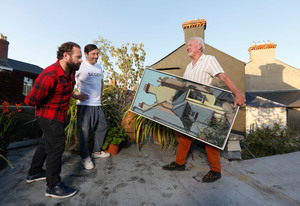
 From top: Christmas shopping in Henry Street, Dublin 1 last December; Eamonn Kelly
One of the ideas at the centre of David Edward’s book “Free To Be Human: Intellectual Self-Defence in an Age of Illusions”, is the idea that corporate consumerism is actually a religion.
The book draws on ideas contained in a wide range of other books, by people like Erich Fromm, Sigmund Freud, Carl Jung, Noam Chomsky and others, bringing together various useful observations made by these writers, in order to build a persuasive argument for the ill effects of corporate consumerism, not just on the environment, but also on society and the individual.
The Economy
It is as if all existential concerns have been subjugated to the one task of continued economic development through perpetual consumption. During the boom, RTÉ used to lead the news every day with a story on the economy’s health, as if for all the world the economy was a being, like some kind of queen bee people were serving.
Edwards characterises this enslavement to the economy as being similar to people serving a religion, with the advertising of the lifestyles promised by corporate consumerism as the liturgy.
Even though it is clear by now that corporate consumerism is eating up the planet, the system must continue as if that is not the case. This is the delusion on which corporate consumerism and advertising depend. The idea that it is possible to consume indefinitely within a finite system, without adverse effect. Once you look clearly at this proposition, as Edwards does here, the delusion collapses.
However, advertising, which is corporate consumerism’s propaganda, is tasked with keeping people blind to this contradiction at the heart of corporate consumerism.
Atheism
Edwards identifies atheism, which he also characterises as a “religion”, as being the underlying “belief” system that allows for the pursuit of perpetual consumption. Atheism is a religion in the sense that, like religions, it is founded on a “certainty”, a belief, the certainty in atheism being that life is meaningless. Whereas in religion the “certainty” is that there is a God and a divine plan and so on.
In both cases neither can know with any certainty whether there is or isn’t a God or a purpose to life. That’s where faith comes in. With atheism, the “faith” is that faith is also meaningless, since the certainty is, in atheism, that the universe is Godless.
It is into this vacuum that corporate consumerism inserts itself, becoming a religion of its own, based on the belief that life is meaningless and short, and should therefore be enjoyed to the fullest by consuming.
When put like that it is immediately obvious that such a belief system has absolutely no regard or concern for anything that may happen after the current “enjoyers” of this system of consumption have faded to their own personal oblivion.
The idea is to take what you can because “you deserve it”, one of the tenets of this religion, and let future generations make what they can of what’s left, if anything is left. If nothing is left: well, tough shit.
No Conspiracy
This system, as described by Edwards, is not like some kind of conspiracy, but operates by a series of filters that have the effect of filtering out those who might be opposed to such a short-sighted system, while favouring those who serve the system. The filtering works a bit like an algorithm set to always make choices, both in people and things, that ensure short-term profits and instant pleasure.
This filtering occurs across all aspects of the system, having the effect of rewarding those with “success” who support the system, while side-lining critics of the system, who are often characterised as “odd” or even “insane”. This is the system’s way of disarming criticism and is used routinely, through media, to discredit critics of the system, including scientists warning about impending climate catastrophe due to over-consumption.
A good example of how the system protects and perpetuates itself would be the manner in which whistle-blowers are treated, often characterised as “enemies” of the system they are reporting on, or delusional, or working some, as yet undiscovered, angle of self-interest.
The point is, the system doesn’t need a “conspiracy”, or some collective of “controllers” or planners to ensure outcomes that, even in the face of climate disaster, ensure that it’s always business as usual in the system.
In fact, corporate consumerism works at its most efficient when people are asleep to its logical outcomes, in this case the certainty that unfettered consumption in a finite system must eventually end up consuming everything, like a black hole.
Corporate consumerism not only seeks to deny that such an outcome is inevitable, but also implies that if this is the case then, so what? Enjoy yourself, have fun while you still can.
Contempt For Life
This is what makes this ideology an enemy of nature, and is perhaps one of the reasons why its political representatives, the neo-liberals here at home, chiefly in the person of Varadkar, are suffering so badly in the polls.
It would appear that ordinary people are beginning to realise the nihilism at the heart of the neo-liberal ideology. The uncaring creation of poverty and homelessness, and ultimately, on the macro level, the destruction of the environment itself and the planet’s life support systems, in the name of short-term profits and share-holder satisfaction.
Corporate consumerism, the ideology served by neo-liberalism, is a project which encourages the abandonment of ideas of social justice, along with the abandonment of those people perceived to be expendable, along with a disregard for impending climate catastrophe; all in the name of business requirements and short term-profit. An ideology that amounts to a declaration of contempt for life.
Eamonn Kelly is a Galway-based freelance Writer and Playwright. His weekly round-up appears here every Monday.
Previously: Eamonn Kelly on Broadsheet
RollingNews