


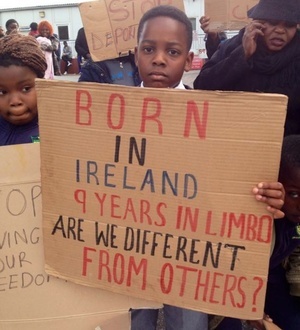

From top: A Direct Provision protest last year; Issues raised by children living in DP centres
A report report into conditions faced by children in Direct provision was published by the Department of Justice
The report, conducted by University College Cork on behalf, concluded:
The main message that emerges from the data is that on the whole, children and young people living in Direct Provision are dissatisfied with the system and say that their personal wellbeing, family life, private life and social life is adversely affected by long stays in the Direct Provision centres.
Although some of the children and young people talked about “the amazing community” and “nice people,” and others referred to their enjoyment of having easy access to their friends, the majority of those consulted are highly critical of what they state are the live for long periods of time.
They say that they do not like the system, that it is “not fair”, “not safe,” and that they are frequently subjected to rudeness and insensitive treatment by staff (including security staff) and by adults living in the centres.
Many children and young people raised issues relating to racism, stigma and bullying, both where they live, and in school.
While some of the children and young people like the area they live in, particularly those who live near the sea and those who live near the centre of Dublin, many said they “can’t travel” because of poor transport services, have very little access to outside places, and “don’t really go out.”
A number of children and young people also talked about the problems they face in going on trips organised by their schools.
A recurring theme among the children and young people consulted was the food they are provided with in their centres. In particular, many issues arose about the quality and the quantity of food that is provided.
The diets were described as “horrible and disgusting” (13 – 18 years), “always the same” (8 – 12 years), and “the food has no taste.” (8 – 12 years).
Undercooked food, especially chicken, came up as a problem in a number of consultations, and children said that residents often won’t eat the food.
Access to culturally appropriate food and/or cooking facilities was also an issue, as was the communal dining system. One child said they “do not like to stand in the queue for food” (8 – 12 years).
All ages spoke about the inadequacy of the weekly payments to meet basic needs such as school books, uniforms and other related expenses. Teenagers also mentioned the clothing allowance as being entirely unrealistic and as contributing to difficulties in fitting in with their peers.
A striking finding from these consultations is the similarity between the themes emerging, and those identified in the ‘Working Group to Report to Government on Improvements to the Protection Process, includin g Direct Provision and Supports to Asylum Seekers. Final Report: June 2015’, namely living conditions, supports, and the length of time for processing asylum applications.
There you go now.
FULL report here