

Gulp.
Terroir stalks the land.
Hic.



Ardú Street Art Initiative members from left: From left: Clare Keogh, Peter Martin, Louise Barker, Rose-Anne Kidney, Paul Gleeson and Shane O’Driscoll in front of a mural by Aches
Last night.
Louise writes:
Ardú Street Art Initiative arrives with the intention of injecting colour, vibrancy, and life into Cork city and aims to unite the Leeside community through art, lifting its creative energy at a time when it needs it most. Ardú welcomes seven of Ireland’s most respected and renowned street artists: MASER, Shane O’Driscoll, Deirdre Breen, Peter Martin, James Earley, ACHES, and Garreth Joyce, to create works at key city centre locations, in response to a theme inspired by the 1920 Burning of Cork.
The Ardú team are delighted to announce their return to Cork city’s streets from today September 27th, until October 11th, with four more large scale murals to brighten up the city centre landscape. Commissioning artwork from home grown talent of the highest level is the main aim of Ardú. The 2021 edition will welcome artists: Friz, Shane O’Malley, Conor Harrington and Asbestos…
Pics: Clare Keogh

“I have no issue with the principle of (vaccinating children as young as five)…..But I would be bound by public-health guidance in respect of it, because public health will have to weigh up the benefits for the child in respect of receiving the vaccine as opposed to the risks to the child.”
Taoiseach Micheal Martin (above) on Saturday
Meanwhile…
‘…Younger children have had a difficult pandemic to date. In the beginning they were incorrectly labelled as “vectors”, which led to avoidance and for many to feel stigmatised, according to recent expert evidence before an Oireachtas committee. Children’s education has also suffered. The long-term psychological effect of Covid is unknown.
Children in the Pfizer trial were given 10 microgram doses, rather than the 30 micrograms recommended for over-12s. The antibody responses and side effects were comparable. In other words, the safety profile and immunogenicity data in children aged five to 11 vaccinated at a lower dose are consistent with those in other older populations at a higher dose. The researchers plan to submit the results to regulators to seek approval for vaccinating children younger than 12, the current age limit. However, there remain differing opinions as to whether young children will need to be vaccinated.
…Taoiseach Micheál Martin has signalled the State will move to vaccinate children aged between five and 11 if advised to do so. The approval of the European Medicines Agency and then consideration by the National Immunisation Advisory Council and the chief medical officer, Dr Tony Holohan, will be required. These authorities have provided sound advice so far. There will be no reason to doubt whatever recommendation is made.’
Editorial, Sunday Independent.
Should we vaccinate young children against Covid? (Sunday Independent)
Meanwhile…
The following thread details Children under 17 in the USA that have died after taking the Covid Injection.
Healthy Kids should not be injected with a serum that provides them no benefit, has no long term safety data & is still in trail phase.
Children are not human shields. pic.twitter.com/InnLFXPwxx
— Chris (@chrislittlewoo8) September 25, 2021
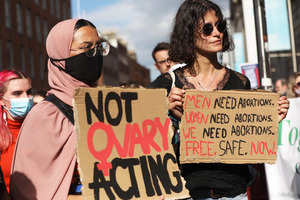


Saturday.
Kildare Street, Dublin 2.
The 10th Annual March for Choice took place today outside Leinster House where the Abortion Rights Campaign held a socially distanced, ‘static rally’ for ‘free, safe, legal and local abortion access’.


From top: Outgoing Chancellor Angela Merkel and her CDU party candidate to replace her, Armin Laschet, spoke at a rally on Saturday; Germany’s SPD leader Olaf Scholz
This morning.
Olaf Scholz set his sights on the German chancellorship on Monday after his centre-left party narrowly came out on top in the general election.
The Social Democrats (SPD) edged out Armin Laschet’s Christian Democrats (CDU), the party of departing Chancellor Angela Merkel, which scored its worst-ever result.
The narrow result paves the way for complex coalition talks, meaning Mrs Merkel could still be in office at Christmas.
Mr Scholz hopes to form a government with two smaller parties, the Greens and the Free Democrats (FDP).
However, Mr Laschet could still become chancellor if the two kingmakers choose to side with him instead.
‘I’ll be darned’: Biden reacts to pivotal German election result (CNBC)
Getty/Reuters
Congratulations to the Class of 2021 who today begin their journey of … *checks notes* white collar crime? pic.twitter.com/EzeFILrkQR
— Gavan Reilly (@gavreilly) September 27, 2021
Um.
This morning.
Thanks Ultan Mashup
End of an era! Closing down tomorrow after 35 years pic.twitter.com/rHHOz1zhCl
— Dr Emily MarkFitzGerald (@emilymfg) September 26, 2021
Dun Laoghaire, county Dublin
ESB writes:
Honestly, I loved this place. I cannot believe it: [proprieter] John Hyland is a legend. And now it’s closing down?
Anyone?

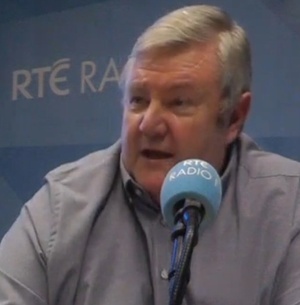
No fair-minded person could come away after listening to the RTÉ Radio One documentary, Women of Honour with a positive view of military management, writes Derek Mooney (above)
Whenever I have written about defence issues I have done so from the point of view that we do not properly appreciate the men and women of Óglaigh na hÉireann/The Irish Defence Forces.
Whether I was bemoaning our failure to treat defence as a political priority, highlighting the problems with retaining personnel, or lamenting the gross underuse of our Defence Forces on national cyber defence, I have often portrayed military management as being a hapless victim.
While my benign depiction of a military management doggedly doing its best in the face of an indifferent political and administrative system, is fair in the instances listed above, it is not always the case.
No fair minded person could listen to Kate Hannon’s compelling, but distressing, RTÉ Radio One documentary, Women of Honour, and come away with a positive view of military management.
Listening to the documentary was difficult, but it is essential listening for anyone with any interest in Irish defence matters.
Hearing former members relate their ordeals of rape and sexual assault was harrowing, but then hearing how their senior officers and adjutants responded when told of the attacks, was enraging.
These senior officers did nothing. But, in doing nothing they became accessories. Their failure to act against the perpetrators just re-victimised the victims.
It has so many echoes of the sexual harassment scandals that rocked the Canadian military in the late 1990s and again last year. Scandals that exposed a systemic culture of harassment and assault of female military personnel.
Katie Hannon directly references the most recent Canadian #militarymetoo controversy in the documentary’s opening minutes. Katie tells us how a radio report of what was happening in Canada encouraged the former defence force members who comprise the informal Women of Honour group to retell their stories.
They heard how the Canadian military justice system had revictimized the victims and recognised that was what happened to them.
They heard how the “the hostile, sexualised and hyper masculine culture” within Canada’s military system was allowing perpetrators to continue with their careers but leaving victims unable to come forward, and they thought: me too.
Katie’s documentary catalogues a spectrum of failures that ranges from unacceptable behaviours contrary to Defence Forces values and discipline, to ones that are simply criminal, including sexual and violent offences performed by individuals.
But the documentary is not just the tale of a few rotten apple offenders protected by colleagues and mates, it also documents many examples of systemic bullying, harassment, and discrimination.
It tells the story of a female air corps officer passed over for training and promotion. Having exhausted the internal arbitration and redress systems, including an appeal to the Minister, all of which found that there was no discrimination, she took her case to the WRC, the Workplace Relations Commission.
The WRC not only found discrimination, it recommended that these systems be updated before the end of December 2021, saying that:
“…it beggars belief that women should have been serving in the Irish Defence Forces for decades without the Forces’ systems and instruction ever having been appropriately updated to ensure they reflect anti-discrimination law as it applies to pregnancy and maternity”.
The Defence Forces has separate conciliation and arbitration and redress schemes designed to offer a fair alternative to the normal systems of collective bargaining enjoyed by civilian employees, but the schemes were never intended to operate to lower or outdated standards.
The schemes, which consist of the department on one side, and the two defence forces representative associations (PDFORRA and RACO) on the other, were established in 1991 to compensate for the fact that serving Defence Force members may not join a trade union, and thus have curtailed representation and support in the workplace.
Indeed under military regulations serving Defence Force members may not discuss any matter relating to their service with a public representative, which is why you usually see issues of army pay raised by groups organised by groups representing the partners and families of serving members.
If the schemes – that were supposed to deliver enhanced systems of arbitration and redress in exchange for surrendering the right to workplace representation – are not updated to reflect the workplace entitlements enjoyed by others, then the concordat has not been honoured.
One way of addressing that wrong is concede the right of defence force representative organisations to associate or affiliate to ICTU along the lines set out in Section 8.5 of the July 2020 Briefing to the incoming Minister for Defence.
Speaking of that briefing, it is sad to note that it only mentions issues of bullying, harassment, and discrimination in the context of the IMG (Independent Monitoring Group). The IMG was established back in May 2002 and charged with overseeing implementation of the reforms recommended in the Doyle Report The Challenge of a Workplace.
As the Briefing notes, the IMG reported in 2004, 2008 and 2014. Each time it reported progress in culture change, but it also recommended further monitoring. The next IMG report is long overdue. It should have reported in 2019/2020. Though the Defence Department says it has prepared the terms of reference, two years later and the next IMG has yet to be even commissioned.
Though the IMG process has been constructive and productive, is it enough in itself? The Women of Honour would say no.
The 2008 IMG report noted that the number of bullying and harassment complaints had dropped from 27% in 2001 to under 0.5%. That was progress. Indeed we hailed it as such, back in 2009.
But was it as great as we hoped? Was it a sign that the problem had decreased dramatically or was it an indication that many cases were going reported?
That must be addressed, and it is why the Women of Honour’s demand for an independent inquiry, must be granted. It is a call echoed by former Army officer Dr Tom Clonan whose 2000 PhD equality audit of the Irish military, titled “The Status and Roles Assigned Female Personnel in the Permanent Defence Forces” lead to the Doyle Report.
The fact that the problem is widespread and not unique to the Irish Defence Forces should not dissuade the government from acting now. Yes, we could benefit from seeing how others address this problem, but we cannot wait for others to act.
Ireland has a deserved reputation not just for the professionalism and excellence of the personnel we send on UN mandated peace support operations, but for their compassion and understanding.
I know from my own experience of visiting such operations that the Irish men and women I encountered in Lebanon, Chad, Kosovo or Sarajevo had a genuine appreciation of why they were there.
They had no sense of superiority or disdain. They saw the people in whose country they were temporarily based, as equals. People whose basic human rights they were there to protect. I was hugely impressed by the real empathy I heard from troops on these missions, across all ranks, when we chatted informally over pints in the mess.
As they opened up, you could tell just how touched and moved they were by the poverty and pain they saw around them. They knew the high-end politics that had landed these regions in strife, but they focused on the devastation that war and conflict was bringing struggling communities and families. While the cultures and traditions may be different, they still saw families, ordinary men women and children, just looking to get by.
Indeed, one of the most under told stories of the Irish peacekeeping experience is the number of humanitarian and projects that Irish troops have supported and driven, in partnership with Irish Aid.
In Kosovo Irish troops helped renovate schools and provide outdoor sports grounds while in Lebanon they supported an orphanage in Tibnin and aided various elderly care and literacy projects. There are many examples elsewhere too.
These were not PR exercises, gauged to win over local trust, but examples of Irish troops, during their own free time, seeing what the local community needed, be it a hospital, school or clean water supply, and delivering it though individual effort and support.
So how do I reconcile a military culture that fosters these countless examples of caring and compassion with the one that disgracefully fails its own victims of sexual harassment and violence?
I simply cannot. The two accounts are real and true. Which is why, as I said at the outset, listening to the documentary was so difficult.
Across its 108-year history, the Defence Forces has shown itself capable of great caring and courageousness. It has also shown itself capable of absorbing criticism and implementing major reforms. Indeed, few other State institutions have demonstrated the same openness to reform as the Defence Forces.
But the military will need political support and investment to do it – two things denied to it for too long. It must receive both, now.
Derek Mooney is a communications and public affairs consultant. He previously served as a Ministerial Adviser to the Fianna Fáil-led government 2004 – 2010. His column appears here every Monday. Follow Derek on Twitter: @dsmooney

Adding high-fat dairy based foods to your diet may help in lowering the risk of cardiovascular diseases, Swedish eggheads claim
Some boffins have concluded that
A diet which is high in fat
Will help you live long
And if they’re all wrong
I may have to just eat my hat
iStock










MORE to follow.