



The Direct Provision Challenge.
Living on €19.10 for a week – the amount asylum seekers in direct provision get.
From Monday, December 5 to Sunday, December 11.
United Against Racism writes:
Rules:
– You have only €19.10 to spend for the week.
– Your meals are paid for separately, not included in this allowance.
– For those who travel to work or school, these travel expenses are not part of this allowance.
– All your other expenses are to be paid from this allowance.
So, how do you live on €19.10 per week?
Are you willing to take the Direct Provision Challenge?
Take part and send us a short video or text report to info@united-against-racism.net
The Direct Provision Challenge (Facebook)
Previously: Inside The Asylum
Pope Tweetz
at


Sheila writes:
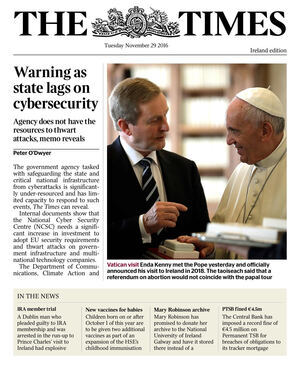
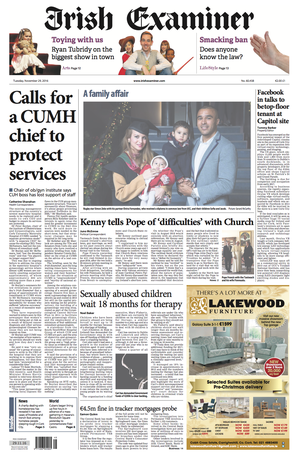
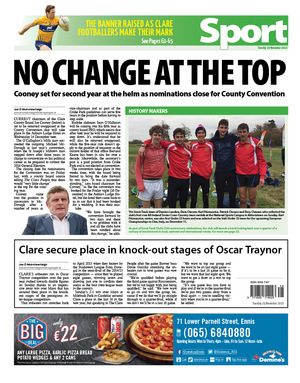
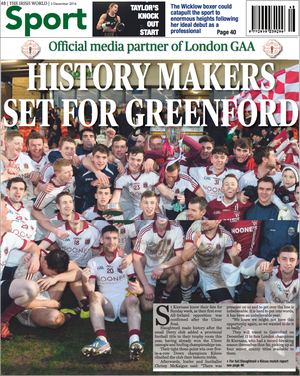
A friend of mine did a thing (which I found out about recently): Pope tweets. Then Robo Pope tweets back the same tweet. But in between its translated from English to Japanese back to English back to Japanese and so on. Fifteen times each way. Sometimes it’s gibberish. But sometimes a little bit funny.






MORE to folly.

Women who had symphysiotomies and their supporters outside the Department of An Taoiseach in 2014
Further to the publication of Justice Maureen Harding Clark’s report on the symphysiotomy redress scheme last week…
And some of the subsequent reporting of the same…
Sinead Redmond, of the Association for Improvements in the Maternity Services (AIMS) writes:
The Association for Improvements in the Maternity Services (AIMS) Ireland is outraged at the suggestion that the survivors of symphysiotomy have exaggerated, or been in some way dishonest, in their claims in what has been a long and difficult struggle for them, in the pursuit of justice.
We, at AIMS Ireland, know that women are very slow to expose themselves to legal proceedings, especially when they have been traumatised in the past. The fact of the matter here is that medical records are missing.
We are very disappointed that Judge Maureen Harding-Clark has made completely unfounded accusations of dishonesty against elderly women and their supporters, based on a lack of documentation and records. At the same time, she fails to hold the hospitals and medics responsible for not keeping that documentation, as is their responsibility.
The claim that a woman’s medical record could prove or disprove that a procedure had taken place is laughable. Medical record keeping of the time was minimal, to say the least. Many women’s medical records for a birth consist of a few lines, hardly comprehensive proof.
All medical records prove is that a midwife or obstetrician wrote something once upon a time on a chart. Whether this is an accurate reflection of events is another story entirely. It is not uncommon to see issues with medical record keeping to this day.
Further, AIMS Ireland is at a loss to understand why, in an era where women not only had no access to abortion, but also had no access to contraception as well as no legal right to not be raped within marriage, women who had further pregnancies after symphysiotomy are deemed by the judge to not have been traumatised by the symphysiotomy.
Women of the time had no say over whether they became pregnant or not regardless of their state of health and wellbeing, and as of course is still the case, they had no say over whether they remained pregnant or not. Becoming pregnant was not something a woman had any say whatsoever in.
This report is a further violation of those women, who are and were entitled, in their latter years, to expect more of a state that claims, with little evidence, to be more enlightened.
Women who have experienced mistreatment know that it has happened. They are neither hysterical nor litigious as suggested by those who should know better. It is beyond belief, that those practicing medicine in today’s world, would turn to the ancient argument of the hysterical woman.
The biggest issue for AIMS Ireland today, is the establishment’s complete failure to hold a mirror to its practices both past and present. It demonstrates to women today how little value is placed in their well-being.
It further illustrates that ‘the professionals’ in this country have rights over women’s bodies which would not be given in other jurisdictions.
In media commentary this week, the point has been made that symphysiotomy is still used in poorer countries where alternatives are lacking. The key point here is “where alternatives are lacking”. This was not the case in Irish hospitals in 1965, with access to trained surgeons, surgical theatres and antibiotics.
There is no valid reason for the fact that though symphysiotomy was dropped and even banned as a procedure in other Western countries, it continued to be used in Ireland as late as the 1980’s, no matter how frequent its use was.
Points have also been made regarding the life-saving potential of symphysiotomy in specific situations. No one is questioning that.
We are questioning the medical need to perform these procedures in Irish hospitals in the years in question, when evidence showed a caesarean section was a viable alternative.
We at AIMS Ireland find it appalling that women’s experiences, trauma and injuries at the hands of what was a highly patriarchal and religious-led maternity care system, could be so lightly dismissed, and their suffering labelled as in some way “normal”.
Women should not be suffering either emotionally or physically after childbirth in Ireland.
Meanwhile…

That’s true. About 1500 documented symphysiotomies, 600 claimants. https://t.co/59OjdqgJeO
— Mairead Enright (@maireadenright) November 28, 2016
Previously: ‘Confabulation, False Memories And Conspiracy Theories)
Related: Medical Council ‘carefully considers’ symphysiotomy report (Paul Cullen, Irish Times)
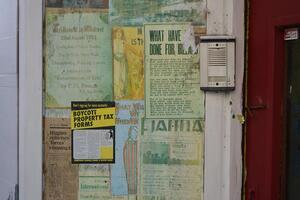


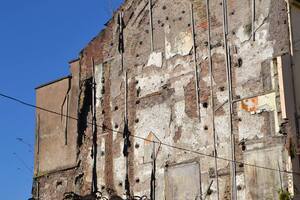
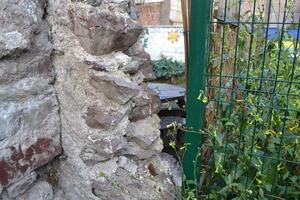
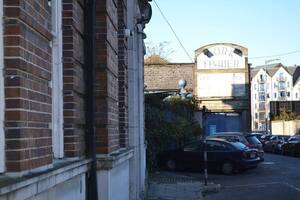


Shots of the old medieval quarter of Cork City.
Taken by Broadsheet contributor Mike McGrath-Bryan over the weekend.
Sez Mike:
An area laid waste by recent business closures but ignored by gentrification, the Old Town area of the city has long possessed its own character. Though urgent economic assistance is needed for the area, she continues to show a resilience – typical of Corkonians in general.
A real character shines through, while the intervention of community group Reimagine Cork has given the place a touch of colour, with a DIY feel.


This afternoon.
The O’Callaghan Davenport Hotel, Dublin 2
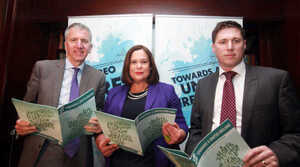
Top from left: Northern Ireland Assembly Finance Minister Mairtin O Muilleoir, Sinn Féin Deputy Leader Mary Lou McDonald, and United Ireland campaign co-ordinator Matt Carthy MEP, at the launch of a new Sinn Féin document Towards a United Ireland. To wit:
Northern Ireland’s Secretary of State to trigger a referendum under the terms of the Good Friday Agreement there would first need to be the political will from Dublin.
The document says referendums on Irish reunification would be held concurrently north and south of the border.
It says that the Orange tradition must be accommodated under a new constitution and there would be new symbols and emblems.
Northern Ireland Minister for Finance Máirtín Ó Muilleoir said reunification would mean a benefit of £35bn between now and 2025….
FIGHT!
Irish reunification would see benefit of £35bn by 2025 – Sinn Féin (RTÉ)
Leah Farrell/Rollingnews


Colourised Photochrom postcards of daily life in colonial Tunisia at the end of the 19th century entitled “Views of Architecture and People in Tunisia” from the catalog of the US Library of Congress.
Above: a street in Kairwan in 1899; Porte Française, Tunis; Bedouin woman; Arab men; Souc-el-Trouk, Tunis; crowds gather around a snake charmer; Private drawing room, Kasr-el-Said; Cathedral of St. Louis, Carthage and a family of Bedouin beggars, Tunis.

https://www.youtube.com/watch?v=06zU6c7IqJo
You may recall a post in March by visual artist and researcher Vukašin Nedeljković, called Postcards From Direct Provision.
Vukašin, from Serbia, sought asylum in Ireland in 2007, and was eventually granted ‘leave to remain’.
He founded Asylum Archive which aims to “collaborate with asylum seekers, artists, academics, civil society activists, amongst others, with a view to create an interactive documentary cross-platform online resource, which critically foregrounding accounts of exile, displacement, trauma and memory”.
Further to this…
Vukašin is running an exhibition – called Asylum Archive – of accumulated artefacts, oral histories and photography at the NCAD Gallery on Thomas Street in Dublin 8, until January 3, 2017.
The NCAD Gallery is open Monday to Friday from 1pm to 5pm.
Earlier: The Christmas Bonus
