

The shell of a White Lipped Snail magnified 2500 times by a scanning electron microscope. New platelets can be seen forming in the darker layer.



The shell of a White Lipped Snail magnified 2500 times by a scanning electron microscope. New platelets can be seen forming in the darker layer.

The beautiful Andrea Corr,
Has let her fans know what’s in store,
Her talent, it seems,
Will melt through steel beams,
As Jim brings the band back once more.
John Moynes
(Rexfeatures/Wire)

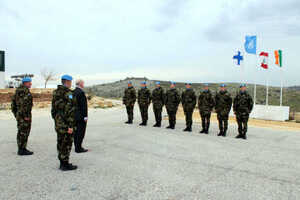
From top: Overseas deployment map; Minister for Foreign Affairs and Trade, Charlie Flanagan inspects Irish troops attached to the UNIFIL peacekeeping force in Lebanon last February
French President, Francois Hollande’s, recent invocation of article 42.7 of the Lisbon Treaty has called on all EU member-states to aid and assist France by all means in their power.
This is the first time since the Lisbon Treaty’s formal adoption in 2009 that the so-called mutual defence clause has been activated – meaning we’re all wading deep into unchartered waters.
Ryan McCarrel writes:
Francois Hollande’s request came with a further wrinkle – the French army is already thinly stretched across much of sub-Saharan Africa, from Djbouti along the Gulf of Aden to Senegal on the Atlantic.
Therefore, president Hollande and his cabinet have apparently made it plain that they want other EU member states to send their military support to either Mali or Lebanon, essentially to act as stand-ins for France’s overstretched forces, so they can be redeployed in order to beef up security at home and redirect their attention towards fighting ISIS in Syria.
It is entirely unclear, and indeed, debatable as to whether this is what the authors of the treaty had in mind when they drafted the mutual defence provision in the first place.
What is clear, however, is that increasing the amount of Irish soldiers deployed on overseas missions, to approximately 850, was already on the government’s agenda long before the attacks in Paris – even if relatively few bothered to pay attention.
So it should have come as no surprise when Irish defence minister, Simon Coveney responded favorably to the French request for more soldiers – in fact, he doubled down on the strategy after attacks in Mali on Friday left 21 dead, many of whom were foreign nationals, at the Raddison Blu hotel in Bamako.
At the same time, Coveney charged that those – including myself – who have openly questioned the wisdom of sending more Irish soldiers to France’s deeply fractured former colonies, were “trying to create a story that is unfair.”
Insisting that any request to deploy more soldiers would come through the United Nations adding a further assurance that if such a request were received it would conform to the ‘triple lock principle,’ and therefore, would not violate Irish neutrality.
First, it must be said that if anything ought to be considered “unfair” here, it is Minister Coveney’s framing of IDF deployments as Ireland’s moral and legal responsibility explicitly in response to the attacks in Paris, given that the government had already decided to send an additional 180 soldiers to Lebanon beforehand.
There’s little reason to excuse this politicking, considering raising net deployment numbers has long been part of a 10 year defence strategy that the Minister himself oversees.
Second, when we take a closer look at the history of Irish foreign policy, including past deployments, it becomes increasingly clear that the idea of the so-called triple lock – and with it Irish neutrality – is as much myth as it is reality.
The triple lock principle is a rhetorical trope invented by Tanaiste Mary Harney in 2001 that essentially refers to the political process that ought to take place prior to the deployment of Irish soldiers internationally.
It was clarified in 2002 by then Taoiseach, Bertie Ahern, when he said that any deployment of Irish soldiers abroad must first 1) be approved by the Dáil 2) and the Irish government; and, 3) must be endorsed by the UN – even if only loosely.
Much has changed since then.
Writing in 2013, UCD Professor, Ben Tonra, noted that the triple lock “appears no where in Irish legislation” adding that, “In truth, the only ‘lock’ that exists … is the self-imposed legal requirement for some class of UN authorisation.”
Yet even this self-imposed requirement for UN authorisation, is no longer a guarantor of neutrality – in part, because what constitutes UN authorisation has, for the Irish government at least, slowly eroded over the last decade.
Authorisation used to mean a UN resolution explicitly establishing a peace-keeping force, this is no longer the case. In fact, since the Daíl passed the Defence Act of 2006, what counts as UN authorisation has grown into a ‘laundry list’ of terms, including “supports, endorsed, approved, or otherwise sanctioned.”
The slow erosion of what constitutes UN authorisation was, and continues to be, an intentional maneuver to circumvent the UN security council. In particular, in response to growing weariness on the part of some Irish politicians who are tired of countries like China, using their position on the UN Security Council to veto international missions that the government would otherwise support.
Of course, if we take that last point seriously, what it really means is that by 2006 the Irish government was looking for ways to side-step what was increasingly being regarded as an overly restrictive definition of neutrality.
This, then, is the non-legally binding triple lock mechanism which supposedly safeguards Irish neutrality, that Defence Minister Coveney refers to when offering his assurances. A weakly worded commitment to only partake in missions that have some level of UN support. Perhaps this slow erosion helps explain why Irish soldiers are currently deployed in 13 countries.
It would be unfair to group all of these overseas deployments together of course. The Irish Defense Forces deployment to help with the Ebola epidemic has little to do with their deployment to Afghanistan, for example. And yet grouping these missions under the same UN banner is exactly what looser definitions of ‘UN endorsement’ allows the government to do ().
It’s this grouping that allows the minister to so casually discuss IDF deployments to Mali and Lebanon as if they are interchangeable even though they vary widely. Each conflict has its own context specific dynamics and potential risks and consequences for Ireland’s national security and the the safety of Irish soldiers that must be taken into account, regardless of UN endorsement.
With regards to Mali, the growing possibility that the peace accord will fall apart, or that it was never fully implemented in the first place, means that there may be no ‘peace to keep’ – while extremists there have made a habit out of targeting peacekeepers and aid workers specifically. These, in addition to France’s colonial legacy and particular set of national security and regional economic interests, were only some of the contextual factors that Minister Coveney wanted to so quickly write off as an “unfair story.”.
Yet falling back upon rehearsed rhetorical tropes that boil down to the UN’s tacit approval of some interventions and not others does not in-of-itself provide an indicator of a mission’s legitimacy or moral standing – much less does doing so provide detailed reasons as to why Irish bodies in particular ought to be expected to fill in for French soldiers were they to redeploy to bolster security at home or ‘bring the fight to ISIS’ so to speak.
The UN’s checkered past of powerful states manipulating resolutions to their benefit, and ongoing scandals involving UN peacekeepers, including allegations of sexual abuse, can attest to the first part.
As for the second – Ireland needs to seriously consider the implications of sending more soldiers abroad, at a time when the very safeguard protecting Irish neutrality, the so-called triple lock mechanism, continues to suffer from legislative erosion AND when interlocking security arrangements between the EU, NATO, and the UN muddle what would otherwise be a fairly clear picture of what we could safely consider ‘neutral’ peace-keeping missions.
Indeed, the unprecedented invocation of Article 42.7 by Hollande, in addition to the further French government’s clarification that this aid and assistance ought to take the form of military support for EU-led UN ‘endorsed’ ‘peace-keeping’ missions in their former colonies – so they can redirect their soldiers to fight in yet another conflict beset with its own geopolitical intrigues – just goes to show how muddled this picture has already become.
Ryan McCarrel (@ryanmccarrel) is a PhD candidate in Geopolitics University College Dublin where he specializes in NATO’s relations with its non-member states.
Previously: In Harm’s Way

Ahead of the Conor McGregor vs Jose Aldo fight on December 12th…
Leon writes:
Some Conor McGregor animation from Galway…


Anne Marie McNally (top second left) during secondary school and (above) today.
When Third Level is what ‘others’ do and getting to the junior cert is an achievement.
Anne-Marie McNally writes:
It was Ben Franklin who said “an investment in education always pays the best interest.” That enlightened comment came somewhere in the 1700s but as is true of most words of wisdom, they are more relevant today than ever.
Growing up in inner city Dublin, in what remains one of the most disadvantaged communities in the country, I weaved my way through an education system where my schools, both at primary and second level, were labelled as ‘disadvantaged’ or ‘underperforming’ -before the days of what would now be called DEIS schools.
I had some great teachers along the way but they were struggling in a system where the overriding attitude was that we, the student population, were not really destined for any form of educational greatness so delivering the curriculum and getting us to Leaving Cert would be considered real success though junior cert would be likely more realistic. Ambition was not nurtured – pragmatic stereotyping was more the order of the day.
Most kids I worked my way through the system with came from strong families who were hamstrung by economic disadvantage – my own included. Many of them had parents who themselves had never had access to any education beyond early second level.
Third level seemed like something ‘others’ did. Personally I was lucky to have parents at home who prioritised education and that, combined with my natural indignation at being told by the system that I ‘couldn’t’, ensured I broke the cycle and pushed through. But I was very much the exception rather than the rule and that’s just not acceptable.
I sat in classes where we were encouraged to look to the local VEC at best or the local sewing factory at worst. To aspire to university was highly unusual and really not something that happened very often. When it did it was miraculous – I still get asked back to speak to students by way of the ‘girl done good’ narrative!
Unfortunately not much has changed in the intervening decade or so since I left school. Data published last year following an Irish Times analysis showed that progression rates from affluent areas were almost double those of socio-economically disadvantaged areas.
The analysis also found that those progressing from more affluent areas were more likely to have attended a fee-paying school and/or availed of private grinds. So, as in most things in life, the balance of opportunity is weighted heavily in favour of those who have at the expense of those who have not.
Interestingly, another key indicator that emerges in relation to educational progression is the level of educational attainment of the mother in the family. In other words, there’s a cycle – a vicious cycle- of generational inequality that is perpetuated and solidified by educational inequality.
Education should be seen as a public good – the more society puts in the more society gets out. But rather than families recognising this, it is the State that needs to appreciate the sentiment. It is perfectly acceptable for families to avail of the best education they can afford – indeed they should.
However, it is society’s responsibility to ensure every family has access to the same quality of education regardless of what they can afford. It is not enough to simply invest bricks and mortar into school building projects if you don’t have a symbiotic investment in teacher training and ensure teaching is recognised as a valuable and vital component of a healthy society.
Teachers should be recognised as crucial elements of a vibrant successful society and economy and the respect and remuneration afforded to teachers should reflect that value.
Tomorrow, my Social Democrats colleague in Dublin Central – one of the areas with the lowest third level progression rates in the country – Councillor Gary Gannon will host a public meeting in the Sherriff YC hall [Sheriff Street in Dublin 1] to discuss access to education.
This week is college awareness week. Awareness of college is one thing but awareness that college is a viable option for all –no matter your background – is a whole different thing and that is where we need to get to. If you’re around at 11am in the morning then join Gary in a discussion about how we achieve educational equality.
After all, when Mandela said “education is the most powerful weapon you can use to change the world” I’m pretty sure he was also referring to those outside the affluent suburbs.
Anne-Marie McNally is a political and media strategist working with Catherine Murphy TD and will be a candidate for the Social Democrats in the forthcoming General Election. Follow Anne-Marie on Twitter: @amomcnally


ZompireWolf (top); creators Derek Dillon (left) and Ralph Hosford of DurtBird Games.
Part Zombie, part Vampire and part Werewolf…all trouble!
Ralph writes:
Though you may be interested in a follow up in regards to ZompireWolf… With only a few hours to spare, we managed to cross the line and get successfully funded! We are very proud to be the first Irish computer game to be funded on Kickstarter! Just wanted to say a MASSIVE thank you to everyone!
Previously: The Sum Of Their Parts

Brand New Retro‘s Brian McMahon will launch the Brand New Retro buke this Thursday at 6.30pm upstairs in the Workman’s Club [Wellington Quay], Dublin.
It’s the best of and latest greatest hits from the Brand New Retro site.
Brian writes:
After almost 5 years of digitising content for brandnewretro.ie the time is right to bring these scans back to the format in which they first appeared, and the format in which they are best appreciated. Print. I am delighted to announce that the Brand New Retro book will be on sale from this Thursday. The book is a uniquely Irish compendium of over 700 images, adverts and articles featuring the best bits from brandnewretro.ie along with lots of new scans. The book is a collaboration with my pal Joe Collins and is published through Liberties Press.
Meanwhile..
A night of Irish pop culture will ensue at MVP, Clanbrassil Steet, Dublin 8 tonight.
This Is Banter will be joined by Brian, Joe Collins and Sinead Kenny to talk about the motivation behind Brand New Retro and the early days of Irish pop culture and Life before the Internet.

What you may need to know:
1. Captain America (Chris Evans) gets the hump with Iron Man (Robert Downey Jr.). Iron Man gets the hump with Captain America. Battle lines are drawn. Dun dun duuuuun!
2. Directors Anthony and Joe Russo will also take over from Joss Whedon for the next two Avengers movies.
3. Have we reached peak comic book movie? Is there still an appetite for watching more CG characters destroying another city?
4. At least Ant Man (2015) didn’t do that. Come to think of it, Ant Man might be in this. How would you know?
5. Black Panther @1:50. Meow.
6. Broadsheet prognosis: Third time Bucky.
Release Date: April 29, 2016.
Mark blogs at WhyBother.ie

‘sup?
Jody writes:
Why is RTÉ Player showing me a crude mobile phone video clip apparently taken from some tourist of a crocodile show somewhere in Asia when I’m meant to be seeing Nine News? The 30 second clip repeats 3 times before the news and 3 more times during what I assume is meant to be an advert break. I didn’t bother waiting for the weather forecast.
Anyone?
