

Ah here.
Private Eye.
On shelves tomorrow.
Thanks Bernard
Previously: Armagammon



This morning.
Fitzwilliam Square, Dublin 2.
Labour candidate for the Dublin Bay South by-election Senator Ivana Bacik lodged her nomination papers with the Dublin City Returning Officer, joined by former Labour TD for the area, Ruairi Quinn, who, as Minister for Education, abolished student loans, removed Catholic patronage of schools, replaced the hated Leaving Cert, did stuff.

The Aviva Stadium lit up in the Pride colours in 2019
This evening.
Via The Irish Sun:
Dublin’s Aviva Stadium will be lit up in the colours of Pride tonight to show support for members of the LGBTI+ community in Ireland.
The move comes in the wake of UEFA blocking Germany’s proposal to do likewise for their EURO 2020 fixture against Hungary.
Meanwhile…
— UEFA (@UEFA) June 23, 2021

Monday

This afternoon
Um.
Anyone?
COVID-19 advice for the public: Getting vaccinated (WHO)
Previously: Not For The Moment

 From top: Oliver Cromwell (left) and Samuel Pepys; David Langwallner
I have just completed a successful case, from the defendant’s point of view, in the sleepy market town of Huntingdon, Cambridgshire, which, from distant election broadcasts, I had appreciated was John Major‘s seat.
That was the extent of my initial knowledge. Perhaps there is a gap in my education, as it is the birthplace of two of the central British figures most relevant to our age: Oliver Cromwell and Samuel Pepys.
It is, in fact, like Sleepy Hollow, a kind of hangover from a Tim Burton film with an odd karma. Kind of half-museum theme park and half-dilapidation. But for the historic buildings, it’s not unlike a rural Bray. The land of the triffids.
Well, we all are now in that space and my co-counsel had not done a trial in person in 18 months. Mars attacks: Coronavirus Part 3. The Indian variant with variants to come as convincing as Jaws: The Revenge (1987) , which I have kindly not brought up with Sir Michael Caine as he saunters into my nearby Waitrose in Leatherhead, Surrey. Of that shark sequel he once said:
“I have never seen it, but by all accounts, it is terrible. However, I have seen the house it built, and it is terrific.”
Well, is that not the impetus behind the drug companies and the siphoning of wealth to the mega rich, further accentuating social division and compliant anarchy.
And that house in Leatherhead is now on the market. Well, Sir Michael is not stupid.
Ireland, of course, has always viewed Cromwell as a genocidist not to put too fine a point on it. He was also, of course, a regicidist. And a little plaque outside The George Hotel in Huntingdon shows that, during the religious wars, the soon-to-be executed King took refuge here. A brief respite in the storm before his execution in 1647.
The wars, of course, were religious and Cromwell was the defender of British Protestantism and dissent. So, his legacy in the UK of puritan principles is much greater and rounded and more ambivalent than in Ireland. His birthplace is also here in a reconstructed old folk’s home, currently restricted in visitation by Covid restrictions, though his actual house is in nearby Ely which I also visited.
At one level, the glorious revolution was an objection to extremism and a celebration of religious difference which is worth remembering in an increasingly divisive and extremist age, not least divided by religion. As religious fundamentalism is in the ascendent, Huntingdon reveals ever more messages for our age.
Cromwell, it must be said, was largely tolerant of other fractious Protestant sects – “God’s Peculiar” – though not Quakers nor Ranters. He was also tolerant and encouraged, in effect, the readmission of the Jewish population, though not Catholics.
He certainly was also not tolerant of witch hunts. In 1649 Cromwell led an invasion force into Scotland to stop the Kirkland-led Scottish witch hunt, a witch hunt it should be said by Protestant extremists. But he was finishing off the glorious revolution when the ‘Witchfinder General’ Matthew Hopkins murdered 11 witches in Huntingdon where the Cromwell Museum now has a flagship exhibition.
‘This year is the 375th anniversary of the visitation of one of the most sinister figures in 17th century history to Huntingdon, the infamous and self-styled ‘Witchfinder General’ Matthew Hopkins. In May 1646, several people from the county were accused, tried, and found guilty of witchcraft; condemned, and executed. A display tells their story and includes rarely seen contemporary documents relating to the accusations and a local clergyman’s attempts to stop this persecution.’
The Cromwell Museum Huntingdon. Notice For a Present Exhibition.
It should be noted how moderate or considered Cromwell’s stance was, in context, as three witches in 1593 had been executed in Huntingdon for the murder of his grandfather’s second wife. The cult film Witchfinder General with Vincent Price (1968) is worth checking out as we enter an age of kitsch and grand guignol and disinformation.
People were led to believe that witches copulated with the devil – as bizarre as some of the untruths toda – as Witchfinders by Gaskill (2006), available in the Cromwell bookstore, intimates. Confessions were often induced by compliant poverty as consent is, in our day and age, forced or false confession as The Innocence Project has now flagged.
So, an authoritarian moderate as far as those who were not Catholics but no egalitarian and as a man of high birth, Cromwell did not endorse those working-class Protestants who fought for it, the Levellers. The revolution was ultimately, in Marxist terms, a middle-class revolution.
In Ireland, Cromwell was ruthless and hated Catholics. After the sieges of Drogheda, he refused to accept surrender and massacred over 2,500. He said re said butchery with butcheries to come:
“I am persuaded that this is a righteous judgment of God upon these barbarous wretches, who have imbrued their hands in so much innocent blood and that it will tend to prevent the effusion of blood for the future, which are satisfactory grounds for such acts which otherwise cannot but work remorse and regret.”
In effect, subhumans do not warrant human compassion. So those who invoke him as a hero should be careful about his demonisation of others. Puritanism or Brahmanism of all shapes morphs far too easily, as I wrote in a review of Geoffrey Robertson’s autobiography for Cassandra Voices into an uber mensch sense of rightness and a binary Manichaean division of the universe. The Kingdom of your heaven secular or religious, or your ideology, justifies your actions or rather those who have God or right on their side can do no wrong. For Cromwell, read Blair or any Jihadist fundamentalist.
In 1660, after death, his remains were exhumed and hung drawn and quartered. His head rehoused in Sidney Sussex, Cambridge for which he was also an MP. It should, of course, be noted that what Cromwell did to Drogheda is not that different to what Canadian and American venture capitalists, with their Irish aides de camp, are doing to Ireland.
Samuel Pepys, a near contemporary and a fellow Huntingdon resident whom one likes a lot more and much the greater man, whose house I visited of which more later, wrote the following in his diary about the exhumation of Cromwell:
‘This day the Parliament voted that the bodies of Oliver, Ireton, Bradshaw, & company should be taken up out of their graves in the Abbey, and drawn to the gallows, and there hanged and buried under it: which (methinks) do trouble me that a man of so great courage as he was, should have that dishonour, though otherwise he might deserve it enough.’
.
A rather nuanced assessment, as is want, in the greatest diarist the English language has produced. Pepys’ Diary also references, at great length the bubonic plague.
By August 1665, he was certainly concerned though diary references date from April of that year. He cited the bill of mortality as having recorded 6,102 victims of the plague but feared “that the true number of the dead this week is near 10,000,” mostly because the victims among the urban poor were not counted. Then, as now, statistics lie or are concealed. And the poor die unrecorded or of related diseases or ineffective vaccines or products of dubious utility or of non-supply, and in Brazil now in droves.
By mid-September, all attempts to control the plague were failing, Pepys notes. Quarantines were not being enforced, and people gathered in places like the Royal Exchange. Social distancing, in short, was not happening. Le Tout Ca Change. Unlike the Roundhead, Cromwell, the British Cavalier tradition still is remarkably resilient. And that’s largely a good thing.
Pepys was equally alarmed by people attending funerals despite admonishments. Having participated in a coffeehouse discussion about “the plague growing upon us in this town and remedies against it,” he could only conclude that “some saying one thing, some another”. Confusion abounds now also and disinformation. Popular misconceptions. And surely people should be entitled to attend funerals and religious ceremonies as our sense of humanity dwindles?
During the outbreak, Pepys was also overly concerned with his frame of mind; he constantly mentioned that he was trying to be in good spirits and his diary is most instructive in that respect.
On September 14, for example, he wrote that hearing about dead friends and acquaintance…
“…doth put me into great apprehensions of melancholy… But I put off the thoughts of sadness as much as I can”.
He was, in fact, a man of great fortitude and survived a major operation without an anaesthetic. For a small effete human being, he was extraordinarily courageous. Well, the weak can be strong and the Cromwellian brutalised strongman dangerous.
During the plague, the fear of the outsider loomed large, and Pepys found that when he left London and entered other towns, the townspeople became visibly nervous about visitors. Facts I have noticed in my two recent circuit trials in Huntingdon and Leamington. This is a time for absolute caution and prudence in human affairs.
“They are afeared of us that come to them,” he wrote in mid-July, “insomuch that I am troubled at it.” And, yet, he was willing to risk his health to meet certain needs that the puritanical Cromwell would not have approved of.
By early October, he visited his mistress without any regard for the danger…
“…roundabout and next door on every side is the plague, but I did not value it but there did what I could con Ella.”
Well, the rites of spring and summer will no doubt open in what will, at best, be a lull in the storm, now deferred in the stop-start compliance universe. The puritan and Brahmin Cromwell would no doubt have condemned such pleasures of the flesh.
So, as far as the two great inhabitants of Huntingdon are concerned, the messages for our time are those of plague; protestant moderation though not against sects such as the Levellers; forbearance; official lies and fear and panic in a time of chaos, but also, in fact, a different form of genocide. Death by attrition, neglect and culls. Death by increments and disinformation. And absurd Malthusian ideas gaining a dangerous traction.
We are living thus also in an extreme age of demonisation. An age of witches and witch hunts. Schiff’s book on The Salem Trials, not in the exhibition in Huntingdon, demonstrates how a conventional puritanical or fundamentalist or orthodox thought leads to a hatred of difference and sorcery that starts the problem and creates social sanitisation and indeed cleansing. The hatred of difference and exceptionalism.
The book also clearly shows that those who subscribe to such collective hysteria believe in superstition. Just as they believe in witches, they believe in unicorns, or the world is flat or creationism or… the efficacy of vaccines or the government are only doing it for our benefit.
Satanism, Schiff’s book also makes clear, is that witchcraft is also equated by narrow-minded people with subversion and dissidence. And it justifies torture, dehumanisation, and corporate state-sponsored murder, intentional or reckless.
Thus, Sleepy Hollow Huntingdon had much to say for our age. But all those who are like the Johnny Depp character Ichabod Krane should be wary. The ice age has arrived. A new dark age, non-receptive to a critical intelligence or a truth-seeking investigative force but divided by tribalism, demonisation, and witchunts of all shapes and hues as the world fragments.
And the weather in mid-Summer is most fickle and changeable in Huntingdon. Well does God forgive? And who is, or more pertinently what is, your God anyway? God a la mode. The God of Mammon and caste entitlement?
David Langwallner is a barrister specialising in public law, immigration, housing and criminal defence including miscarriages of justice. He is emeritus director of the Irish Innocence Project and was Irish Lawyer of the Year at the 2015 Irish Law Awards. Follow David on Twitter @DLangwallner



VFX/3D tutor Clinton Jones challenged his community of 3D artists to interpret a simple animation of a person walking with a heavy load. 2,400 entries were received and this reel – which almost seems to have its own strange narrative – contains the best 100.
You can watch the entire two and a half hour roll of all 2,400 entries here, should you wish.


This lunchtime.
Dublin city centre.
Meanwhile, the reopening of indoor dining on July 5 is now under question due to ‘the rise in the number of Delta variant cases’.
Indian takeaway it is so.
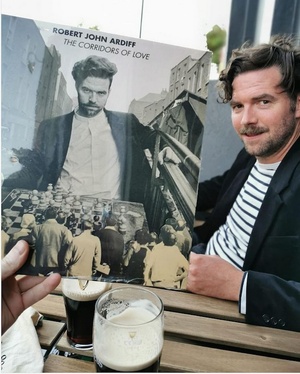
Robert John Ardiff – Black Dog
“When the black dog sings
And the half light ends.”
Erstwhile member of Choice Prize-nominated Come On Live Long, Robert John Ardiff (top) gets introspective on this ballad from his second solo album The Corridors Of Love.
Robert writes:
“The album is a love song to the forgotten; the left behind. I wrote the songs over the past year, while I was looking around at the city I live in, thinking, ‘what the hell is going on and where has the soul from this place gone?’ And I don’t just mean because of the pandemic.
“The anxiety that people feel because they can’t afford a house or a place to rent, when they are living paycheck to paycheck, when they are trying to create art or raise children or buy food – and the people in charge don’t seem to care for them.
“The idea came about after reading a book by Deborah Levy entitled ‘The Cost of Living‘ in which she describes the apartment she lives in as ‘the corridors of love’. So I took this idea and tried to tell the stories of the people behind these doors and incorporate it with my own personal experience.”
Nick says: Rooms with a view.
A gun is being put to the head, and why is this happening? It’s happening because in 2013 it was decided that there would be a National Maternity Hospital co-located and there has been procrastination. Minister Harris told us that he would get this sorted within a month in 2017. pic.twitter.com/9PKrkH2Kep
— Catherine Murphy (@CathMurphyTD) June 23, 2021
This afternoon.
The Dáil at the Convention Centre.
Earlier…
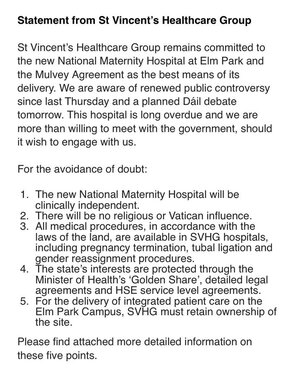

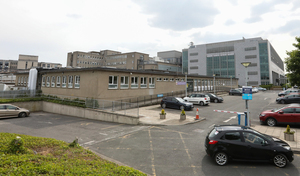
From top: Statement from St. Vincent’s University Hospital (SVHG)Minister for Health Stephen Donnelly; the Dermatology Department of St. Vincent’s University Hospital – this building currently occupies the site of the new National Maternity Hospital (NMH). St Vincent’s Hospital Group has rejected calls for the government to purchase the site in order to ensure the NMH is fully publicly owned.
This morning.
Via Irish Examiner:
The Health Minister Stephen Donnelly confirmed on RTÉ’s Morning Ireland. that despite a statement last night in which the St Vincent’s Hospital Group (SVHG) said it would not sell the land to the state, a meeting between the state and the religious order has been agreed.
He said:
“The people of Ireland fund St Vincent’s. I think the given that the people of Ireland are owed more respect than to be told by press release by St Vincent’s what is and is not going to happen,”
“The government’s position is the people of Ireland, or the women of Ireland, wants to own the land that their own maternity hospital is built on.
I would very much like to see that facilitated and I think it would be in everyone’s interest if that was.
“I think they should be cognisant and have a bit more respect for the people of Ireland who fund their hospital, I don’t think that’s the way to do business. These conversations need to be held and they need to be held respectfully,”
‘The people of Ireland are owed more respect than to be told by press release’ (Irish Examiner)
