Screen Shot 2014-08-18 at 11.58.01

Neigh.

A prison inmate whose ex became pregnant by another man got pals to throw a horse’s head through his love rival’s window. His cronies blasted the horse with a shotgun – then sawed off its head to use in the sickening attack in Dublin, The Star [not available online] can reveal.

That’s mafia, Ted.

rockin

Via Gumtree.ie:

“Man in the Moon’ Baby Cot/Crib/Bed, made for a dreamer or future astronaut, pilot, or just a star gazer. makes me wish i was small again! Solidly built from old wineboxes and heartwood, using timber dowel to eliminate the look of ugly screws and nails. The moon can sit solidly on the floor with no rocking movement, or the moon can sit on a stand which gently rocks the whole moon from side to side (not front to back as you’d imagine the moon to do!), looks beautiful when in action you just want to crawl into it yourself and catch a few Zzzzzs!

Linda writes:

“Buying for new babies is hard enough – but ‘built from old wineboxes’ – how can you resist?”

Baby Rockin Bed (Gumtree.ie)

Screen Shot 2014-08-18 at 10.33.12
Screen Shot 2014-08-18 at 10.34.24

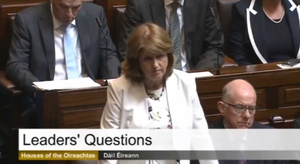
Deputy Catherine Murphy asked the Tánaiste Joan Burton a number of topical questions on the final sitting of the Dáil before the summer recess (July 17) in light of the UN HRC hearings in Geneva.

The Labour Party leader firmly ruled out any hope of new legislation for victims of rape and incest and those seeking terminations for medical reasons (TFMR).

Deputy Catherine Murphy:
“This week’s damning review of our human rights practices by the United Nations Human Rights Committee makes for grim reading but it is hardly surprising. Our failure in regard to the Magdalen laundries survivors, the symphysiotomy survivors, those who spent time in mother and baby homes and those who were victims of clerical child abuse is shameful. However, we stand to repeat the mistakes of the past if we do not act to address the grossly discriminatory laws that govern abortion. The UN committee confirmed that we are in breach of the International Covenant on Civil and Political Rights by denying women the option to avail of abortion in certain circumstances, namely, rape, incest, fatal foetal abnormalities and where a woman’s health is in danger. I would argue that we are not only in breach of the covenant but also in breach of basic humanity in denying an abortion to a woman who has been raped, is a victim of incest or has to endure carrying to full term a pregnancy when there is no prospect of delivering a live baby. I found it profoundly chilling to listen to the remarks of the principal officer of the Department of Health who told the committee that denying these women the right to abortion was the will of the people. I question what people are meant. The eighth amendment to the Constitution was inserted more than 30 years ago and attitudes have changed significantly since then, as recent polls have shown.

The Labour Party is a socially progressive party. The Tánaiste is the leader of that party as well as the deputy leader of this country, and she is also one of the few women in a decision-making role in this Government. Is she going to use her powerful position to bring about change in this area and, if so, how is she going to do that?”

Tánaiste: “In regard to the issues arising around fatal foetal abnormalities, the Deputy will be aware that some time ago the Government legislated successfully in regard to the X case. That is reflected in our legislation and is an issue that both parties in Government have addressed. In regard to fatal foetal abnormalities, I am on record as stating that I would like to see a situation where it is possible to address them. As of yet we do not have agreement on that in the programme for Government. It is a personal position and I have been on public record in this regard over a long period.”

Deputy Catherine Murphy: “I know we have legacy issues and it is very uncomfortable to consider past failures in hindsight. We are asking how we allowed such things to happen and who was in power at the time, but will the pattern be repeated by people in power now, and will we have the same conversations in 30 years?”

Deputy John Halligan: “Exactly.”

Deputy Catherine Murphy: “The same committee might then be reviewing how the country dealt with issues like fatal foetal abnormalities, for example, or people who have been raped or subject to incest and who have been denied their human rights. The Tánaiste indicated her personal views are on the record but I ask her as Tánaiste – deputy leader of the country – and the leader of the Labour Party for her position on the issue.

I went to Liverpool Women’s Hospital with people who were part of a study group on fatal foetal abnormalities. People were put through a tortuous process where, for example, they would have had to retrieve the remains of a baby they wanted by way of something like DHL delivery, which is absolutely appalling. It is inhumane and we cannot rely on a 31 year old referendum decision, presuming that people have not moved on when so many events have taken place in this country. We need a referendum, as the Tánaiste knows, if we are to change that position. Does the Tánaiste accept we need a referendum and will she commit to working towards such a referendum?”

Tánaiste: “There has been an extensive process with the Constitutional Convention, which considered various issues and reported findings. As I pointed out, the Government and the Dáil has dealt with issues arising from the X case. Those had been unresolved over a very long period of years. We want a position in Ireland where every baby is a wanted baby. The Deputy spoke about cases and the people she accompanied in Liverpool, and those are tragic circumstances as the babies are wanted but their life outcomes were in doubt because of medical issues.

It was referenced in Geneva that on a previous occasion, the Irish people gave a view – as was their entitlement – on what they wanted reflected in the Constitution. I did not share the view at the time and my party and others like me recommended voting against the amendment to the Constitution. As a democrat, the Deputy must recognise that the people voted for the eighth amendment to the Constitution. The Government has legislated for and dealt with issues surrounding the X case, which has been a difficult issue in this country over a very long period. That is what was agreed in the programme for Government.”

Deputy John Halligan: “So the Tánaiste will not agree to a new referendum.”

Leaders’ Questions July 17 2014

Previously: Violation Once Again

Without Consent

What The Man From The UN Said

10351470_10152582034202159_966616662811590874_n902762211

Protestors from a March for Choice on Nassau Street in Dublin in September, 2012, above, and a poster for a protest march on Wednesday, top

Choice Ireland will hold a demonstration on Wednesday, August 20, at 6pm at the front of the Spire on O’Connell Street in Dublin to protest the treatment of the alleged rape victim who was suicidal when she was refused an abortion.

Spokesperson Sinead Ahern says:

“Choice Ireland have called this demonstration alongside a number of pro-choice groups including AIMS Ireland, Rally for Choice, and the Abortion Rights Campaign in order to protest the treatment of a pregnant woman who was refused an abortion despite being suicidal. It is unclear whether an appeals process was made available to her, or the grounds on which an order for her hydration was made by the courts once she went on hunger strike. The treatment of this woman at the hands of the state has been deplorable.”

“This case has shown that the law is not fit for purpose. We are calling on people to take to the streets on Wednesday evening at 6pm to show the government that denying women basic human rights is unacceptable. Choice Ireland pointed to potential difficulties like this when the legislation was being drafted and this will not be the last case where a woman seeking an abortion to save her life makes the headlines while this legislation remains on the statute books.

“We are calling for a referendum to repeal the 8th amendment so that women can avail of the healthcare and medical treatments that they need.”

Choice Ireland call demonstration in protest at treatment of suicidal pregnant woman who was refused an abortion (Choice Ireland)

adidas

Derek Byrne writes:

I know you occasionally do this don’t normally do this…..you might be able to help.I left a bag in a taxi on Saturday night. I took the cab from outside Doyle’s on College Green to Stoneybatter about 3.30am.
It was a black Adidas bag from Sonar festival 2010 (as above). In it was a large CD wallet, 2 pairs of Sennheiser headphones and an iPhone 4 charger. The CD wallet had all my music in it – built up from the last 10 years. I’m pretty desperate to get it back.

Anyone?

RTE_Logo

RTÉ journalist Dyane Connor spoke to Rachel English on Morning Ireland earlier, to discuss the case of the woman whose baby was born by Caesarean section after a panel of experts turned down her request for an abortion.

Neither journalist mentioned that the woman was raped.

Rachel English: “We’re joined by RTE reporter, Dyane Connor. I suppose I should say as well, Dyane, that there are legal restrictions on what we can say about the woman at the centre of this case but what can you tell us about her.”

Dyane Connor: “Yes, there is a court order in place, so she cannot be identified at all, to protect her identity. We do know that she was in her second trimester when she was admitted to hospital, requesting an abortion. Now, as it required under the new legislation which came into effect at the beginning of this year, she was assessed by a panel of three medical experts – two psychiatrists and an obstetrician. I understand it was decided that she did have suicidal thoughts but it was decided not to carry out an abortion, instead to terminate the pregnancy by a Caesarean section. Now when the woman was told of this, she was very upset and she began a hunger and thirst strike. At this point, the HSE went to the high court to get an order, to allow it to hydrate her, because, for a woman to undergo a Caesarean section, I understand, it’s very dangerous if she is dehydrated. Now a further court date was set, subsequently to this, the woman I understand did agree to allow a Caesarean section to be carried out and this was performed when she was either 24th going on her 25th week of pregnancy, the baby was delivered.”

English: “Now this practice if we go back for a moment, this practice, the assessment by a medical panel. This was introduced under the Protection of Life During Pregnancy Act, so what happens? How does this work?”

Connor: “Well, once the legislation is called upon, the woman is seen by three medical experts, so you have to psychiatrists who are examining her mental health and then an obstetrician who obviously, in this instance, made the decision that the baby is considered viable, can survive outside the womb. Now an option that was open to the woman, when she was refused an abortion, she could have I suppose asked for a review of this decision which would have meant that a panel of ten medical practitioners are then called upon. This has to be done within, no later than three days, after the initial decision is made. Once the panel has convened to review that decision, they then must make a decision no longer than seven days. Obviously time is of the essence in this case. Now, it’s very important as well to stress that the termination of a pregnancy is the ending of a pregnancy. In the first three months, we would refer to it as an abortion. But in later stages of pregnancy, this termination of a pregnancy can be the delivering of a baby by Caesarean section if an obstetrician believes that the baby is viable.”

English: “As you mention the timeframe here, can we go back over that for a moment because there does appear to be some confusion. Now, it’s reported that the young woman here, that she first asked for an abortion when she was eight weeks’ pregnant. And, yet, some time seems to have passed before she was assessed by this panel of medical experts.”

Connor: “That’s correct. A colleague of mine, Emer Lowe, was also working on this story over the weekend and sources close to this woman say she did find out she was pregnant in her first trimester and that she asked her doctor for an abortion and she claims that she wasn’t given the options that should be open to a woman in a situation like hers. And it was impossible for her to travel abroad for an abortion in her circumstances. But it was her second trimester before she went in to hospital, looking for the abortion.”

English: “What’s known now about how the young woman is and, indeed, how the baby is?”

Connor: “I believe the woman is quite upset and traumatised and the baby was born by Caesarean section and is being cared for and treated in a hospital at the moment, where the baby will remain for the coming months. What happens then is still not clear. But I understand that at the moment, it looks like the baby will be taken into care.”

English: “Dyane, thank you very much indeed.”

Anyone?

Listen back here

Woman sought abortion at eight weeks (Kitty Holland, Irish Times)

Meanwhile, on the BBC..

Woman denied abortion in Republic of Ireland ‘was raped’ (BBC)

kilkenny

The Kilkenny protestors.

You’ll like them.

Darragh Byrne writes:

“This video asks protesters who they are, where they are from, what they do and most importantly why they are here. Includes footage from ‘The Carnival of Happiness’ event involving poetry and gladiator…”

Previously: The Lady In The Raft

Saving Kilkenny

Thanks Padraig O’Ceaillaigh

Broadsheet.ie