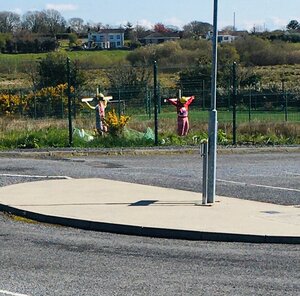
From top: The Peace Wall gates at Springfield Road/ Lanark Way interface in Belfast on April 7; Derek Mooney
As the riots raged along the peace walls in Belfast last week, I spotted a tweet bemoaning the absence of loyalist leaders of the calibre of the late David Ervine.
David was the avuncular, savvy leader of the loyalist Progressive Unionist Party (PUP). He was aptly described by Northern Ireland secretary John Reid as “possibly one of the most eloquent politicians in Northern Ireland”.
Ervine died tragically young, aged just 53, of a brain hemorrhage, in Jan 2007. Speaking at the time, the then Taoiseach, Bertie Ahern called him a “courageous politician who sought to channel the energies of loyalism in a positive political direction.”
I don’t claim to have known David well, though I did meet him several times and even debated against him in UCD before an audience of US politics students. He was characteristically witty and demonstrated a willingness to engage and debate the future of the North, that showed his confidence in his in his identity and position. This is not something you can say about many in today’s unionism.
That day in UCD Ervine told the story of his 1975 encounter in Long Kesh prison with the UVF leader Gusty Spence. Ervine had just been jailed for attempting to transport a bomb across Belfast.
Spence wasted no time in the conversation. “Why are you here?” he asked Ervine.
“Because I was caught”, said Ervine.
“No” said Spence, “why are you here?”.
“I was fighting for Ulster”, Ervine then replied.
Spence puffed on his pipe and said “No. No. Now why are you here?”
As I recall, Ervine said he and Spence went through a few more rounds of this before he saw that Gusty was trying to get him to question his own attitudes and beliefs. Spence was inviting him to see that working class Protestants were no better off than working class Catholics and thus recognize the futility of the loyalist and republican campaigns in what could only ever be a zero-sum game.
[There is a more detailed and nuanced account of this exchange on pages 192-193 of Roy Garland’s 2001 biography of Gusty Spence. A book launched by David Ervine.]
I mention David Ervine not because he would have been the solution today’s problems, but because his absence encapsulates what is missing in unionism and loyalism: informed and confident leadership.
Let me be clear, I am not suggesting for one millisecond that the teenagers, wound up by sinister elements in loyalism, are lobbing petrol bombs into the back gardens of their Catholic neighbors because they have some fundamental objection to the Northern Ireland protocol and the three levels of sanitary and phytosanitary checks on goods entering Northern Ireland from Great Britain.
Clearly, they don’t. Those who are closer to the situation tell me that last week’s troubles at Lanark Way have their origins in recent PSNI successes against the drugs operations of certain loyalist gangs.
But who is going to ask the youths the question that Spence repeatedly posed to Ervine: “why were you there?” I doubt their answer will be that they were protesting the drug seizures. Is it not more likely that it will be that they were there to fight against the Fenians for Ulster, so that their people could have control over their country, their community and their street?
Given the considerable dialing-up of the unionist political rhetoric on the NI protocol and the aftermath of the Bobby Storey funeral, it is impossible to argue that what happened in Belfast is entirely disconnected from what has been happening in other places across the North, such as the illegal loyalist band parades in Ballymena, Portadown and Markethill.
Those organisers are forthright in stating that their parades are a protest against the Northern Ireland Protocol and the decision not to prosecute senior Sinn Féin figures who attended Storey’s funeral.
So, how can those Unionist leaders who have been whipping up anger on these two issues and called on the PSNI Chief Constable to resign, calmly condone some illegal protests and then condemn what is happening in Belfast?
Yet, isn’t that what Arlene Foster attempted to do in her Twitter response last Wednesday? Yes, she did call it vandalism and attempted murder and she did state unequivocally that it did not represent unionism or loyalism. But how credible is this when only a few weeks earlier she was meeting with the representatives of loyalist paramilitaries to find common cause?
How can her condemnations be taken as authentic and consistent when she goes on to say that the actions she condemns “only serve to take the focus off the real law breakers in Sinn Féin”?
How can any political leader, let alone a First Minister, stand over a statement that starts by calling out vandalism and attempted murder, but ends-up saying that it is “them’uns” who are the real law breakers? They are vandals or they are not. Their culpability is not diminished by the blameworthiness of senior Sinn Féin figures flagrantly breaching Covid rules.
I have no doubt that last week’s riots genuinely distressed the First Minister. But I’d be surprised if some of her upset didn’t also come from her seeing that her words could have helped whip up disaffected and volatile young men to think that they must fight back against those, who they are told, are hell-bent on weakening Northern Ireland’s place in the UK.
Across Arlene Foster’s time as First Minister we see that she is at her best when she tries to speak as the First Minister of all of Northern Ireland and at her worst when she speaks as the leader of unionism alone, or as the leader of a faction of the DUP.
We rightly champion the success of the Good Friday Agreement, whose 23rd anniversary we marked last weekend, but we should also remember that it has not been a panacea for all the North’s ills.
Despite increased investment into the North, the economic benefits have been pitifully slow to trickle down and improve the lives of those living in marginalized communities, particularly along the interfaces. It would be naïve not to see this as a contributory factor to this week’s violence.
The other problem is how allegiance to the sovereign power is now proving to be a problem for both communities. The Zero-sum game of: if they are winning, we must be losing, no longer dominates.
While the nationalist/republican community still has difficulty having allegiance to a State that finds their presence problematic, Unionism also has a problem. It is a growing problem as the State to which Unionism and Loyalism shows allegiance (i) increasing declines to reciprocate that loyalty and (ii) is itself increasingly coming apart.
We saw a pained expression of this growing frustration last January when Ian Paisley Jr plaintively asked Tory MPs:
“What did we do to members on those benches over there to be screwed over by this protocol?”
Unionism has never been more disrespected or shoddily treated than it is by the current occupant of 10 Downing St. The Guardian’s Nick Cohen puts this point in a historical context in an excellent analysis piece from February, while I warned last December that Boris Johnson’s duplicity would not end with Brexit, saying:
“Johnson’s duplicity is no respecter of alliances or relationships. Even the DUP, must realise by now that they cannot trust Boris Johnson any more than Dublin or Brussels can trust him.”
Maybe the DUP does grasp it, but its leadership is now so compromised by its past fidelity to Johnson that it cannot act on it.
So, we seem destined to repeat the mistakes of the past, mistakes that could well see the NI institutions, Executive and Assembly stumble along, teetering on the edge of collapse. This does not mean we are going back to the bad old days from before the Good Friday Agreement. But it could mean we are back in the one step forward, one step back choreography that plagued the first decade of the Agreement’s implementation.
Over the weekend several former Northern Ireland Secretaries of State urged the British government to take the situation there more seriously saying that the British government had “allowed this to degenerate to the most serious crisis for a quarter of a century.”
One of them, Labour’s Peter Hain, said:
“Compared with the attention Blair, Major and Brown gave to Northern Ireland, it has been treated with casual indifference”.
While another, Peter Mandelson (also Labour) accused Johnson of duplicity in his handling of the NI protocol and warned that Johnson must show “more candour & engagement”
Their criticism is fair and measured. But the remedy does not lie in the British government acting alone. The history of Northern Ireland since the 1970s has taught us that progress can only be made when the two governments act and speak together.
It is therefore vital that the British/Irish Intergovernmental Conference, established by the Good Friday Agreement, meet to allow UK and Irish ministers work to help each other to de-escalate rising political tensions in Northern Ireland. Reports in yesterday’s Observer that Number 10 is resisting calls for such a meeting with Dublin are deeply worrying.
So too is the claim that what happened in West Belfast, Carrickfergus and Newtownabbey, should make “nationalist politicians and commentators think twice before engaging in idle chatter about the imminence of a united Ireland” as one Irish political commentator put it last Friday.
Leaving aside the gratuitous loaded phrase “idle chatter”, the assertion is akin to King Canute standing at the waters edge and commanding the tide to turn back – though in Canute’s defence, he at least he did it to show the limits of his power.
Many in Unionism have believed for months that a border poll/referendum is imminent, not because political leaders, academics and policy makers here are considering what a united Ireland might look like, but because they see what has been happening across Britain, post Brexit. Informed Unionism knows that what happens in Edinburgh, Cardiff and London will have a bigger impact on political life in Northern Ireland that almost anything said in Brussels or Dublin.
They know that next month’s Scottish parliamentary elections (where the 30-day polling average has the SNP on 50.1%) is of critical and immediate importance to the future of the UK union. Especially as the SNP is unapologetically fighting that election under the banner of Scotland’s future must be Scotland’s choice. And nobody else’s, as you can see in this party political broadcast.
What happens in Edinburgh, Cardiff and London over the next 12 to 18 months will have huge ramifications for what happens in Northern Ireland and that – inevitably – has major implications for the rest of us on this island. That is the discussion that An Taoiseach Micheál Martin, and his successor, should now be preparing to have with Boris Johnson.
Any suggestion that we should not be thinking and preparing for a range of eventualities is not just a nonsense, it is effectively a call for political dereliction.
Derek Mooney is a communications and public affairs consultant. He previously served as a Ministerial Adviser to the Fianna Fáil-led government 2004 – 2010. His column appears here every Monday. Follow Derek on Twitter: @dsmooney
Charles McQuillan/Getty Images