A 1985 ad for General Electric rightly identified by We Are The Mutants as having the most amount of 80s any ad from the 80s could possibly have. Imagine the film Krull starring Jon Bon Jovi in suede lace-up boots. You’re not even close. To wit:

Only in a decade as contradictory as the 1980s would one of America’s most respectable and historic companies spend nearly a million dollars on a commercial depicting new wave “adventurers” in a post-apocalyptic “third millennium” wasteland as part of a last ditch campaign to save its fatally outmatched consumer electronics line. The company was General Electric, and the commercial was aimed squarely, even obnoxiously, at the nascent MTV generation.

awesomer

Fr Binoy Mathew, co-Parish Priest of Mountview and Blakestown Parish in Dublin, said that since November parishioners were visiting the Church of the Sacred Heart of Jesus in Huntstown, Clonsilla to get communion after watching mass online on Sundays

This morning/afternoon.

The Archdiocese of Dublin has advised parishes and priests not to organise events to give communion to parishioners after mass, either inside or outside of churches.

The advice came as a parish in west Dublin stopped handing out communion to 130 parishioners on Sundays, after gardaí advised it should not be doing so.

“Under current restrictions all religious services continue to take place online. In the interest of health and safety priests and parishes ought not to distribute Holy Communion before or after mass, in or outside churches,” the Archdiocese said in a statement.

Gardai shut down Dublin church as priest ordered to stop giving out sneaky Holy Communion bread in Huntstown (Dublin Live)

Pic: KFC Architects


Behold: Mars. Right there – wandering along through the constellation Taurus, close (in the sky) to the Seven Sisters or Pleiades star cluster. To wit:

In fact, this deep, widefield view of the region captures Mars near its closest conjunction to the Pleiades on March 3. Below centre, Mars is the bright yellowish celestial beacon only about 3 degrees from the pretty blue star cluster. Competing with Mars in colour and brightness, Aldebaran is the alpha star of Taurus. The red giant star is toward the lower left edge of the frame, a foreground star along the line-of-sight to the more distant Hyades star cluster. Otherwise too faint for your eye to see, the dark, dusty nebulae lie along the edge of the massive Perseus molecular cloud, with the striking reddish glow of NGC 1499, the California Nebula, at the upper right.

(Image: Petr Horalek / Institute of Physics in Opava)

apod

From top: Bank of Ireland CEO Frances McDonagh this week announced the closure of 130 branches; Grace Garvey

Did Bank of Ireland’s advertising boffins have Brendan Kennelly’s poem ‘Begin’ in mind when choosing their ‘Bank of Ireland Begin‘ tagline, I wonder. ‘Begin to the pageant of queuing girls,’ if you insist on bothering a cashier.

I was more than a little dubious when listening to the bank’s boss, Francesca McDonagh, on Morning Ireland earlier this week placing responsibility for the closure of 103 branches firmly at the feet of her customers. According to McDonagh, they had abandoned their local bank in droves, preferring to do business online.

My last trip to a branch, pre-Pandemic, was a shambles. The tiny suburban branch was jammed with office workers on lunch break. Rather than have all tellers on deck to facilitate the lunchtime rush, they had just one counter open, while another member of staff did her best to divert people to a series of ATMs.

The queue moved at a snail’s pace and by the time I got within spitting distance of the front – and mindful of the five-minute drive back to work for a 2 o’clock meeting – I had to down tools and leave. Mission not accomplished and an hour lost.

This frustration has been shared by countless bank customers over the past 10 years, and suggests that people have not abandoned their local banks; they have been pushed out as part of a long-standing plan, dating as far back as the mid-80s, to get rid of the branch network and move customers online. It is disingenuous of McDonagh to claim otherwise.

The reasoning behind the shift towards automation was obviously to cut costs – as was the decision to outsource production support to India – but also to eliminate human error, on the basis that better lending decisions are made by computer algorithm than a fallible human. It was felt that a bank manager might be swayed by sentiment when dealing with someone they knew.

A friend and I were reminiscing lately about a personable bank manager we once shared. He was such a pleasure to deal with that we both followed him when he was posted to a new branch. He knew his customers well: where we lived, where we worked, what kind of car we drove – and how seriously we were likely to take repayments if he gave us a loan.

He was keen to drum up business for the bank and would always try to recycle the money he had just loaned you in the local economy. For instance, signing off on a motor loan, he might ask casually what kind of car you had in mind and lo and behold, his local dealership – also a customer – had exactly that model, and before you knew it, you were driving out their forecourt with your new wheels.

The value of relationships of this kind, developed over years, count for the little in the latest scheme. The social dividend isn’t something the banks factor in. Lending dictated by algorithm as opposed to lending to the person is seen as progress from the bank’s point of view, but lending will always have an element of risk if the economy is to grow. Besides, how fail-safe is it really if a bewigged couple can create multiple fake accounts and swindle the bank of thousands over a couple of years?

In October 2006, the Bank of Ireland in Glenamaddy, Co Galway, closed its doors for the last time. Since then, the Ulster Bank branch has followed suit, as well as the Garda Station and several businesses and pubs.

Locals claim the initial closure ruined the town. People who used to come from surrounding villages to bank were forced to drive to bigger towns, and ended up shopping there as well. Once busy streets are now deserted. ‘You drive through the town and it’s dead; the streets are empty, even before Covid,’ a local school teacher says.

Those most affected are elderly people, particularly those who no longer drive. They’ve had to forego their privacy to enlist adult offspring to do their banking online. Younger people, many of whom bank with Revolut or N26, are unaffected. But plenty of the over-40s, who are at home online, either have no interest in online banking or don’t trust it.

Most farmers over 60 couldn’t care less about internet banking, I’m told. They don’t want a cashless society and are wary of scams. Patchy broadband is also an issue. These dissenters feel ignored and can’t understand why the Government hasn’t objected to the latest closures, when policy purports to endorse economic and social development in rural areas such as theirs.

As any banker will tell you, the Bank of Ireland is a private enterprise, albeit one in which the Government has a stake of 14%. Sure, it got a bailout from the taxpayer in the aftermath of the 2008 crash, but that’s been repaid in full. They’ll talk about how challenging Irish banking is right now, with onerous Central Bank capital requirements, data protection, no margins and low interest rates.

But the fact remains that Bank of Ireland made a handsome profit of €758 million in 2019. Granted it took a hit last year on foot of bad debts on loans that cannot be repaid due to Covid-19, but it returned to profitability in the second half of the year. So, it’s fair to say the bank is profitable overall.

Given its position at the heart of communities countrywide down the years, it remains to be seen whether financial inclusion will be part of its Corporate Social Responsibility remit in future.

If we’ve learned anything from lockdown, it must surely be the importance of the personal touch, of having a human at the end of the phone. This is not just a question of urban-rural balance, it’s equally a virtual-real dilemma.

It’s not about stopping the march of time or being a neo-luddite, it’s about using this pause in activities to appraise the commercial landscape and decide how we as a society want to live.

Relentless automation continues to lay waste to livelihoods, while funnelling wealth into the pockets of a few. When a corporate entity urges us to begin, it suggests wiping the slate clean. Let’s not lose sight of all that is rich about life as we know it before rushing to obey.

‘Though we live in a world that dreams of ending
that always seems about to give in
something that will not acknowledge conclusion
insists that we forever begin.’ 

Grace Garvey is a Communications and Content Marketing Strategist. Grace can be reached at ggarvey2021@gmail.com. 

RollingNews

Um.

Dublin Plogging tweetz:

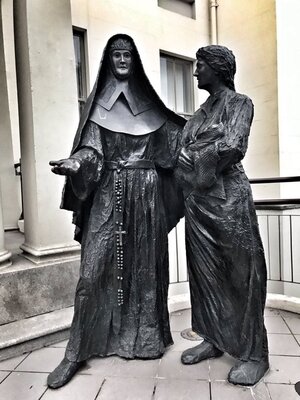
Urban wandering within 5km in Dublin. The Baggot Street Sisters of Mercy Mother and Baby home statue is in a “Circle of Mercy” sponsored by Allied Irish Banks? Anyone?

Meanwhile…Former Sisters of Mercy convent complex for sale in Passage West for €1.2m (Irish Examiner)

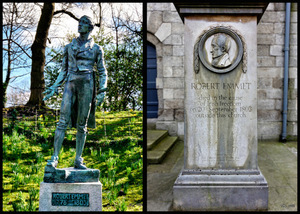
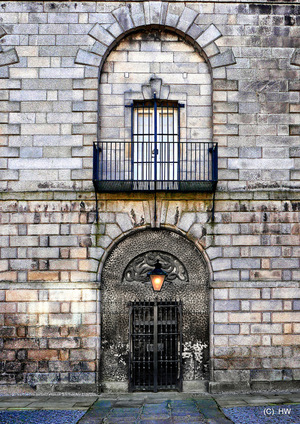
From top: St Catherine’s Church, Thomas Street, where Robert Emmet was executed and his head severed on a butcher’s block; Kilmainham Gaol

Dublin’s Public Executions sites.

Harry Warren writes:

Walking along a pandemically deserted Hammond Lane in Dublin late at night, a shiver passed up my spine. One of those odd feelings, I turned around to glance behind me to reassure myself that I was on my own. I then remembered that Hammond Lanes original name was Hangman’s Lane. Knowing its history is enough to give anyone the shivers.

It was a medieval route that the condemned walked heading to ‘Gibbets Mead’, (gibbet was an old name for the gallows and mead was a field) located in an area around Smithfield square then known as Oxmantown Green.

Executions were frequent in those days and over the years hundreds walked or were carted to their doom along this route. Dublin had many other locations over the centuries where public executions took place and here are just a few of them.

During the 18th century the majority of Dublin’s public executions were in the area of St. Stephen’s Green. Ever sit in the shade of a tree in the Green enjoying a summers sunshine? Be mindful of what tree you are under as you could be beneath a branch of a tree where an executed body dangled above you…

On the day of the execution a horse and cart would parade the condemned to the Hanging Tree, friends and families of the condemned would accompany the carriage. Whilst the condemned were still in the carriage the rope from the Hanging Tree would be noosed tight around their neck.

The cart would be moved on and the condemned would be left dangling experiencing an excruciating and lingering death from strangulation. The last hanging in Stephens Green was of Patrick Dougherty in January 1782, for the robbery of Thomas Moran.

Dougherty assisted by his partner in crime George Coffey, had mugged Moran and stole his watch, a seal, a key, a pen-knife, and a pair of silver shoe buckles. The stolen goods were worth £15 and Dougherty, found guilty, swung for the theft.

Not only did the condemned suffer capital punishment their executed remains often ended up in the hands of the anatomists in the Royal College of Surgeons or other Dublin medical schools for public dissection.

“Very often the corpse of a murderer was followed to the College gates by his weeping relatives or by a howling mob. A small portion of the anatomical theatre was set apart for persons who might desire to witness the dissections of malefactor’s bodies.”

The good anatomy professors loudly bemoaned that they were restricted to only six corpses a year of convicted murderers who were hanged for their crimes.

The area around Stephens Green began to be developed for buildings. As a result, public executions were relocated to the now demolished Newgate prison on Little Green now the present-day St. Michan’s Park near Smithfield.

Another concurrent location was Gallows Hill in what was then Kilmainham commons. Before Kilmainham Gaol was built on the site of Gallows Hill, the last hanging carried out there was on the double, two brothers named Connolly received the death sentence for the stealing of a cow and were duly hung.

Speaking of Kilmainham, most Dubliners would be aware of the heinous ‘executions’ of the leaders of the 1916 Rising inside Kilmainham Gaol in the Stonebreakers yard, but how about the public executions that took place just outside the entrance door?

The condemned were publicly hanged on the gallows, now designed with a trap door for the condemned to drop through to snap their neck, above Kilmainham Gaol’s entrance doorway.

The new gallows worked so well that in 1798 a virtual copy was installed in Newgate Prison in the city centre. Enjoy the photograph of the Kilmainham Gaol entrance and note the sculptures above the door, the many-headed serpent represented the five worst crimes that resulted in capital punishment, murder, piracy, rape, theft and treason.

Watch out for the two small granite insets in the recess overhead that are visible in the entrance door photo. This is where the gallows used to be attached for public hangings. If a noteworthy or famous person was to be hung, thousands of spectators, men women and children, would visit Kilmainham on the day of execution.

Hawkers sold alcohol and food and the army and cavalry were at hand to control the milling throng. It was truly a ‘Gala Day’. The expression Gala Day is derived from the Anglo-Saxon gallows day when crowds would visit a public hanging. The last public execution in Kilmainham took place in 1865 when Patrick Kilkenny was hanged for the murder of Margaret Waugh.

The young revolutionary Robert Emmet had a particularly grisly end after he was accused and found guilty of high treason. Shortly after 1 o’clock on 20 September 1803, Emmet was publicly executed in front of St Catherine’s Church, Thomas Street, Dublin.

Emmet was hanged and then beheaded. It took thirty minutes for Emmet to die by hanging as there was no ‘long drop’ to snap the neck, he slowly died of strangulation being of light build. His executioner then clumsily severed his head with a large blade on a deal block borrowed from a local butcher.

Displaying the blood dripping head to the crowd the executioner exclaimed: ‘This is the head of a traitor, Robert Emmet’. According to eyewitness accounts his blood seeping into the gutter was hungrily lapped up by dogs.

‘The remains were brought to Kilmainham Gaol and left for some time in the court of the prison where the prisoners might view it from their cells’.

The blood-stained butchers block was displayed to the public for two days at Thomas Street after the execution.

The block itself has an interesting history. It came into the ownership of Sir Thornley Stoker, a leading surgeon and brother of Bram Stoker the author of Dracula. It was later sold at an auction to support the Volunteer Dependents Fund held at the Mansion House on 20–21 April 1917 and presented as a gift to Mrs Margaret Pearse, mother of the Pearse brothers. It is now to be found in the excellent Padraig Pearse Museum in St. Enda’s Rathfarnham.

There are many more locations in and around Dublin where public hangings and executions took place. So, the next time you are outdoors in Dublin, hopefully enjoying some nice weather, you may be relaxing at the site of a long but not forgotten gallows.

All pics by Harry Warren

Susan Quirke – To The Bone

Keep on keeping on.

That’s the message of resilience in the new single by Limerick-born, Clare-based singer/songwriter Susan Quirke (top).

Look out for her debut album In The Sea, due on April 23, and featuring members of The Frames and Lir as special guests: Colm Quearney (guitars); Colm Mac Con Iomaire (violin); Robbie Malone (bass); Graham Hopkins (drums); and Justin Carroll (piano).

And read the inspiring thread on how Susan became a recording artist here

Susan writes:

“Many people are experiencing deep pain, grief, loneliness and isolation as a result of the pandemic. In many ways suffering is part of the human journey, as is the tremendous courage, resilience and strength people can often demonstrate during tough times.

“I wrote this song for someone in my life who was going through a difficult time. It was written as an invocation for them, calling on them to remember their power and strength. It’s also written as a balm to soothe people’s hearts and minds.

“It starts off quietly and then builds and builds to a full band sound, creating a call to the vast strength that lies deep within us all. It contains a blessing encoded in the lyrics that sings to the elements of nature that we can receive healing from: earth, wind, fire, water.

“In moments of pain and grief, there is an ancient well we can draw on inside us… To the bone is a reminder of something we sometimes forget – that we’re strong to the bone.”

Nick says: A marrow escape.

Susan Quirke

This morning.

Via Independent.ie:

The vaccination was rolled out after 300 doses of the Moderna jab arrived without notice. Dr Paddy Malone, the village’s retired GP, assisted with the distribution of the vaccine on Saturday.

There were 137 persons vaccinated on Saturday and they were supervised by a retired anaesthetist and two nurses in Murphy’s Bar in the Kerry village after the jabs were delivered.

The bar premises – closed because of Covid restrictions – was opened to facilitate the vaccinations, but no drink was served.

Hic.

All over-70s in Kerry village receive vaccine after surprise delivery (RTÉ)

Pic: TripAdvisor

Broadsheet.ie